Every startup should have a daily markdown file called "what_the_market_is_telling_us.md"
It updates every morning from the places where customer truth already lives:
1. Stripe for who pays, upgrades, downgrades, and churns
2. PostHog for what people actually do in the product
3. Intercom or Plain for support tickets/complaints
4. Granola or Gmeet transcriptions for sales calls/ customer interviews
5. HubSpot or Salesforce for CRM notes/lost deal reasons
6. Linear, Jira, or GitHub Issues for bugs and feature requests etc
7. Ideabrowser MCP for outside market signal: startup ideas, trend reports, social/search demand, AI research reports, and builder prompts that show what people are starting to want before it shows up in your own customer data.
Basically, the file should notice what changed in the business this week and not just be this summary of here’s what happened (which I think a lot of people have their agents do).
Why this is valuable:
1. Maybe new buyers are using different words than they were a month ago.
2. Maybe trial users are getting stuck in the same place.
3. Maybe upgraded customers all touched one feature right before they paid.
4. Maybe churned customers keep mentioning setup confusion.
5. Maybe sales calls are suddenly losing to a competitor you used to beat.
6. Maybe support tickets are revealing a workflow your product accidentally became responsible for.
You get the point.
The fastest way to PMF is understanding customers better than anyone else, and the highest signal customer insight is usually a change in behavior.
So I’d have the agent update the file every morning with the pattern it found, the receipts behind it, and the product or GTM decision it might affect.
For example:
“3 customers who churned this week all mentioned setup confusion, and 2 of them never invited a teammate.
This looks more like an activation problem than a pricing problem, so I’d look at team invite and onboarding before building another analytics feature.”
A little helpful tip for all those out there looking to get more from their LLMs.
The biggest opportunities right now:
1. build for solving loneliness (the more AI floods everything, the more people crave real human connection, IRL and small social)
2. build for agents that need to spend money (they're getting virtual cards and budgets, someone builds the spend controls, fraud protection, receipts)
3. build for people drowning in AI output (everyone generates infinite drafts now, the bottleneck moved to reviewing and choosing, build the judgment layer)
4. build for the burnout economy (everyone is expected to always be on and always optimizing, and the backlash toward rest, slowness, and enough is building)
5. build for verifying humans (deepfakes broke trust, every dating app, marketplace, and video call needs proof-of-human within 2 years)
6. build for the physical world (the trades, hardware, robots that AI is finally reaching)
7. build for the agent that answers the phone (every local business misses calls after 5pm, a voice agent that books the job is worth thousands a month)
8. build for the aging (70M+ boomers who want to stay healthy, sharp, and connected)
9. build for the LLM-search land grab (being the cited answer is the new SEO)
10. build for the newly automated (the paralegal, the analyst, the marketer whose job just changed and needs to reskill fast)
11. build for the seat-pricing collapse (software repricing from $50/seat to per-outcome, whoever nails outcome billing wins a category)
12. build for AI enablement (95% of businesses use nothing beyond ChatGPT, someone has to onboard the other 95%)
13. build for the agency everyone resents (businesses pay $1k/mo to agencies they hate, an agent that does 80% of it undercuts the model)
14. build for verticals on 2011 software (dentists, HOAs, contractors, all overdue for an AI-native rebuild)
15. build for reviving dead software (thousands of abandoned apps with real users, agents can maintain what a team couldn't, buy and revive)
16. build for markets too small to matter before (500 lobster fishermen was never worth a team, now it's a weekend and a real business)
17. build for agents hiring agents (a shadow economy is forming, it needs escrow, reputation, and dispute resolution for machines)
18. build for the anti-AI premium (as everything gets generated, human-made and analog become status symbols people pay up for)
19. build for distribution-first (anyone can build the product now, so the audience is the moat, media company first, product second)
20. build for the reinvention of college (what does an MBA even mean anymore)
21. build for a world with more free time than it knows what to do with (if AI takes the busywork, the question becomes what people do with the hours, and that's a civilization sized market)
note: more trends/ideas @ideabrowser (free to sign up)
22. build for the return to the physical (screens fill with slop, people crave the real world, the hands-on, the local, the analog)
23. build for the caregiving wave. The population is aging fast, tens of millions are caring for parents, and the whole burden is landing on families with no support.
24. build for the longevity shift (people want to live to 100 healthy, and a whole industry is forming around actively managing your own biology)
25. build for the housing and rootlessness problem (people can't afford to settle down, and the whole idea of a stable home base is up for grabs)
26. build for spiritual hunger (as institutions hollow out, the need for meaning, ritual, and belonging is exploding into new forms)
KEEP BUILDING
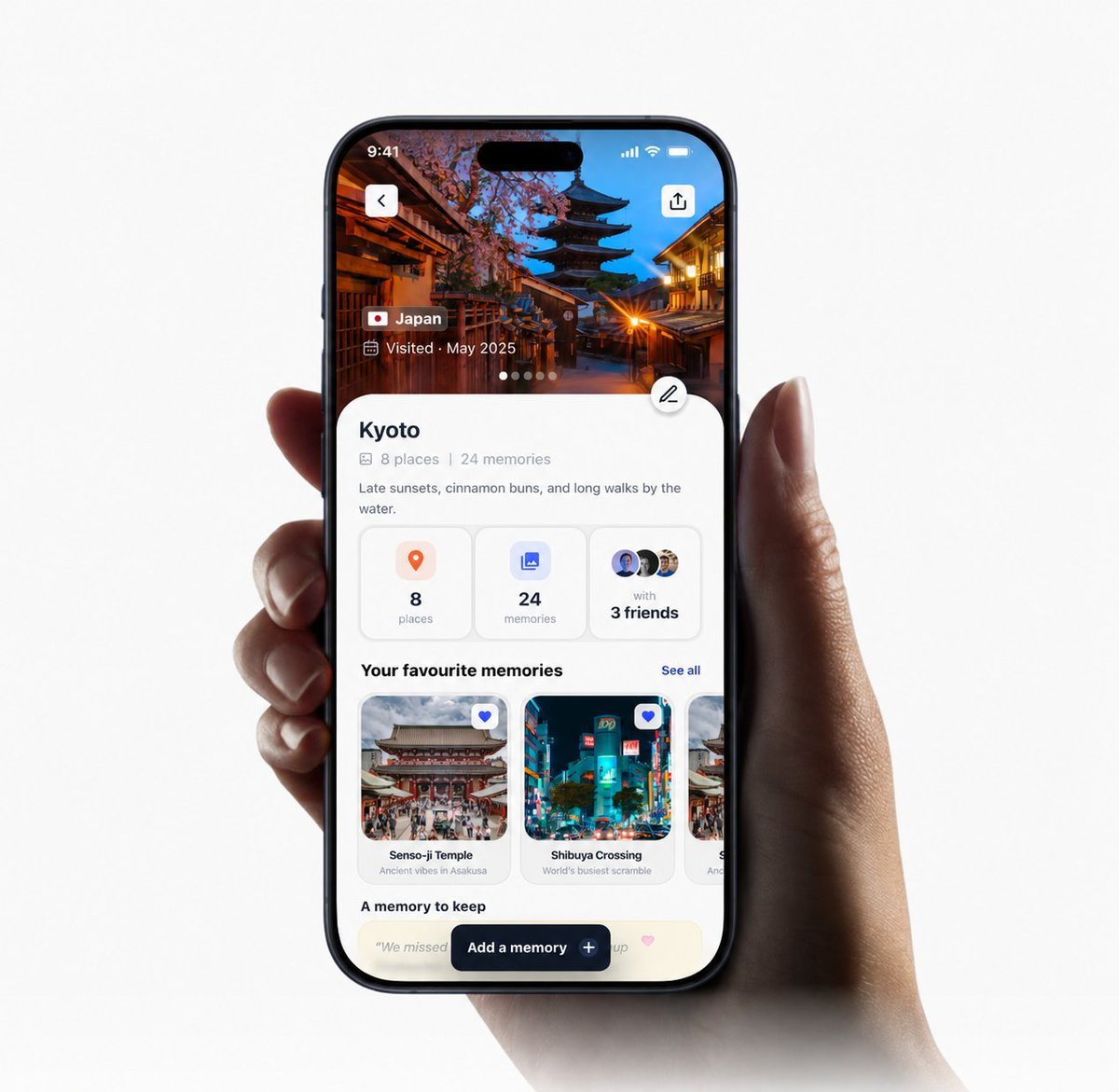
Insane idea which can be revolutionized with AI
Meal recipes database
Onboarding:
- get info what user likes
- prepare a few meals (query to OpenAI model)
- paywall to unlock more meals
- daily new meal recommendations
- combine with calorie tracker
- print
screenshot is from https://t.co/6FgAIOZ9Yw
How to make $8,000/day
as an app developer
step 1: make an app in 24-72 hours
step 2: create a new instagram and tiktok account
step 3: find a viral format in your niche
step 4: post 6 videos a day
( that alone will get yout to $1k -$5k/mrr )
step 5: hire 2-3 UGC creators and have them
post content along side you.
step 6: now you have $25k/mo
step 7: invest your new earned money on spark ads
And meta ads on your top performing content
step 8: now that you have a lot of users make improvements to your app based on user feed back to increase ARPU ( more money per user )
Step 9: keep growing your team, your ad spend
and keep improving your product
"I'm useless"
That's how I feel right now.
Codex built me a new iOS app and submitted it.
One prompt.
I never even opened the App Store. It used my browser to write the app listing and uploaded screenshots that it took on my local simulator.
I got pinged when the app was accepted.
Back in the pre-AI days, I'd throw my fist in the air and tell my wife.
Today, I felt nothing but admiration for how far AI has come.
The skills I acquired in the last 10 years have become useless.
But strangely, I feel good about it. It means the only thing I’m valuable at is being me: thinking and deciding what to work on.
The next 10 years are going to be interesting as our value shifts from execution to judgment.
I failed for years: ~14 projects.
And then I tried B2C iOS apps.
I'll hit $10k/m in a few weeks.
I think it's the easiest way to win.
Because the "moat" is the easiest to build.
These are the moats I see:
1. The moat of complexity.
Think Postiz or Revolut. APIs that take weeks to get approved. Or complex industries, like banking need capital or regulatory approval.
You simply can't vibe code these in a weekend. Complex B2B products will survive, because there's too much effort involved in making it.
Can be very hard difficulty I think. You have to put in the grind on the product. And there's still an element of luck involved: for example, there's a lot of PostBridge clones that went nowhere. I tried this and failed!
2. The moat of personality.
Big developers will always be able to sell by virtue of their following. This is true in any domain. Verified MRR existed before Marc, but no one trusted an anon dev with their stripe. It's a really good idea, but it succeeded in part because Marc is so trusted.
This is a very tricky moat to build, as it relies on growing a following. I believe there are clear patterns for social medi growth, but that's a post for another day.
3. The moat of a network.
Think NomadTable or IG. People use these apps because of their network. Anyone can vibe code them in a day. But people still use the app because of their huge network.
This is potentially the hardest moat. Involving either a lot of luck, massive amount of work or a big network from previous experience.
4. The moat of mass distribution (B2C).
Most mobile apps are very technically incredibly simple. The effort instead is 90% marketing. If you have a tiny bit of taste it's easy to stand out massively.
Here, we're not selling to businesses. We're selling to the masses, the normies who doesn't even use ChatGPT!
In my view this is the easiest moat, because it's the one with the least amount of luck involved.
Marketing is not yet a science, but there are a lot of proven patterns for success: AI UGC, paid tikslop/apple ads.
This is just my anecdotal experience! n=1.
I may have gotten lucky: I'm building a new app to do it all again, so we will see if it's a science.
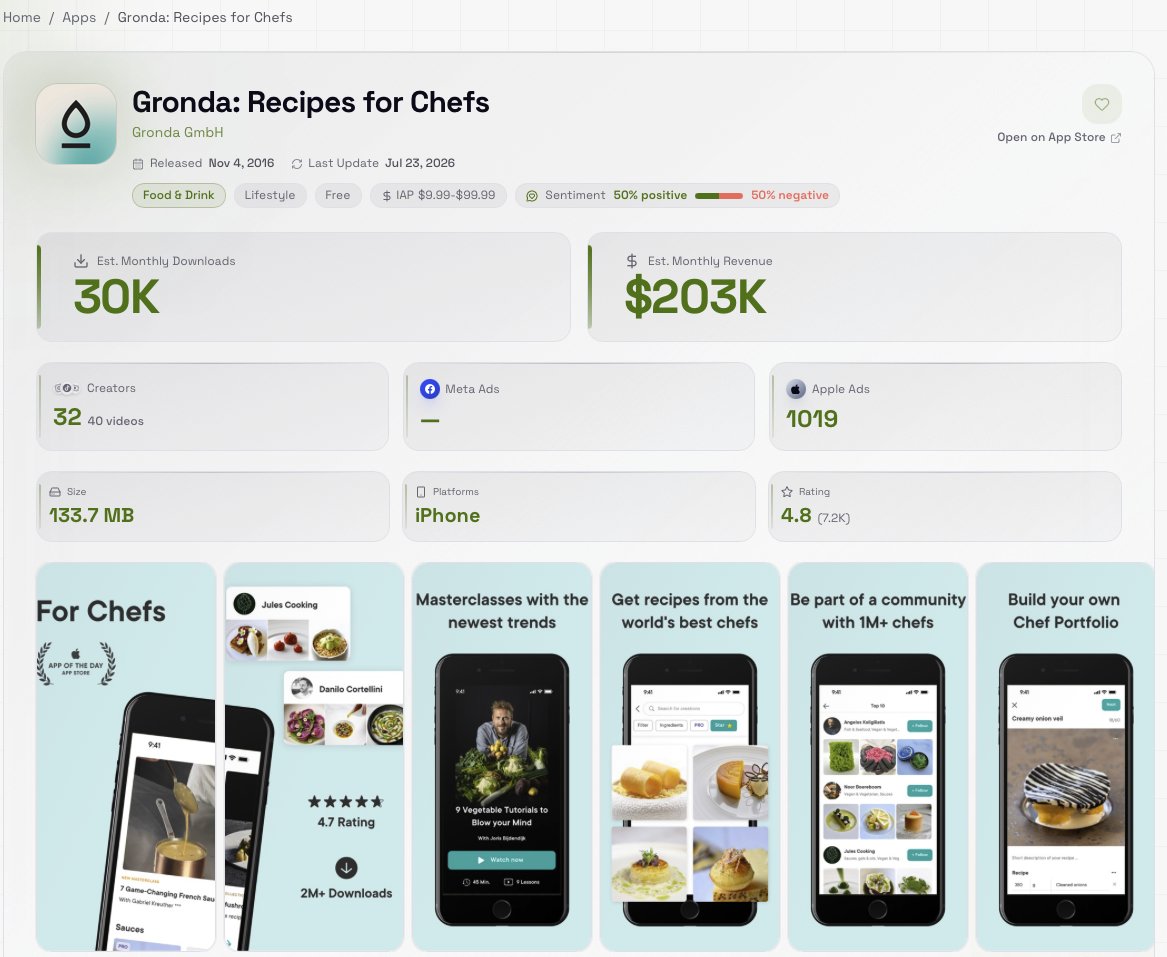
Somebody built Tiktok for Bible and reached $70k MRR in 7 months
Can be done for any niche.
This is simply "Micro learning" for X
- Micro learning for coding
- Micro learning for philosophy
- Micro learning for medicine
- Micro learning for bible
screenshot from https://t.co/6FgAIOZ9Yw
$29k/m Today's hidden gem:
sticky notes on your lock screen. that's the entire app.
launched 2 months ago by a solo japanese dev. already at 118k downloads a month, $29k monthly revenue, #3 in productivity. zero ads.
no ai, no accounts, no cloud sync drama. it just puts your grocery list where your eyes already are.
the best app ideas aren't inventions. they're relocations
My app hit $5.4k/m in 50 days.
This is my marketing system:
Apple Ads & TikSl0p.
Part One: Apple Ads • Your first $1k/m.
1. The first week of your app matters for ASO.
2. Use $100 free Apple Ad credits to push it.
3. Ad Type: Apple Search Ads.
4. Bid strategy: Manage Bids.
5. Default CPT: ~$1.20 (varies by niche)
6. Strict keyword match: [competitor name].
7. Search match = OFF.
8. Audience = Specific: iPhone, gender etc.
9. Split campaigns by territory.
• Tier 1: US
• Tier 2: UK, CA, CN etc
• Tier 3: ROW: TH, PH etc
10. Scale the bids by tiers: so US > ROW.
11. If it doesn’t spend in first 48 hours, up the bid.
12. Up bids by like 20% each time, don’t double it.
13. I started at $30/day, but I wish I did higher!
Notes:
Apple Ad Maxing works best if you have a really good App Store page. The entire idea is: user searches for competitor product, and they get yours instead, and think "wow that looks better let me download that". You shouldn’t try and impersonate the other app, make it even better (it’s honestly not even hard). Use ChatGPT to make your screenshots super nice.
This strategy won’t work if you have bad reviews. No reviews is fine! Just > 4.3. If your ratings are lower than this, reset them with an app update. Ratings are shown per country, so if you got bad reviews in Thailand doesn’t matter, just don’t run ads there. This goes really for any paid ad system.
Part Two: Scaling with TikSl0p • 5k/m+
1. Scroll in your niche. Find organic viral posts.
2. Recreate them with AI or film yourself/friends.
3. Seedance-mini-2 is best cost to value model (imo).
4. Run a campaign with 6-12 different formats.
• Formats = Type: Wall of text, slideshow etc.
• Creative = The actual post, within the type.
5. I ran the campaign at $70/day.
6. Let it spend at least $50 on each creative.
7. After $50:
• If CPA < LTV then scale it.
• If CPA > LTV then stop it.
8. I did realised LTV: total rev / paid customers.
9. LTV is too easy a target, though.
10. I now do: Initial Transaction > CPA.
11. This is simpler, and a better goal for my app.
12. When you scale, only do 20% every few days.
13. Don’t ever scale more than 30%.
14. Don’t get complacent, keep trying new formats.
15. Comment moderation: Block negative comments!
17. Make sure you get the $6k matched credits.
18. I ran 5 campaigns, ~5 formats, and ~30 creatives.
Notes:
Tiksl0p is a hard system, you may need to spend thousands of $$$ before finding profit, but when you do, you’ll see it happening in real time, you’ll make your money back 100x. Apple Ads is easy to find profit, but has less scaling potential, in my experience. I couldn’t push mine very far, but it may vary on your niche.
Get your first $1k/m with Apple Ads.
Keep it as a nice little base, then scale with TikSl0p.
Remember, there are infinite ways to win, this is mine, and winning is simply losing on a long enough timeline. Best of luck to everyone, I pray all my appmaxxers win.
My vibe-coded app grew over 300% in just 60 days and hit $10,000/mo
heres the truth that nobody tells you:
1. I didn’t get smarter
2. I didn’t work harder
3. I didn’t spend a single dollar on ads
I simply put my focus and attention on the most basic thing, which is marketing.
The biggest confusion I see in the founder space is people overthinking how to market their app in 2026.
"Do I post AI UGC content?"
"Do I start running meta ads?"
"Should I just do organic marketing?"
If you're reading this, just cut all that out and remember this one thing that I will tell you here.
1. Create a new Instagram account for UGC content.
2. Psycho analyze and steal your competitor's organic UGC formats and structures like an artist.
3. Post two to five times a day with those formats on Instagram with a many-chat DM automation system
That's all I did in the last two months, and that just skyrocketed my business, which looks like an overnight success.
But the truth is we're just simplifying everything and optimizing for the best outcome.
Organic UGC content is like influencer marketing back in 2015, and it's an absolute gold mine.
So if you had to take away anything from this one post, it's that you need to start posting real UGC content on your Instagram with your face to start off and learn how UGC works, how to engineer virality.
And if you're not willing to do this, then you're just not built for entrepreneurship.
Always have a sense of urgency.
There is absolutely no reason for you not to make at least $5,000 a month with a vibe-coded app.
I don't have any tech or coding background. I didn't go to college. I graduated high school in 2025 and just put my head down and started working.
Now close out of X and go make that new Instagram account right now
Our app makes $50,000/ week
between IOS and android.
At this rate thats $200,000/mo
This is the exact tool stack we use
to rank #7 and beat companies
That have millions in funding
As a Bootstrapped team of 2
✅ Rork: using fable 5 to update the app and quickly beta test it
✅ FunnelFox for doing web to app funnels and saving close to 30% of apples fees when running meta ads
✅ Higgsgield MCP: for running AI UGC and testing AI ads
✅ Amplitude: tracking all your apps analytics ( onboarding drop off and more )
✅ Singular: MMP for ads
✅ Superwall: for collecting payments in app and a/b testing paywalls
✅ Claude Code: To build internal systems and tools
✅ Sideshift: To hire and pay creators
Using these tools is non-negociable to building a generational app
This weekend I built an iOS app with:
- Astro for finding a trending niche
- Codex for planning
- Claude for design
- Grok for code
Then I localized the App Store listing for 36 markets.
Now it’s waiting for App Store review.
One person.
One weekend.
Four AI tools.
36 markets.
Building apps is getting easier.
Getting users is the real game now.
I had to delete an entire $3,500+ codebase and start literally from scratch.
not because the code was wrong but because the context was so far gone that cleaning it up would have taken longer than rebuilding.
we were building an X lead generation automation internally. no documentation, no structure, just opened claude code and started prompting. felt fast at the time.
but the underlying mess was so bad that i spent a full day trying to untangle it before i accepted that the fastest path forward was deleting everything and starting again.
that's when i built the 4 file system.
CLAUDE[.]md - my stack, conventions, folder structure, what not to touch and what needs approval. claude reads this every session. i never re-explain the entire project from scratch again.
design[.]md - the actual design language. colors, spacing, component rules, tailwind classes. claude stops guessing what "clean" means and starts matching what we actually intend.
components[.]md - every reusable component documented. claude pulls from what exists instead of silently building a second version of something already there. kills technical dead code before it starts.
slices[.]md - the full build broken into vertical shippable pieces before a single line of code is written. one slice at a time. nothing breaks what came before.
the gap between what you intended and what got built is never a prompting problem.
its a documentation problem.
$3,800,000,000,000
That's Apple's valuation.
They built a tool that guarantees your app shows up when someone searches for exactly what your app does.
Apple Search Ads.
You don't need to rank organically.
You don't need to hunt for keywords.
Apple Search Ads is the only traffic source on the App Store where you pay exactly when someone searches for what your app does.
No algorithm luck. No viral gamble. Just a marketplace where you bid on intent.
Most indie founders ignore it because they think it's for big budgets.
Here's exactly how to run it profitably with $500.
1. Understand the math
Apple charges you per tap (CPT). Average CPT on low-competition keywords is $0.50 to $1.50.
Your goal is to keep cost per install (CPI) below your app's LTV.
If your app makes $5 per user over 30 days, you can afford up to $5 CPI.
Most apps fail here because they don't know their LTV.
2. Keyword research (skip the obvious ones)
Don't bid on your own app name. You already rank there organically.
Instead, target competitors and category terms.
Open App Store Connect. Go to Apple Search Ads. Create Campaign. Choose Basic.
Add keywords using these sources:
- Your top 5 competitors' exact app names
- Category terms your app solves (e.g. "budget tracker" not "finance app")
- Long tail terms with under 10 apps bidding (use Sensor Tower or manually search)
3. Set up a basic campaign in 10 minutes
Choose Search Results only. Skip Search Tab because it shows ads even when users don't search.
Budget: $20 per day for 7 days. That is $140 to test.
Ad group: exact match keywords only. Broad match burns money.
Screenshot creative: upload your highest converting store screenshot. Apple will A/B test it automatically.
4. The only two metrics you care about
Conversion rate (CR): how many users who see the ad download. Above 15% means your keyword and screenshot match intent.
Cost per install (CPI): what you actually pay. If CPI is higher than your target, pause the keyword.
At the end of 7 days, drop every keyword with a CR under 10% and CPI above your LTV.
Keep the winners. Double the budget.
5. Scale the winners
Now take your top 5 keywords and increase daily budget to $50 per day.
Add broad match for those same keywords. Apple's algorithm will find new variants that convert.
Also create a second ad group with Search Tab ads. Same creatives. This shows your app to users browsing without a specific search.
Watch the CPI. Search Tab tends to be cheaper but has lower intent.
6. The mistake that kills your ad spend
Most founders turn on Apple Search Ads and walk away.
You need to check it every 3 days for the first 2 weeks.
Keywords that worked yesterday can go cold when competitors start bidding.
Lower your bid by $0.10 each time. Keep cutting until the click volume drops. That is your sweet spot.
7. Recycle learnings into organic ASO
After 30 days, look at which keywords converted best.
Take those exact terms and move them into your app's keyword field, subtitle, and description.
Apple just told you which keywords bring paying users. Use that data to improve your organic rankings.
Now your paid traffic and organic traffic compound !
Open App Store Connect. Start a campaign with $50. Run the strategy for 7 days.
You will know exactly what works before your organic strategy even kicks in.


![Hartdrawss's tweet photo. I had to delete an entire $3,500+ codebase and start literally from scratch.
not because the code was wrong but because the context was so far gone that cleaning it up would have taken longer than rebuilding.
we were building an X lead generation automation internally. no documentation, no structure, just opened claude code and started prompting. felt fast at the time.
but the underlying mess was so bad that i spent a full day trying to untangle it before i accepted that the fastest path forward was deleting everything and starting again.
that's when i built the 4 file system.
CLAUDE[.]md - my stack, conventions, folder structure, what not to touch and what needs approval. claude reads this every session. i never re-explain the entire project from scratch again.
design[.]md - the actual design language. colors, spacing, component rules, tailwind classes. claude stops guessing what "clean" means and starts matching what we actually intend.
components[.]md - every reusable component documented. claude pulls from what exists instead of silently building a second version of something already there. kills technical dead code before it starts.
slices[.]md - the full build broken into vertical shippable pieces before a single line of code is written. one slice at a time. nothing breaks what came before.
the gap between what you intended and what got built is never a prompting problem.
its a documentation problem.](https://pbs.twimg.com/media/HNB-MCdWoAAinqw.png)










![_frederickjames's tweet photo. My app hit $5.4k/m in 50 days.
This is my marketing system:
Apple Ads & TikSl0p.
Part One: Apple Ads • Your first $1k/m.
1. The first week of your app matters for ASO.
2. Use $100 free Apple Ad credits to push it.
3. Ad Type: Apple Search Ads.
4. Bid strategy: Manage Bids.
5. Default CPT: ~$1.20 (varies by niche)
6. Strict keyword match: [competitor name].
7. Search match = OFF.
8. Audience = Specific: iPhone, gender etc.
9. Split campaigns by territory.
• Tier 1: US
• Tier 2: UK, CA, CN etc
• Tier 3: ROW: TH, PH etc
10. Scale the bids by tiers: so US > ROW.
11. If it doesn’t spend in first 48 hours, up the bid.
12. Up bids by like 20% each time, don’t double it.
13. I started at $30/day, but I wish I did higher!
Notes:
Apple Ad Maxing works best if you have a really good App Store page. The entire idea is: user searches for competitor product, and they get yours instead, and think "wow that looks better let me download that". You shouldn’t try and impersonate the other app, make it even better (it’s honestly not even hard). Use ChatGPT to make your screenshots super nice.
This strategy won’t work if you have bad reviews. No reviews is fine! Just > 4.3. If your ratings are lower than this, reset them with an app update. Ratings are shown per country, so if you got bad reviews in Thailand doesn’t matter, just don’t run ads there. This goes really for any paid ad system.
Part Two: Scaling with TikSl0p • 5k/m+
1. Scroll in your niche. Find organic viral posts.
2. Recreate them with AI or film yourself/friends.
3. Seedance-mini-2 is best cost to value model (imo).
4. Run a campaign with 6-12 different formats.
• Formats = Type: Wall of text, slideshow etc.
• Creative = The actual post, within the type.
5. I ran the campaign at $70/day.
6. Let it spend at least $50 on each creative.
7. After $50:
• If CPA < LTV then scale it.
• If CPA > LTV then stop it.
8. I did realised LTV: total rev / paid customers.
9. LTV is too easy a target, though.
10. I now do: Initial Transaction > CPA.
11. This is simpler, and a better goal for my app.
12. When you scale, only do 20% every few days.
13. Don’t ever scale more than 30%.
14. Don’t get complacent, keep trying new formats.
15. Comment moderation: Block negative comments!
17. Make sure you get the $6k matched credits.
18. I ran 5 campaigns, ~5 formats, and ~30 creatives.
Notes:
Tiksl0p is a hard system, you may need to spend thousands of $$$ before finding profit, but when you do, you’ll see it happening in real time, you’ll make your money back 100x. Apple Ads is easy to find profit, but has less scaling potential, in my experience. I couldn’t push mine very far, but it may vary on your niche.
Get your first $1k/m with Apple Ads.
Keep it as a nice little base, then scale with TikSl0p.
Remember, there are infinite ways to win, this is mine, and winning is simply losing on a long enough timeline. Best of luck to everyone, I pray all my appmaxxers win.](https://pbs.twimg.com/media/HNcRc-GX0AAemZH.jpg)


![Hartdrawss's tweet photo. I had to delete an entire $3,500+ codebase and start literally from scratch.
not because the code was wrong but because the context was so far gone that cleaning it up would have taken longer than rebuilding.
we were building an X lead generation automation internally. no documentation, no structure, just opened claude code and started prompting. felt fast at the time.
but the underlying mess was so bad that i spent a full day trying to untangle it before i accepted that the fastest path forward was deleting everything and starting again.
that's when i built the 4 file system.
CLAUDE[.]md - my stack, conventions, folder structure, what not to touch and what needs approval. claude reads this every session. i never re-explain the entire project from scratch again.
design[.]md - the actual design language. colors, spacing, component rules, tailwind classes. claude stops guessing what "clean" means and starts matching what we actually intend.
components[.]md - every reusable component documented. claude pulls from what exists instead of silently building a second version of something already there. kills technical dead code before it starts.
slices[.]md - the full build broken into vertical shippable pieces before a single line of code is written. one slice at a time. nothing breaks what came before.
the gap between what you intended and what got built is never a prompting problem.
its a documentation problem.](https://pbs.twimg.com/media/HNB-MClXUAAYfaO.png)