@reinrich14@python_xi@Isma95fb Haha made you ditch your cloud console😂… I remember getting a huge bill just using google maps api to tests a feature i was working on. I emailed them and they gave me a big discount and said api usage can be expensive, next time it has to be paid in full…🤔
Vibecoding has evolved fast and it will only keep getting better.
It started with people copying and pasting code from LLMs into a single file and hoping it runs 😂
Then came the boilerplate era.
People began buying starter kits and modifying components instead of writing everything from scratch.
Thanks to @marclou…His videos helped popularize that approach.
Now we are in a very interesting phase.
Many builders are no longer living in the terminal.
We now have coding apps that can generate features directly from screenshots. Scripts like Ralph loops can take an idea, generate PRDs, user stories, acceptance criteria automatically and run till definition of done is met.
You can literally start a build, go to sleep, and wake up to progress.
But the most interesting change is the mindset shift.
Most people are no longer obsessed with learning every principle of programming. They simply want to build things and remove the middlemen between an idea and a working product.
And maybe that is the real transformation.
If you are a seasoned developer, your focus should probably shift too.
Not gatekeeping the craft.
But building tools that help this new wave of builders secure, structure, and scale the things they create..
If you haven’t kept up with what’s happened in the last few weeks, read this carefully.
We now have AI systems that can be configured to improve themselves and improve how they work with their human.
You can tell an agent:
“Analyse how you’re working with me. Find friction. Design lightweight tools you can ship overnight to serve me better.”
And by morning, it has shipped utilities and delivered an optimisation report.
Agents can now spawn other agents.
Work in parallel.
Stay in loops.
Build, test, learn.
Cross-check against a human-defined definition of done.
I remember when this was theory.
Recursive improvement.
Systems refining their own performance loops.
We are no longer approaching a hypothetical moment where AI surpasses human capability in certain workflows, we are at this point…
Recently I listened to @steipete say, the aim of a codebase is not to be perfect but easy for an agent to navigate.
That changes everything.
If they can understand intent, they will do the heavy lifting for you..
As we embrace agents more, half baked human artifacts will be normal..
You don’t need to manually complete everything..
Your goal is to help agents understand intent from the start, and the rest will be history…
They will self improve and optimise at rates humans can’t.
Agents have 24hours, humans do not…
They are faster at iterating and can now build tools on the go. There is no need to attempt calling tools they know they don’t have tools.
As Improvement for agents is becoming automated, technological growth will stop being linear.
I’ve heard and seen most people say “Everything was normal… and then suddenly everything is different”
That’s because the shift is happening..
1 → 2 → 4 → 8 → 16 → 32
we are moving so fast and each step is increasing the size of the next step.
Things are about to go crazy..
An attorney, a cardiologist, and a roads worker won the Claude Code hackathon..
They are not software engineers.
That should tell you something.
This is only the beginning…
Everyone is asking what to build?
Maybe build nothing😃..
We are moving towards a time period where everything will potentially be there..
If you build, unless no one sees, other wise can be built by someone in their bedroom..
Infact with reverse ralph loop, you can build based on behaviour of a product. Read documentations, user feedbacks and boom a similar product can be built..
With little iterations over time you will have a working product with a slight twist.
The only advantage going foward will be understanding of business and having domain knowledge..
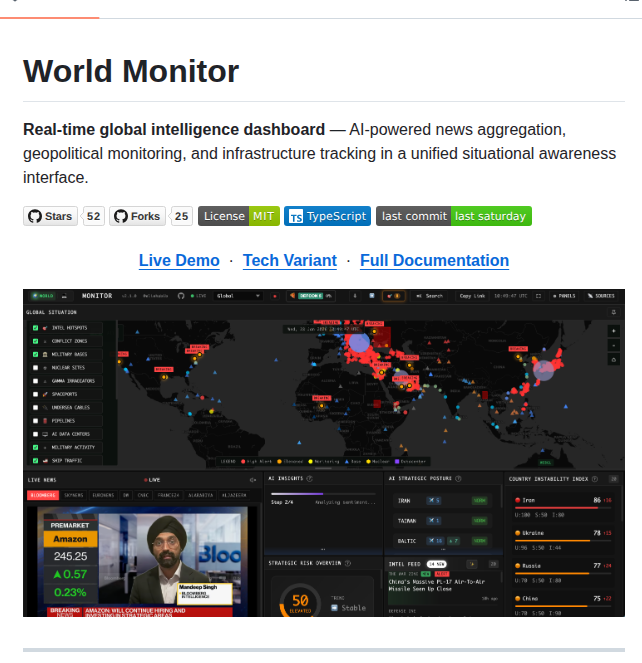
🚨 Someone just built a real-time global intelligence dashboard and open sourced it for free.
It's called World Monitor. Think of it as a CNN war room meets Bloomberg Terminal for geopolitics but anyone can use it.
No paid OSINT tools. No expensive subscriptions. No classified access needed.
Here's what this thing tracks in real-time:
→ Active conflict zones with escalation scoring
→ 220+ military bases from 9 countries
→ Live military aircraft tracking (ADS-B)
→ Naval vessel monitoring including "dark ships" going off radar
→ Nuclear facilities worldwide
→ Undersea cables, oil pipelines, and AI datacenter clusters
→ Protests, sanctions, internet outages, and satellite fire detection
→ Prediction markets as early warning signals
Here's the wildest part:
It has an AI that reads 100+ news sources, classifies threats in real-time, and generates intelligence briefs automatically.
Every country gets a live "Instability Index" score from 0-100 based on military activity, protests, news velocity, and structural risk.
When 3+ signal types spike in the same area, military flights + protests + satellite fires, it triggers a convergence alert.
This is the kind of tool governments pay millions for.
It runs in your browser. One command to install.
100% Open Source. MIT License.