“Trade anything on chain.”
Adam Hollander (@HollanderAdam), Chief Marketing Officer at OpenSea, speaking at Consensus by CoinDesk 2026, is describing a future where the marketplace becomes less important than the ownership layer beneath it.
For years, NFTs were viewed primarily through the lens of collectibles. Hollander’s argument is that the real innovation was never the collectible itself, it was the ability to establish, transfer, and verify ownership digitally.
That distinction matters.
As more assets move onchain, platforms like OpenSea are positioning themselves not around a specific asset class, but around the management of ownership across ecosystems. Whether the asset is a collectible, membership, gaming item, or real-world asset becomes secondary to the infrastructure that allows users to interact with it.
The structural takeaway:
✅ Ownership becoming the core onchain primitive
✅ Cross-chain interoperability reducing ecosystem fragmentation
✅ Tokenized assets expanding beyond NFT-native categories
✅ User experience becoming a competitive differentiator
The broader implication is that the next phase of digital asset adoption may be driven less by new asset types and more by platforms that make ownership portable, verifiable, and seamless across networks.
Follow / Repost - @Thejohnnycrypt0 for grounded insights on how digital assets are reshaping finance and how to ledger them. #thejohnnycrypto #bitcoin #Stablecoins #staking #BTC
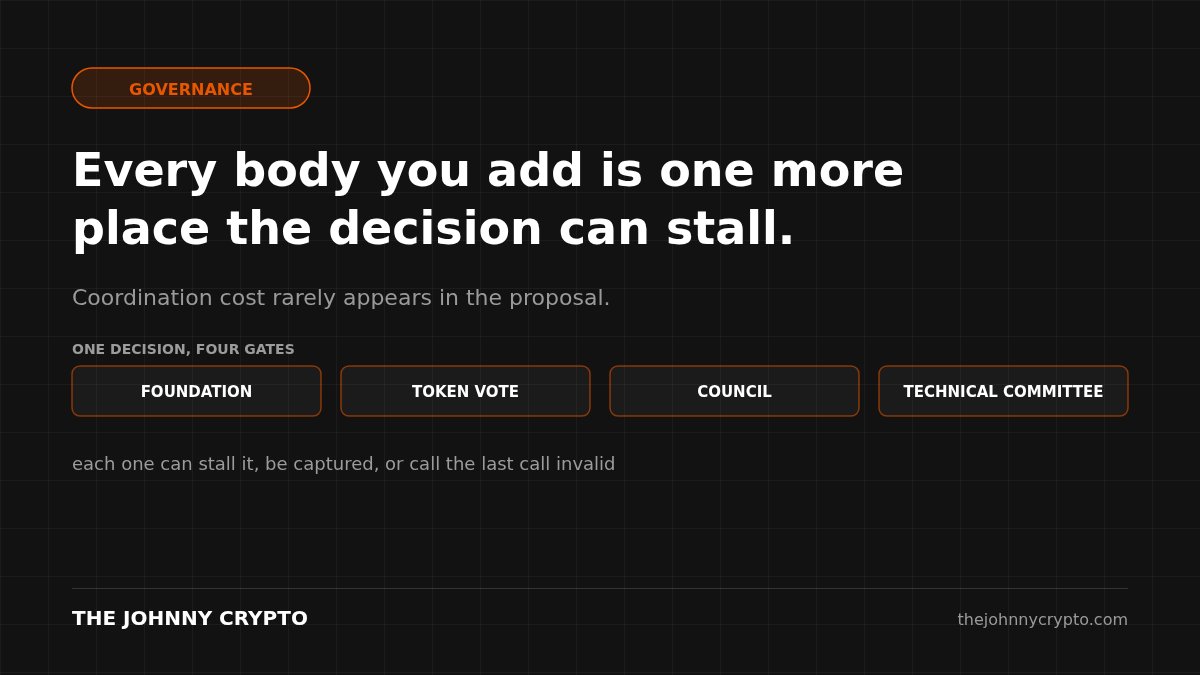
Rain stopped a Little League game I was at this spring. It took forty minutes for anyone to call it.
One person used to make that call. Then the league added a safety officer, then a board vote, then a parent committee. Every addition answered a real complaint. Nobody could end the game.
Governance is the process a network uses to decide what changes and who approves it.
FACT: hybrid designs keep adding bodies. A foundation, a token vote where coin holders vote in proportion to what they hold, a council, a technical committee holding a veto.
THESIS: each body is one more place a decision can stall, one more seat worth capturing, one more group that can call the last decision illegitimate. Coordination gets priced at zero on the day the mechanism is proposed.
COUNTER: informal governance has no paperwork, and that absence gets mistaken for being simple. Whoever has been around longest decides, and they answer to no one. A formal mechanism at least puts that power where you can see it.
WHAT WOULD PROVE THIS WRONG: a network that added formal governance layers and then got measurably faster and more widely accepted over several years. The date it started, decision speed before and after, and fewer legitimacy fights.
Bitcoin gets no exemption. Its process is slow by design, and slow costs its own users something whenever a fix is needed. I hold that view about the thing I own too.
My grandmother kept her savings in a wedding ring and her grocery money in a jar by the door.
Two different jobs, one household, no contradiction.
I think about that every time someone argues Bitcoin has failed because people do not buy coffee with it.
A monetary premium is the extra value people assign to a thing because they trust it to hold worth over time. Gold trades far above what its industrial uses justify, for exactly that reason. Bitcoin picked up the same property.
The premium is settling on bitcoin. The payment experience is moving to other layers and to stablecoins, which are tokens pegged to a national currency so a payment does not swing in value between sending and landing.
A machine buying compute wants a unit that sits still. A person saving for a decade wants the opposite.
The strongest case against me: money that stops being spent eventually stops being money, and a premium with no circulation under it has been fragile before.
What would show me wrong: the premium eroding over several years while the payment layers beside it keep growing.
“Markets tend to consolidate where liquidity, speed, and user demand reinforce each other.”
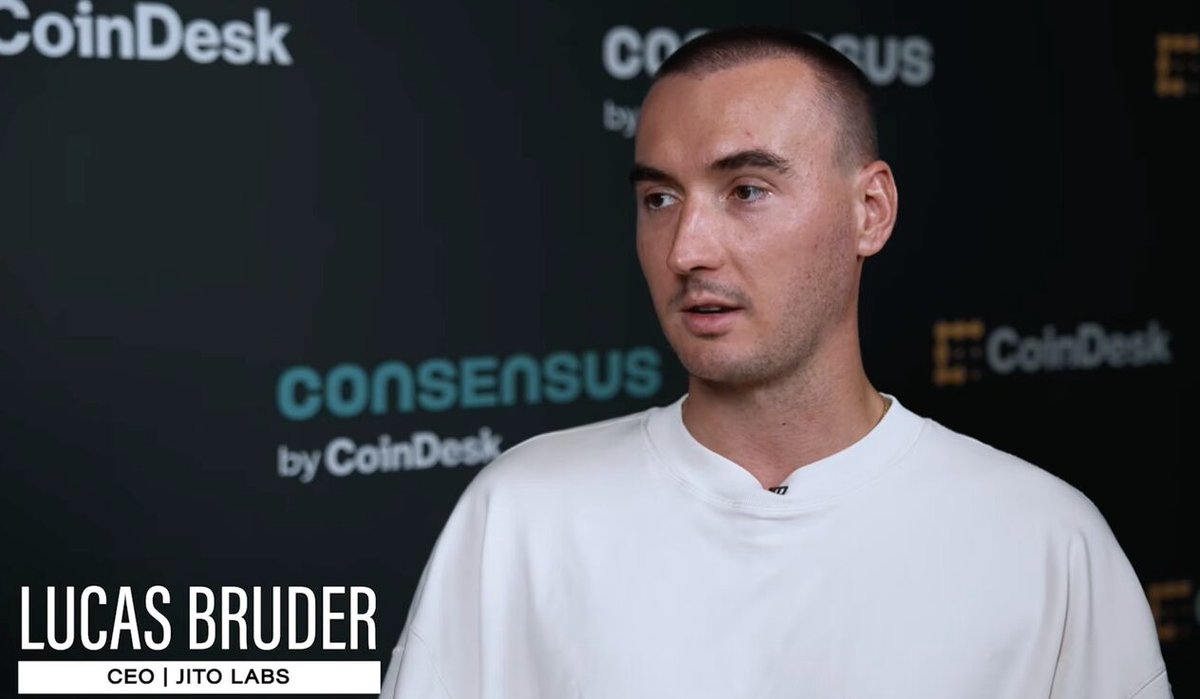
Lucas Bruder @buffalu__, Co-Founder of Jito Labs, speaking at Consensus by CoinDesk 2026, framed Solana’s recent growth as the result of infrastructure maturing alongside trading activity rather than simply benefiting from short-term market cycles.
One of the more notable observations was that the network’s most demanding period may have come during the memecoin boom. Rather than viewing that activity solely as speculation, Bruder suggested it functioned as a large-scale stress test that forced infrastructure providers to improve performance under extreme transaction loads. Those improvements now support broader use cases that extend beyond retail trading.
He also pointed to a growing class of users interested in trading virtually any asset onchain. In that context, tokenization becomes less about blockchain experimentation and more about expanding the range of assets available within increasingly liquid digital marketplaces.
The structural takeaway:
✅ Liquidity becoming a key competitive moat
✅ High-volume trading accelerating infrastructure maturity
✅ Tokenization expanding potential market participation
✅ Trading venues competing on execution quality and depth
The broader trend may be that blockchain networks are increasingly being evaluated like financial exchanges, on liquidity, reliability, market depth, and user experience, rather than on technical architecture alone.
Follow / Repost @Thejohnnycrypt0 for grounded insights on how digital assets are reshaping finance and how to ledger them. #thejohnnycrypto #bitcoin #Stablecoins #staking #BTC
“Those payments may be cryptobased, including stablecoins.”
Bill Tai @KiteVC, Co-Founder & Chairman at Hut8 Corp, used that description at the Wyoming Blockchain Symposium while discussing how AI agents may eventually pay for software and services without a person initiating every transaction.
Tai connected that future to an earlier infrastructure shift. Bitcoin mining pushed operators toward dense, power-intensive data centers, building experience that now carries into AI compute. He pointed to configurations reaching 300 to 500 kilowatts per six-foot rack, which shows how far the physical requirements have moved from conventional enterprise computing.
The software layer is changing too. AI agents can evaluate services, select providers, and initiate transactions as part of an automated workflow. Tai sees crypto-based payment rails, including stablecoins, as one way those machines could settle transactions directly.
The structural takeaway:
✅ Bitcoin mining helped develop operating experience for high-density compute
✅ AI workloads are increasing the power requirements of modern data centers
✅ Software agents can turn purchasing into an automated machine process
✅ Stablecoins can provide a payment rail for machine-to-machine transactions
AI and crypto infrastructure are beginning to meet at two layers of the technology stack: the data centers providing compute and the payment systems handling automated economic activity.
Follow / Repost @Thejohnnycrypt0 for grounded insights on how digital assets are reshaping finance and how to ledger them. #thejohnnycrypto #bitcoin #Stablecoins #staking #BTC
“Technology rarely removes risk, it usually changes where the risk lives.”
Ronghui Gu @RonghuiGu, Co-Founder & CEO of CertiK, speaking at Consensus by CoinDesk 2026, described a security environment where attackers are becoming more efficient and the industry's threat landscape is shifting away from traditional smart contract vulnerabilities.
The most interesting part of Gu’s remarks was not the headline figure of more than $690 million in reported losses. It was his observation that operational failures, supply chain compromises, and social engineering are increasingly responsible for major incidents. As blockchain infrastructure matures, attackers appear to be targeting the people, processes, and dependencies surrounding the technology rather than the technology itself.
Gu also warned that AI is lowering the cost of identifying weaknesses and reproducing attack patterns, potentially allowing threat actors to scale faster than before.
The structural takeaway:
✅ Security risk moving beyond smart contract code
✅ Human and operational processes becoming primary targets
✅ Third-party infrastructure creating new attack surfaces
✅ AI increasing the speed of offensive security capabilities
The long-term challenge for the industry may not be building more sophisticated protocols. It may be creating organizations that can operate securely around them as digital asset ecosystems become larger, more interconnected, and more dependent on external infrastructure.
Follow / Repost @Thejohnnycrypt0 for grounded insights on how digital assets are reshaping finance and how to ledger them. #thejohnnycrypto #bitcoin #Stablecoins #staking #BTC
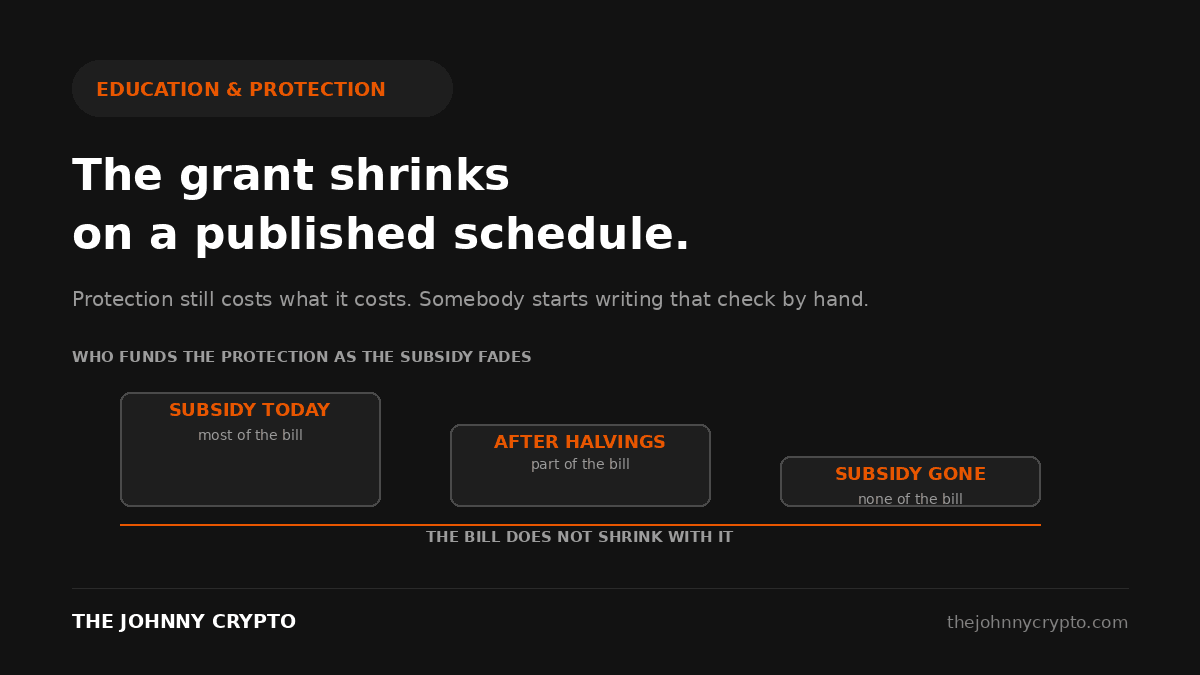
A small town's fire grant shrinks a little every year, on a published schedule. One day the town writes the check itself.
Bitcoin miners get paid two ways: the subsidy, which is new bitcoin the software creates, and fees, which users pay to get transactions included. The subsidy halves about every four years and eventually rounds to nothing.
So security stops being a background cost spread across every holder and becomes a service with a price, a counterparty and a term. Things that get bought can also be sponsored, hedged and financed by people who want something back.
Fair counterargument: markets price services well, fees may rise to meet the need, and a paid service can be more dependable than a subsidised one.
I would be wrong if miner revenue holds up on fees alone across the next several halvings while the number of independent mining operations stays flat or grows.
For Bitcoin, the concentration of who funds the security is the measurement to keep, more than its price.
“Regulatory ambiguity is a massive barrier.”
Julie Stitzel @julie_stitzel, Chief Policy Officer at DCG, used that point at the Wyoming Blockchain Symposium to describe how uncertainty can affect companies trying to raise capital and scale.
Her focus was on durability. Agency guidance can shape the market in the near term, but statutory rules can provide a framework that lasts across changes in leadership. That matters for firms deciding where to build, where to invest, and how much capital to commit.
Stitzel also connected market structure with consumer protection. Proposed legislation includes protections for retail participants while giving companies clearer expectations around how they can operate. She framed that certainty as part of a broader competition for investment across jurisdictions.
The structural takeaway:
✅ Regulatory certainty can influence where capital is deployed
✅ Statutory rules can provide continuity across political and agency changes
✅ Consumer protections are part of the broader market structure framework
✅ Jurisdictions are competing to attract digital asset businesses and investment
Capital tends to move toward markets where firms can understand the rules and build against them with confidence.
Follow / Repost - @Thejohnnycrypt0 for grounded insights on how digital assets are reshaping finance and how to ledger them.
#thejohnnycrypto #bitcoin #Stablecoins #staking #BTC
“Every major financial market eventually gravitates toward infrastructure that is faster, more transparent, and operationally simpler.”
Joshua Riezman @JoshR_GSR, Chief Legal & Strategy Officer at GSR, made a compelling case at Consensus by CoinDesk 2026 that blockchain adoption is increasingly becoming an infrastructure discussion rather than a cryptocurrency discussion.
His comments focused less on speculation and more on market structure. The significance of approximately $300 billion in stablecoins, $15 billion in tokenized treasuries, and $3 billion in tokenized private credit is not simply asset growth, it is evidence that financial products are beginning to migrate onto new rails. Riezman argued that blockchain can improve trading, settlement, and clearing while reducing dependence on multiple intermediaries that historically sat between counterparties.
The structural takeaway:
✅ Blockchain increasingly viewed as market infrastructure
✅ Tokenization expanding beyond experimental use cases
✅ Settlement efficiency becoming a primary adoption driver
✅ Regulatory clarity reducing institutional hesitation
The broader question is no longer whether financial assets can move onchain. It is whether existing market infrastructure can deliver the same combination of speed, transparency, and programmability that institutions are beginning to expect from next-generation financial systems.
Follow / Repost @Thejohnnycrypt0 for grounded insights on how digital assets are reshaping finance and how to ledger them.
#thejohnnycrypto #bitcoin #Stablecoins #staking #BTC
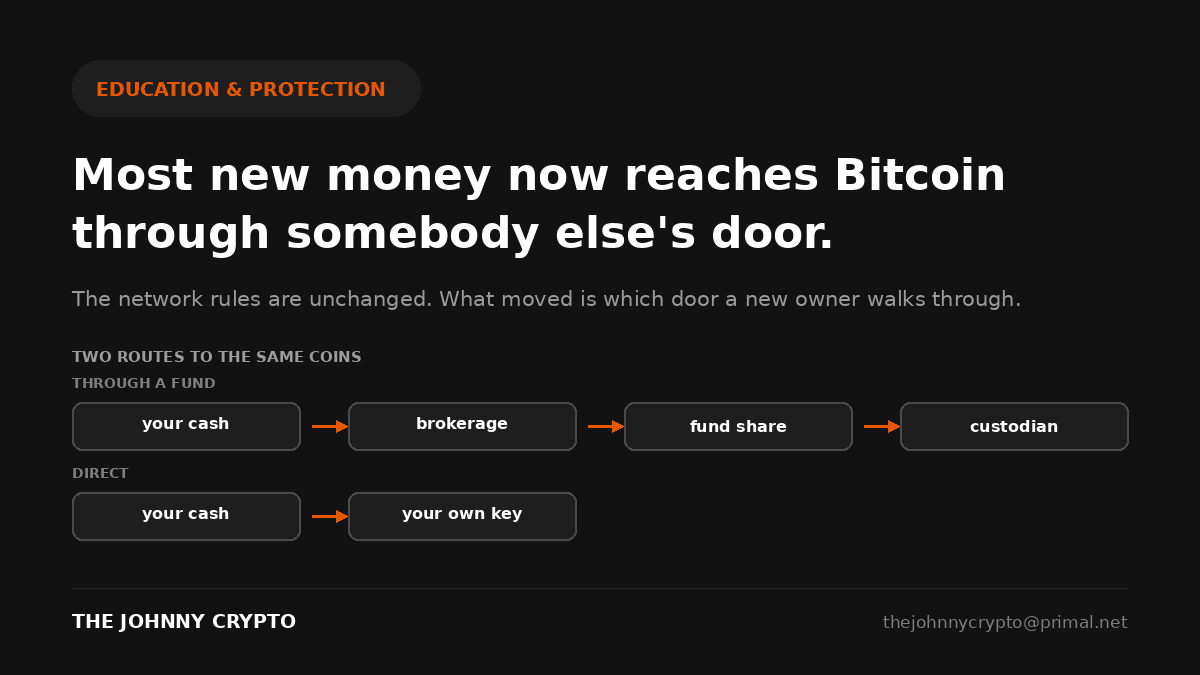
Think about how you own a piece of a company today. You tap a button. A broker holds the shares, a clearing house tracks who owes what, a custodian bank keeps the records. The company did not change when that plumbing got built. The route your money takes did.
Bitcoin is going through the same thing.
As of September 18, American spot Bitcoin funds held about 102.5 billion dollars, roughly 6.29 percent of every Bitcoin that exists. One fund is more than 60 percent of that.
Institutionalized and taken over are two different events. A takeover would mean large firms get to change the rules of the network. That has not happened. The routes got built instead.
Holding your own Bitcoin costs nothing and takes an afternoon. Instructions are everywhere. What I watch is how many owners ever switch it on. Walk through a brokerage app first and you pick up the habits of a brokerage customer. You learn to check a balance. You never learn to hold a key.
Fair counter, in its strongest form: a fund share hands its sponsor no vote over the network's rules, self custody stays open to everyone, and institutional money paid for security work nobody else was funding. All of that holds up, and all of it sits alongside what I am describing.
So I am watching which door people walk through, because the door teaches the habit.
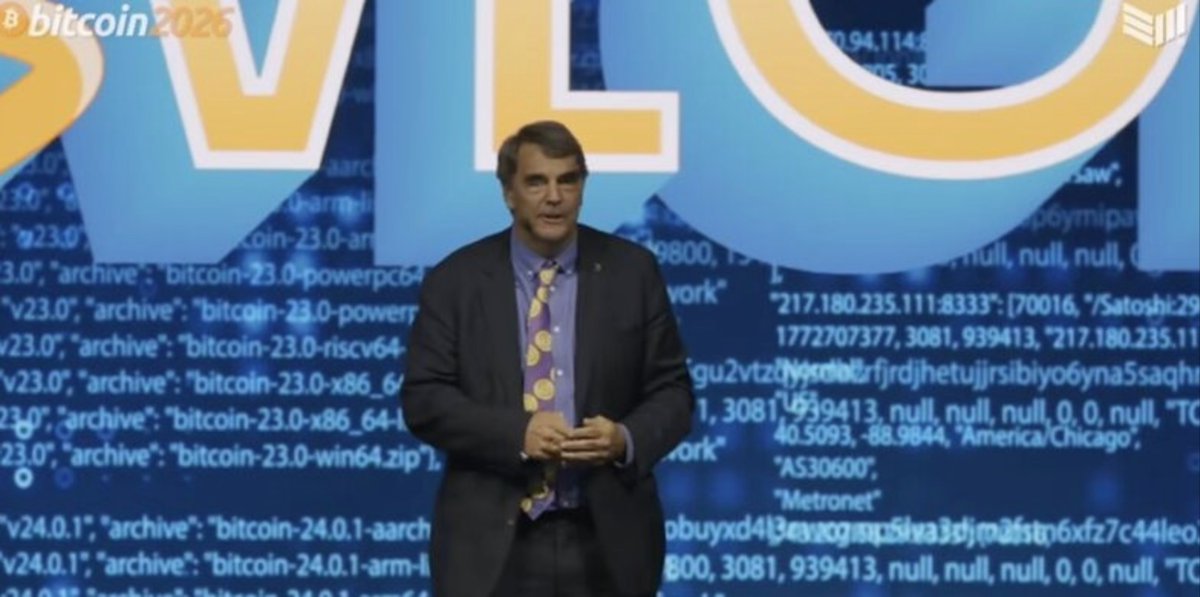
“Reserves are supposed to protect you when the system fails, not only when the system works.”
Tim Draper @TimDraper, Founder at Draper Associates, speaking at The Bitcoin Conference 2026, framed Bitcoin less as an investment opportunity and more as a form of institutional preparedness.
His argument was rooted in a simple observation: events like the Silicon Valley Bank collapse exposed how dependent companies remain on traditional financial infrastructure. If reserve assets exist to preserve operational continuity during periods of stress, then alternative forms of liquidity deserve consideration alongside conventional banking relationships.
Draper extended this logic beyond corporations to families and governments, suggesting that Bitcoin’s role may increasingly resemble a strategic reserve rather than a speculative allocation. In his view, the asset’s utility emerges most clearly when confidence in traditional systems is challenged.
The structural takeaway:
✅ Treasury diversification is increasingly part of the Bitcoin discussion
✅ Banking disruptions can reshape reserve management priorities
✅ Operational resilience may become a key adoption driver
✅ Bitcoin is being evaluated as strategic infrastructure, not just an investment
The broader implication is that Bitcoin’s institutional case may evolve from return potential toward contingency planning, where the primary question becomes how organizations maintain financial flexibility when traditional channels become constrained.
Follow / Repost - @Thejohnnycrypt0 for grounded insights on how digital assets are reshaping finance and how to ledger them.
#thejohnnycrypto #bitcoin #Stablecoins #staking #BTC
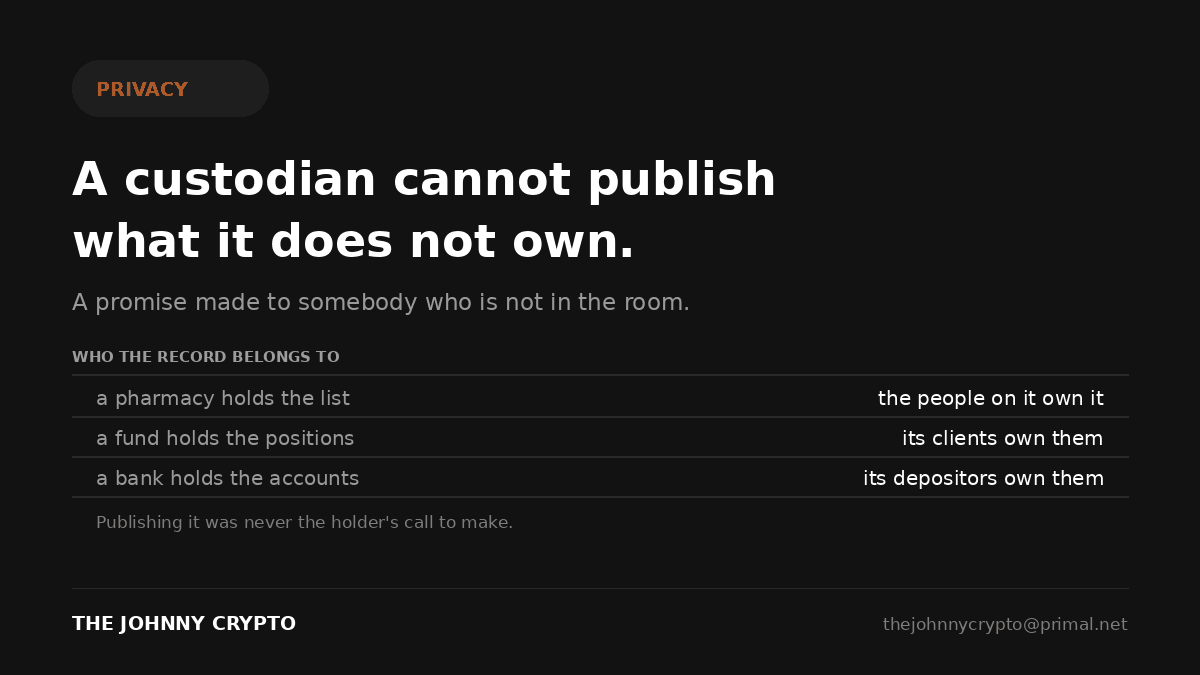
Your pharmacist knows what half the town takes every morning.
That list never goes up on a board. It belongs to the people on it. The pharmacy is holding it for them, under a promise, and publishing it was never the pharmacy's call to make.
Most institutions work this way. A fund holds positions for its clients. A bank holds accounts for its depositors. In both cases the institution is a custodian, which means it looks after something owned by somebody else, under a promise it made to them.
Now put that custodian on a public ledger. A ledger here means a shared record that anyone can read, which is how most open financial software works today. Every transfer, every size, every counterparty, visible to the world by default.
We tend to hear a custodian's objection as an institution wanting to stay out of sight. I hear a smaller and harder problem. A custodian cannot publish what it does not own, and a system that requires publication is asking it to break a promise it made to someone who is not in the room.
So the question at this layer changes shape. For anyone holding something on behalf of other people, a confidentiality layer is the condition of showing up at all.
Here is the strongest argument against me, and the people making it have earned it. Open records are what rescued this industry after the blowups. When a lender claimed it could cover what it owed, outsiders read the ledger and sized the hole themselves that same afternoon. Every institution that ever lost other people's money called the details confidential first.
What would show me wrong: custodians moving real size onto fully public records and staying there for years, supervisors content, no confidentiality layer anywhere.
Bitcoin gets no exemption here. Its base layer publishes every amount forever, and the businesses holding coins for customers inherit the whole problem. Proof of reserves sits in between and is worth asking for: show the coins exist without naming whose they are.
A February 2026 paper covering 125 nations found people underestimate how much others agree with them, and go silent on that basis. r/Bitcoin has 8.2 million subscribers. I have yet to meet a mean one in person. Silence is a vote for whoever is loudest. (4/4)
The loudest table in a restaurant is never most of the restaurant. Pew tracked real posting behaviour on Twitter and found the busiest 25 percent of American adult users produced 97 percent of all tweets. The other three quarters posted a median of zero. (1/4)
So when someone new looks at Bitcoin and sees cruelty, they are watching a rounding error of the people who own it, doing all of the talking. The rest of it has a name. (3/4)
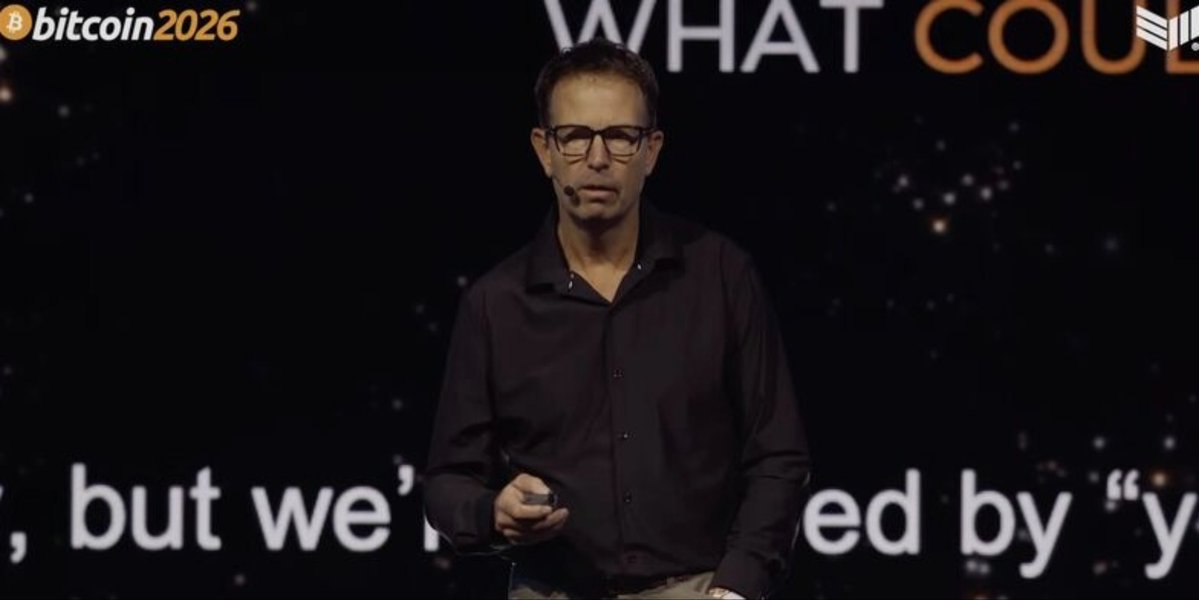
“Bitcoin isn’t just an asset inside the financial system, it’s an alternative set of rules for how the system can operate.”
Jeff Booth (@JeffBooth), Founding Partner at ego death capital, speaking at The Bitcoin Conference 2026, challenged the tendency to view Bitcoin exclusively through the lens of investing, speculation, or portfolio allocation.
His argument was that Bitcoin is better understood as infrastructure. Rather than being another financial product competing for capital, it is a decentralized protocol that establishes a different monetary foundation, one built on fixed rules, open participation, and a supply that cannot be expanded to accommodate growing debt burdens.
Booth contrasted this with modern credit-based systems that depend on continuous monetary expansion to function. In his view, Bitcoin introduces a framework where entrepreneurs can build payment systems, privacy technologies, and application layers on top of a neutral base protocol without requiring centralized control.
The structural takeaway:
✅ Bitcoin is increasingly viewed as infrastructure rather than an asset alone
✅ Fixed monetary rules differ fundamentally from credit-based systems
✅ Open protocols attract application and payment-layer innovation
✅ Network growth increasingly comes from builders, not just investors
The broader implication is that Bitcoin’s long-term significance may ultimately be measured not by its price, but by the economic activity, applications, and financial systems that emerge on top of the protocol itself.
Follow / Repost - The Johnny Crypto for grounded insights on how digital assets are reshaping finance and how to ledger them.
#thejohnnycrypto #bitcoin #Stablecoins #staking #BTC
Open your banking app and hand the phone to whoever is sitting closest to you.
Most people will not. A list of what you bought, where, and when is a fairly complete portrait of a life. Who you see. What you treat. What you are worried about.
Cash carried that protection without anyone designing it. Digital payments do not. Every one of them leaves a record, and the record sits with a company that answers to rules you did not write.
Here is one of those rules. In the United States a bank must file a form describing you and your transaction any time you move more than ten thousand dollars in cash. That form is a currency transaction report. The ten thousand dollar line was set in 1970 and has never been adjusted for inflation, so in today's money it sits somewhere near eighty three thousand. The same sentence in the same old law reaches further into ordinary life every year, and nobody voted to widen it. Banks filed 21.5 million of those reports in fiscal 2025, up from 20.5 million the year before, plus 4.8 million more filed because something about a customer looked off to the bank.
I want to change how this gets framed. Payment privacy is usually debated as a product question: should this system add a privacy option? Framed that way, the person who wants privacy carries the burden of explaining why. Treat it as a default and the burden moves. If privacy is where a system starts, someone has to make a case to remove it, and sometimes they should win it. If privacy is an add-on, you make the case every single time, and most people will skip it.
The strongest argument against me is that these records work. Investigators use them to unwind fraud rings and trafficking networks, and the people pushing for more visibility are usually trying to protect someone who cannot protect themselves. A privacy default makes some of that slower, and I am not going to pretend otherwise.
What would show me wrong: places that widened access to everyday payment records and then watched fraud and violent crime fall for years, with no matching rise in people being extorted or cut off from banking over what their records said.
Bitcoin gets no exemption here. Its ledger, the public list of every payment ever made on it, is open to anyone who cares to look, and privacy on it is deliberate work with tools most people never touch. That puts Bitcoin inside the same argument as everyone else. Where does the burden sit.
If the only thing you can say about a car is that it beats walking, you have not said much. Better than fiat is the standard Bitcoin grades itself against, and fiat is having a rough decade, so the grade comes easy. (1/4)
Gold, in a wild year of its own, came in at 29. El Salvador made it legal tender in 2021 and stripped that status in 2025. By the last survey, 91.8 percent of Salvadorans had gone a year without using it. The chain works. (3/4)