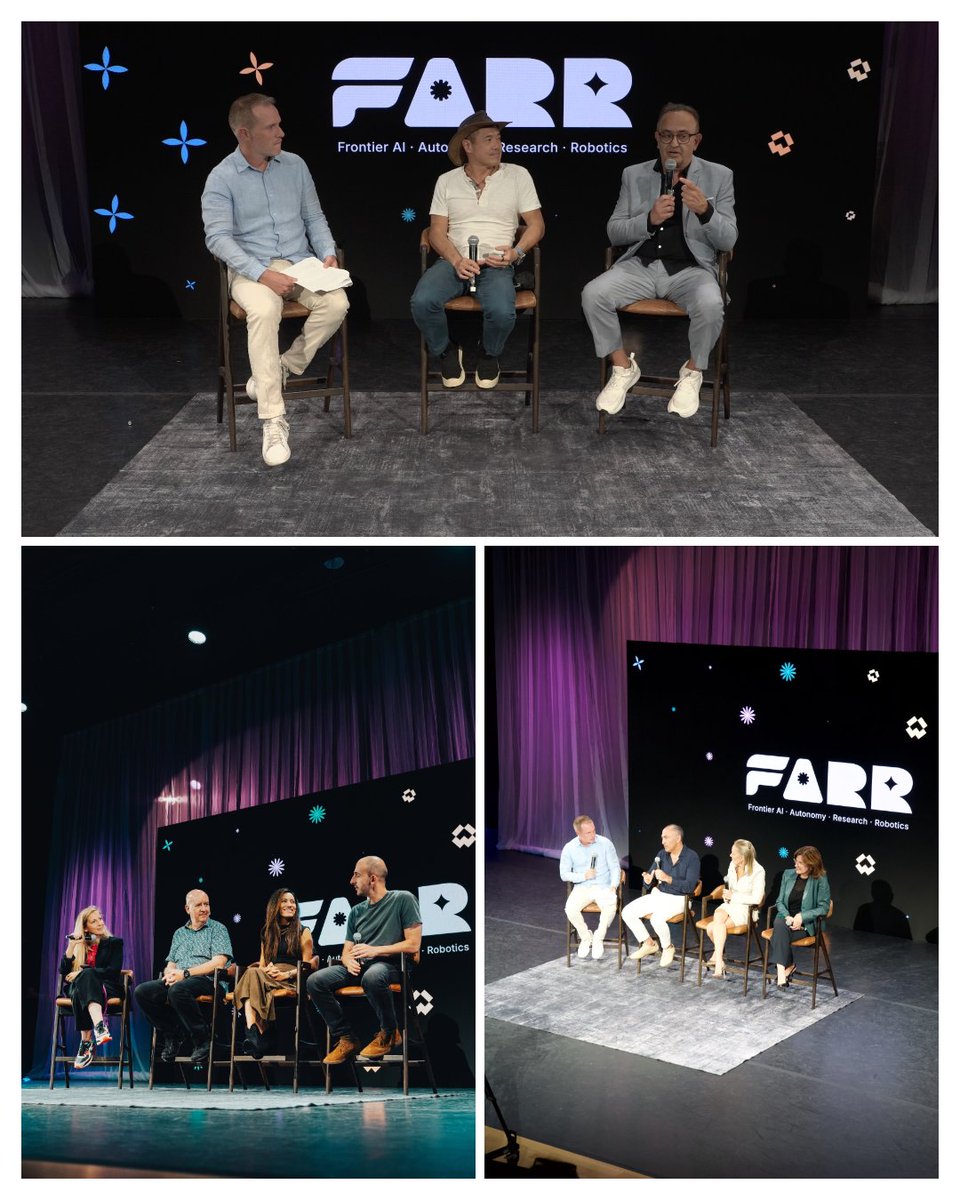
One day. Many perspectives. A future still unfolding.
A heartfelt thank you to every speaker, moderator, and guest who made FARR possible.
On October 5, FARR brought together voices across Frontier AI, Autonomy, Research, and Robotics, exploring questions that reach far beyond any single discipline.
To our speakers and moderators: thank you, truly. Thank you for your time, your candor, and your willingness to bring open questions instead of easy answers. You gave the room its spark, and so many of the conversations you started are still going.
With deep gratitude to:
Speakers
@ramin_m_h · Lindsey Irvine · @chloe_ma · @BartonBetsy5 · @RisaWechsler · @eshear · @steipete · @sam_debrouwer · Killian Murphy · @AzadehYazdan · @aparnacd · Mikayel Khachatryan · @RajeevRonanki · @touraj · @ChrisCassotis · Justine Kasznica · @KiteVC · @mmoazami · @loublanks
Moderators
@JoshConstine · @bilawalsidhu · @marilynika · @thebenbergman
A special thank you to @ivanlinn_ for the music and @austinnasso for the laughs.
And to everyone in the FARR community who joined us in the room: thank you for the ideas, the unexpected connections, and the conversations worth continuing.
The summit may be over. The questions aren't.
With gratitude,
The FARR Team
FARR is the force behind consequential people and ideas.
https://t.co/n21qRbdNcM
#FARRSummit #FrontierAI #Robotics #AIResearch #SFTechWeek
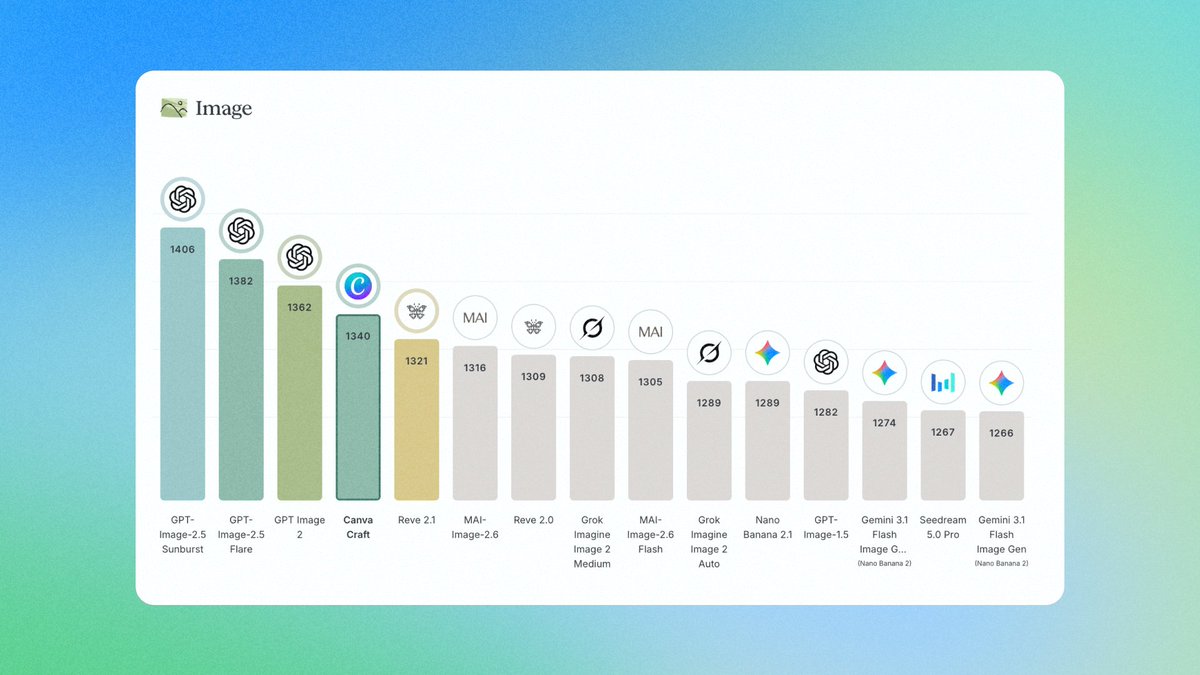
Canva Craft debuted as the world's 4th most advanced image generation model on @DesignArena with an Elo score of 1340.
It delivers exceptional visual quality and state-of-the-art text rendering, outperforming some of the world's leading frontier models.
Five months ago, we were a new player, very small, and none of us had done large-scale pretraining like the frontier labs. Today Canva Craft is #4 on @DesignArena, ahead of every lab except @OpenAI, with a fraction of the para. and data. 0 to 1 in five months. Really proud!
🚨 ثورة في عالم التصميم: "Canva" تطلق نموذج الذكاء الاصطناعي الخارق "Craft" وتقتحم المركز الثاني عالمياً! 🎨🔥
في ضربة قوية لعمالقة التوليد البصري، كشفت المنصة عن نموذجها الأول المخصص حصرياً للتصميم، ليحصد صدارة التصنيفات العالمية (الأول في الوجوه والطبيعة) متفوقاً على أشهر نماذج العالم في DesignArena!
📌 لماذا يُعد نموذج "Craft" قفزة نوعية؟
على عكس النماذج التقليدية التي تنتقل مباشرة من النص إلى البكسلات، يعتمد Craft على معمارية مرحلية تخطط تكوين الصورة وهندستها قبل الرسم لضمان دقة فائقة.
حل جذري لمشكلة الحروف المشوهة وفوضى الترتيب، مع دعم كامل للنصوص بـ 55 لغة ودقة مذهلة تصل إلى 2K.
انطلق رسمياً اليوم داخل (Dream Lab)، مع توفيره عبر واجهة البرمجة (API) ليدمج المطورون ووكلاء الذكاء الاصطناعي قوته في أنظمتهم مباشرة.
عصر جديد من الدقة المطلقة والتحكم الإبداعي في عالم صناعة المحتوى البصري بدأ للتو! 🚀
احفظ التغريدة وشاركها.. هل ستعتمد عليه في تصاميمك القادمة؟ 🧵👇
CANVA JUST LAUNCHED ITS OWN AI IMAGE MODEL!
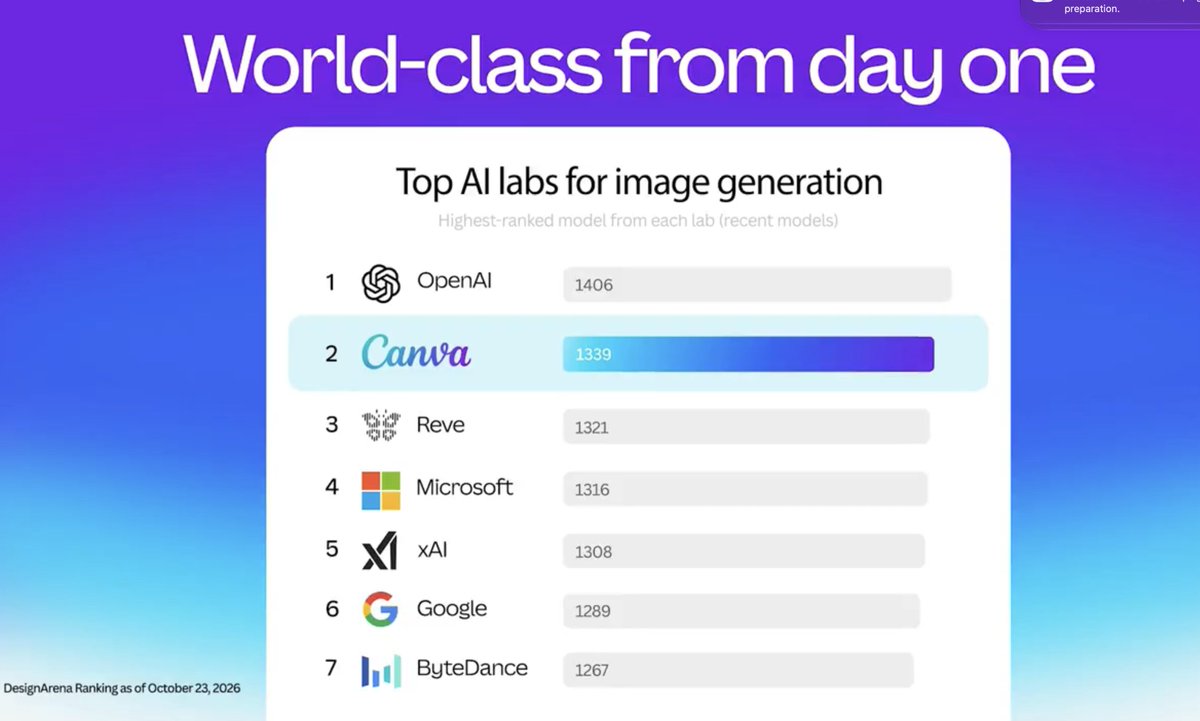
It’s called Craft. Canva says it now ranks 2ND among image-generation labs on DesignArena, behind OpenAI.
It uses a two-stage process: a planner maps out the layout, objects and exact text from your prompt, then a separate renderer generates the image.
This approach is designed for work like posters, ads and product mockups, where readable text and precise placement matter. Canva refined the model using feedback from professional designers.
Craft supports up to 2K resolution and text in 55 languages. It is available now in Dream Lab, with public API access for developers.
Canva just did what most "AI startups" never will.
It didn't wrap someone else's model though instead It built its own frontier image model just for design and it's already ranked #2 for image generation on Design Arena's global leaderboard.
A design tool is now out-shipping AI labs.
Canva Craft, the first ever image model by @canva, takes the #4 spot on DesignArena's Image leaderboard. This makes Canva the #2 Image Lab after @OpenAI!
Notably, it wins most often on photorealistic product and object shots, setting up studio-style lighting and detailed material textures on a single hero object. It also ranks #1 on the Portrait and Landscape subcategories.
Congrats to the @canva team on the launch!
CANVA FOUNDATIONAL MODEL!
@canva craft! Beautiful and beautifully efficient. Crafted with the knowledge and insights of use cases for hundreds of millions of designers producing billions of new designs a month.
Models matter, and are enhanced by better data and massive distribution. Powered, and built by Team Canva!
Introducing Canva Craft 🚀
Extraordinary image generation is now available to everyone, powered by our first frontier model built specifically for design.
With Craft, Canva is now the world's second most advanced AI lab for image generation on @DesignArena's global leaderboard.
See what it can do 👇
Introducing Canva Craft 🚀
Extraordinary image generation is now available to everyone, powered by our first frontier model built specifically for design.
With Craft, Canva is now the world's second most advanced AI lab for image generation on @DesignArena's global leaderboard.
See what it can do 👇
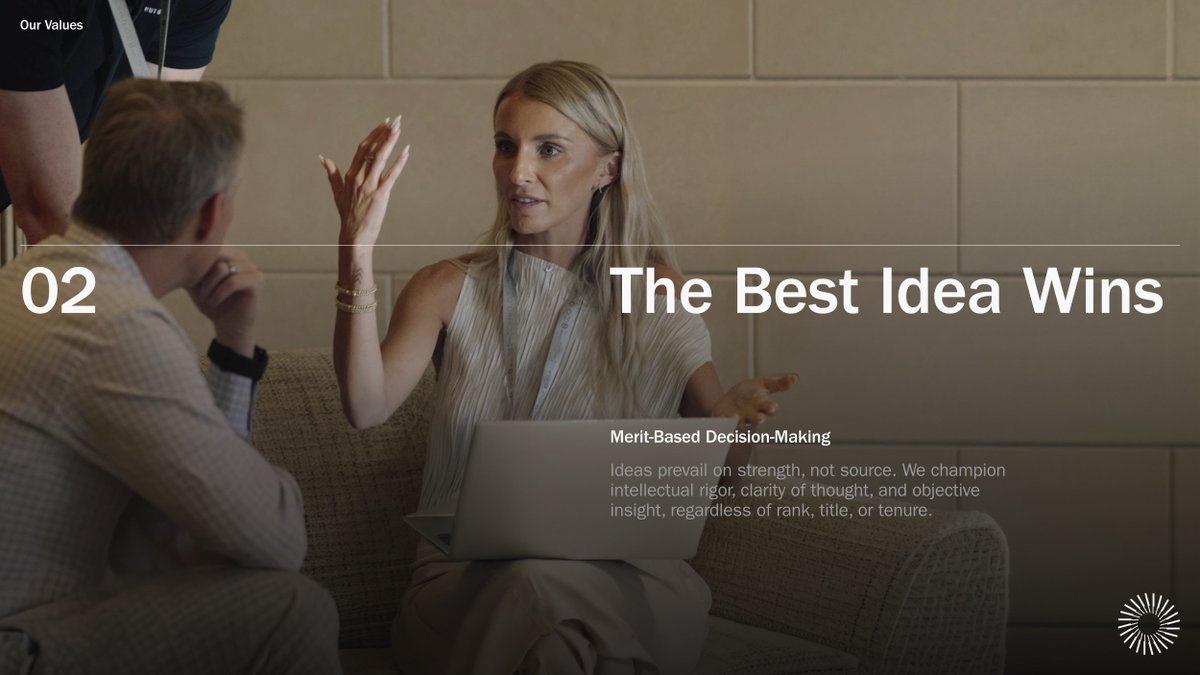
Start From Zero. The Best Idea Wins. All or Nothing. No Room for Ego.
At Hut 8, our values define how we operate, guide how we grow, and reflect who we aspire to be. They set the standard for the environment we’re building: one where talented, purpose-driven individuals can do the most meaningful and impactful work of their careers.
View open positions at https://t.co/ya0GBnBAIf
Encrypt all your AI chats.
One OpenAI-compatible API to hundreds of models, with a privacy label on every route: zero retention, end-to-end encrypted, EU.
Moving from OpenRouter is one base_url change. Start with 1M free tokens on DeepSeek, no card:
https://t.co/Ne0VXd2xOo
Two years ago, River Bend was a piece of land in West Feliciana Parish, and the idea of building an AI data center campus there was one most people did not take seriously. As CEO @ashergenoot said at River Bend: First Look earlier this month, “Many laughed us out the door when we told them about our vision. Look at where we are today.” Today, more than 1,000 people are on site every day making that vision a reality.
Thank you to @LAGovJeffLandry, @LEDLouisiana, and West Feliciana Parish for standing with us when others did not, and to our partners at @AnthropicAI, @Broadcom, @Entergy, @Vertiv and Jacobs. We are committed to building River Bend responsibly, alongside the community that calls this place home.
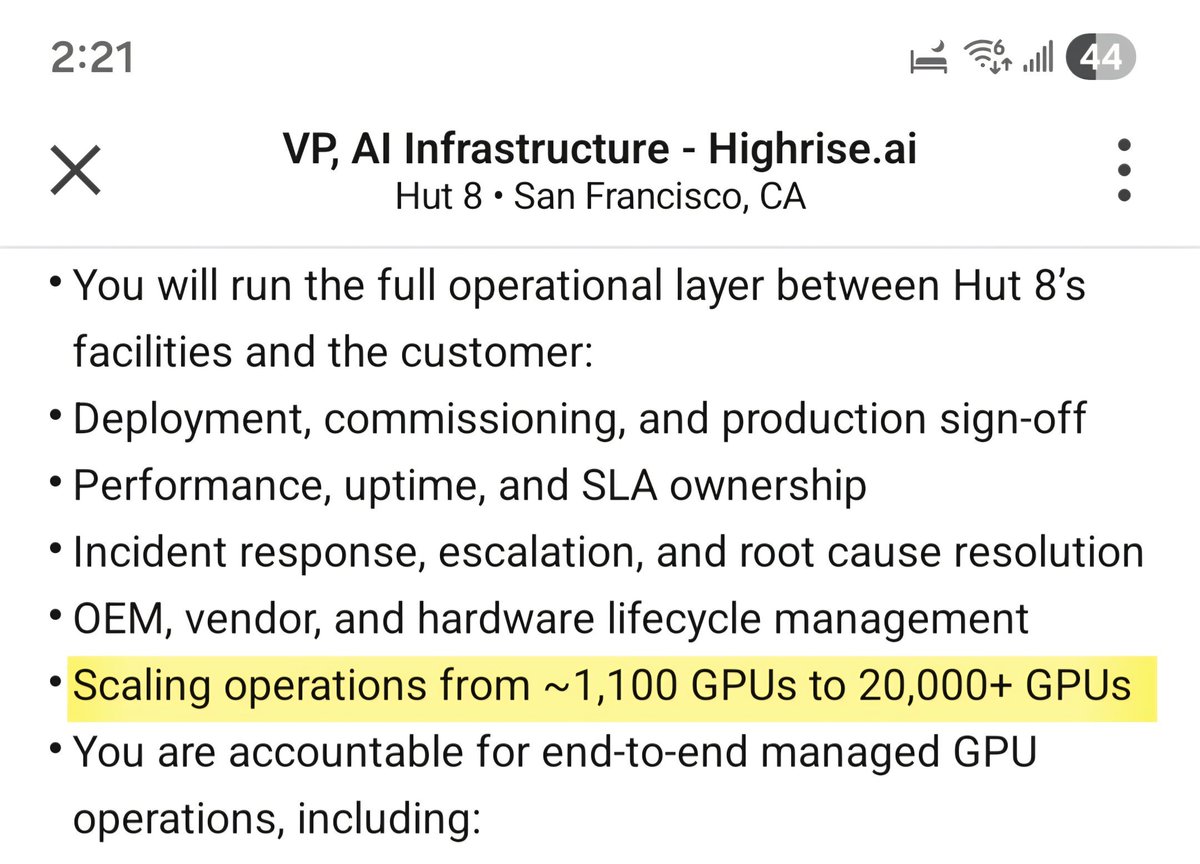
🚨 $HUT HIGHRISE AI HIRES NEW VP TO SCALE GPU FLEET TO 20,000+!
Hut 8's wholly owned neocloud subsidiary, Highrise AI, has hired Erik Grundstrom as VP of AI Infrastructure to help lead its massive GPU expansion.
Erik brings over 25 years of infrastructure experience, including leadership roles at:
🔹 Core42: VP, AI Platform Infrastructure
🔹 Applied Digital ($APLD): VP, HPC Infrastructure
🔹 Supermicro ($SMCI): Director, Field Applications Engineering & Business Development
The timing isn't a coincidence. Hut 8 is developing a $500 MILLION, 50 MW AI data center in Batavia, Illinois, with plans to deploy approximately 20,000 NVIDIA GPUs for Highrise AI. And the project has been making significant progress.
Batavia city officials recently confirmed that the development has completed ALL power and grid approvals, clearing a major hurdle toward bringing the facility online.
https://t.co/MHiy8cfVwx
Connect the dots. Hut 8 is clearing the hurdles, building the infrastructure, and assembling the team to scale Highrise AI into a major player in the GPU cloud market.
https://t.co/oVcCz2cm8g
This is so sad to see. I can remember coming to France in the late 80's / early 90's and ity was a "bastion of curated civilization". The strife there and seemingly insurmountable sociatal and governmental structural issues is truly disheartening. The death by a thousand cuts - of a beautiful culture and society - has happened in our lifetime.
Une vendeuse qui fuit sa propre boutique. À Lyon. En France. En 2026.
Oui, au bout d'un moment, il faut blâmer les abrutis qui brandissent un drapeau palestinien ou algérien pour des causes dont ils n'ont absolument rien à foutre, et qui s'en servent comme d'un permis de piller. Ils sont responsables de leurs actes. Point.
Mais si on s'arrête là, on n'a rien compris. Ces gamins ne sont pas tombés du ciel. Ils sont le produit d'un système. Ce système a des architectes, et ces architectes ont des idées. Il va falloir demander des comptes à tous ceux qui ont créé les conditions de ce chaos, et aux idées qui l'ont rendu possible.
Marc Andreessen les a nommées dans son manifeste techno-optimiste. Ce sont nos ennemis.
Le collectivisme, l'étatisme, la planification centrale, le socialisme.
La bureaucratie, la vétocratie, la gérontocratie.
La haine du mérite, de l'ambition, de l'effort, de la réussite, de la grandeur.
La corruption, la capture réglementaire, les rentes et ceux qui en vivent.
Des institutions qui furent jeunes, ardentes, en quête de vérité, et qui aujourd'hui sont compromises, rongées, en train de s'effondrer.
La tour d'ivoire, et l'expert diplômé qui sait tout mieux que vous et ne paie jamais pour ses erreurs.
Le contrôle de la parole et le contrôle de la pensée.
La stagnation, la décroissance, ce nihilisme si chic chez nos élites qui rêve de moins d'énergie, moins d'enfants, moins d'ambition, moins de vie.
Et au fond de tout ça, le Dernier Homme de Nietzsche : celui qui ne veut plus rien bâtir, plus rien défendre, plus rien transmettre. Juste être tranquille.
Quand on désarme moralement un pays, qu'on apprend à sa jeunesse à mépriser ce qu'elle a reçu, qu'on remplace la transmission par la repentance, l'autorité par l'excuse et le travail par le guichet, on ne fabrique pas des citoyens. On fabrique des pillards. Et des vendeuses qui s'enfuient.
Ces idées ont été théorisées dans les années 80 par Mitterrand et par Attali. Elles sont aujourd'hui incarnées par Macron. Quarante ans. La même pente. Le même résultat.
Il va falloir prendre enfin la leçon du gauchisme et du socialisme, parce qu'elle est toujours la même, partout, à chaque siècle. Ils promettent l'égalité et livrent le chaos. Ils promettent la protection et livrent la peur. Ils promettent la paix sociale et livrent une commerçante qui court pour sauver sa peau dans son propre magasin.
Si on n'est pas capable d'apprendre de l'histoire, on mérite notre sort. Et on méritera ce qui vient toujours après le chaos : le totalitarisme, et ses millions de morts. Le XXe siècle nous l'a écrit en lettres de sang. Nous n'avons aucune excuse. Nous savons.
Raymond Aron l'avait dit : « L'histoire est tragique. »
Ceux qui l'oublient ne s'en protègent pas. Ils finissent simplement par la subir.
Alors choisissez votre camp. Celui de ceux qui excusent, qui expliquent, qui regardent ailleurs.
Ou celui de ceux qui construisent, qui travaillent, qui créent, qui transmettent, et qui refusent de laisser ce pays devenir un endroit où l'on fuit sa propre boutique.
La France n'est pas condamnée. Mais elle ne se sauvera pas toute seule.
On my way to the office this morning, I passed a group of young people protesting, a Palestinian flag draped over their shoulders.
And I asked myself a question I can't shake: why does this generation always fall into the same trap? No matter the history. No matter the context. Even the ones from wealthy families, who went to the best schools, who were dealt every good card. Always the same trap.
I don't think it's stupidity. I think it's a mechanism. And a mechanism can be taken apart, piece by piece.
A. The observation: everything the state touches becomes unaffordable.
Look at economist Mark Perry's famous chart, the one people call "the chart of the century." It tracks US prices since 2000.
At the top, what explodes: hospital services, college tuition, textbooks, childcare, housing. Increases of +100%, +150%, up to +250%, far above general inflation.
At the bottom, what collapses: TVs, software, phones, toys, clothing. A TV today costs a fraction of what it did in 2000, for an infinitely better product.
Look at what separates the two groups. It isn't technology. It isn't complexity. It's one variable: how much the state is involved.
At the top, sectors that are subsidized, regulated, shielded from competition, where the state funds demand and blocks supply. At the bottom, sectors where companies fight every single morning to serve you better and cheaper.
B. The mechanism: why it's systematic.
When the state subsidizes demand without freeing supply, prices rise. Every time. Guaranteed student loans, and universities raise tuition. Housing aid plus blocked building permits, and rents skyrocket. Administered healthcare, and bureaucracy eats the budget before it ever reaches the patient.
In France it's even more vicious, because the price doesn't disappear: it hides. You never see the hospital bill, you pay it through payroll contributions. You never see the cost of school, you pay it through taxes. Public spending at 57% of GDP, one of the heaviest tax burdens in the world, more than €3.4 trillion in debt. And the result? Overflowing ERs, falling PISA scores, young people who can't afford to live in the city where they work.
The market didn't fail in these sectors. It was never allowed in.
C. Suffering demands a culprit.
A 22-year-old lives all of this in their bones. They can't find a place to live. Their degree either buries them in debt or opens no doors. The future feels blocked. That suffering is real, and I don't deny it for a second.
But human beings can't stand suffering without a culprit. They need a face. A scapegoat.
And this is where everything is decided: who taught them how to read the world?
D. Whoever tells the story picks the villain.
Schools are public. Universities are public. Culture runs on grants. Film goes through funding committees. Public broadcasting shapes the narratives. The people handing down the interpretive framework are, overwhelmingly, paid by the very system that creates the problem.
Do you really think that system is going to name itself as the culprit?
No. It names the capitalist. The boss. The landlord. "The rich." The multinational. The commercial West. Same role, same casting, every time.
E. One lens, a thousand causes.
And this brings me back to that flag. A generation taught to read every situation through a single lens, oppressor on one side, rich, Western, capitalist, oppressed on the other, will apply that lens everywhere. To housing. To climate. To conflicts on the other side of the world. The cause changes, the lens stays. That's why the trap is always the same: it's not the cause that draws them in, it's the way of thinking that was installed in them.
F. The perfect inversion.
Here's the irony. Capitalism is the force that drove down the price of almost everything it touched. The state is the force that blew up the price of almost everything it captured. And young people blame the first for the crimes of the second.
It's like blaming the firefighter for the fire because you saw him at the scene.
G. The ballot box confirms it.
In the US, a few weeks out from the midterms, a large share of urban young voters is getting ready to vote Democrat for more state, more spending, more regulation. New York elected a self-described socialist mayor, carried by young voters, on promises of rent freezes and city-run grocery stores. Rent freezes, the policy that has made housing scarcer everywhere it's been tried. The cure that worsens the disease.
In France, it's the same play in two acts. Part of the youth votes for the radical left, which promises more state. Another part votes for the center, which promises to "manage" the state well, and has dug the debt deeper than ever. Two different ballots, one shared assumption: the problem is the market, the solution is the state.
H. The way out.
These young people aren't stupid. They're right to be angry. They're just aiming at the wrong target.
The day they understand that their rent, their tuition and their hospital are expensive precisely because the state runs them, their anger will change direction. They'll stop protesting against those who create. They'll start protesting against those who capture.
That day, the greatest intellectual scam of our time will be over.
My dear American friends, today I'm going to take apart the two most successful salesmen of economic snake oil of our time: Thomas Piketty and Gabriel Zucman.
If you read my last post, you know where this comes from. Gramsci told his heirs not to storm the palace but to capture the institutions: schools, universities, media, culture. I showed you how France became the laboratory. Today I want to show you the field where that strategy worked best of all. Economics.
Here's why. In physics, if your theory is wrong, the bridge falls down. In engineering, the rocket explodes. Reality grades your work. In the social sciences, reality grades slowly, and nobody loses their job when the prediction fails. You pick your data, you pick your assumptions, you build a model, and the conclusion you wanted at the start comes out at the end with a lot of equations attached. That's the perfect terrain for a war of position. You don't need to be right. You need to be cited.
Meet the two generals.
Thomas Piketty wrote Capital in the Twenty-First Century. It sold millions of copies and became the most celebrated economics book of the decade. Gabriel Zucman, his former student, wrote The Triumph of Injustice with Emmanuel Saez and helped design the wealth taxes that Elizabeth Warren and Bernie Sanders campaigned on. This is not a French problem. Their ideas are already inside your Democratic Party.
Now let's go through their theses one by one.
Thesis one: "r > g." Piketty's famous formula says the return on capital grows faster than the economy, so wealth inevitably concentrates in the hands of a few dynasties, and capitalism slides back to the aristocracy of the 19th century.
Look at the list of the richest Americans today. Elon Musk. Jeff Bezos. Jensen Huang. Mark Zuckerberg. Larry Page. First-generation builders. Not heirs. Most of the names on the first Forbes 400 list in 1982 have since fallen off it. Fortunes don't compound forever. They get split between children, spent, mismanaged, and overtaken by people who build something new. And when an MIT graduate student, Matthew Rognlie, looked closely at Piketty's own numbers, he found that the rise in capital's share of income came almost entirely from housing. Not factories. Not shareholders. Real estate, which is a story about building restrictions, not about capitalism. The law of history turned out to be a law of zoning.
Thesis two: "Inequality in America has exploded." Piketty, Saez and Zucman built the charts every journalist uses. Top 1% capturing everything, the middle class crushed.
Then two economists at the US Treasury and the Joint Committee on Taxation, Gerald Auten and David Splinter, redid the work. They counted what the famous charts left out or treated differently: taxes paid, government transfers, retirement income, changes in how people file. Their result: after taxes and transfers, the top 1%'s share of income has barely moved since the 1960s. Same country, same tax data, a completely different story. The difference isn't reality. It's the assumptions. And Piketty's data was already in trouble in 2014, when the Financial Times published an investigation pointing out errors and unexplained adjustments in his spreadsheets.
Thesis three: "Billionaires pay a lower tax rate than the working class." This was the headline of Saez and Zucman's book, and it went viral. The 400 richest Americans supposedly paid less than the bottom half.
To get there, they made choices that critics across the spectrum, including Larry Summers, Obama's own former Treasury Secretary, challenged: how corporate taxes are assigned, how refundable credits that put money into lower-income households' pockets are counted. Meanwhile, the IRS's own numbers say the top 1% of earners pay more than 40% of all federal income taxes. A viral claim is not a fact. It's a campaign slogan with footnotes.
Thesis four: "A small wealth tax on the ultra-rich will fund everything." In France, Zucman's proposal became the left's flagship measure: a 2% minimum tax every year on fortunes over €100 million.
Here's what they never explain. The fortunes of builders are not piles of cash. They are shares in the companies they built. Imagine a founder whose startup is valued at a billion euros but doesn't make a profit yet. To pay a 2% tax on paper wealth, every year, he has to sell pieces of his company. Year after year, he loses control, and the buyers are usually foreign funds. Congratulations, you just exported your best companies.
And we know what happens next, because it already happened. In 1990, twelve OECD countries had a wealth tax. By 2017, only four did. Nearly all of them repealed it, because it raised little and chased away capital. Norway raised its wealth tax in 2022 and dozens of its richest people moved to Switzerland. France ran the experiment for decades before abolishing most of its wealth tax in 2018. Their policy has been tested. It failed every time.
Thesis five: and here they stop pretending. In his next book, Capital and Ideology, Piketty proposes what he openly calls "participatory socialism." Taxes on the largest fortunes up to 90%. Property that is no longer permanent, but "temporary," returned to the collective at regular intervals. He's not hiding anything. The goal isn't to fix capitalism. It's to end private ownership of anything big enough to matter.
So why are they celebrated? Why do they have the prizes, the chairs, the front pages, the invitations to Davos? Zucman even won the John Bates Clark Medal in 2023, one of the most prestigious awards in economics.
That's not a refutation of what I'm telling you. That's the proof of it. That's what it looks like when Gramsci's long march reaches the economics departments. The institutions give each other medals, the media quote the medals, and the politicians quote the media. Nobody ever checks whether the predictions came true.
So stop calling them neutral economists. They are activists with PhDs. Their work starts from a conclusion, that private wealth is illegitimate, and builds the data to justify it.
And understand where that conclusion leads. I'm not saying Piketty or Zucman want camps. I'm saying every regime that tried to abolish large private property ended in poverty, and the worst of them ended in prisons and mass graves. The intellectuals who cheered Lenin didn't want gulags either. Many of them ended up in one. Good intentions have never been a firewall.
Next time someone quotes Piketty or Zucman at you, don't get angry. Ask questions. Who are the richest people today, heirs or builders? Why did almost every country that tried a wealth tax repeal it? Why do two teams using the same tax data reach opposite conclusions? What does Piketty mean by temporary property?
You don't need to win the argument. You just need to make them check.
I come from your future. We gave these men our universities, our newspapers and our budget debates. Don't give them yours.