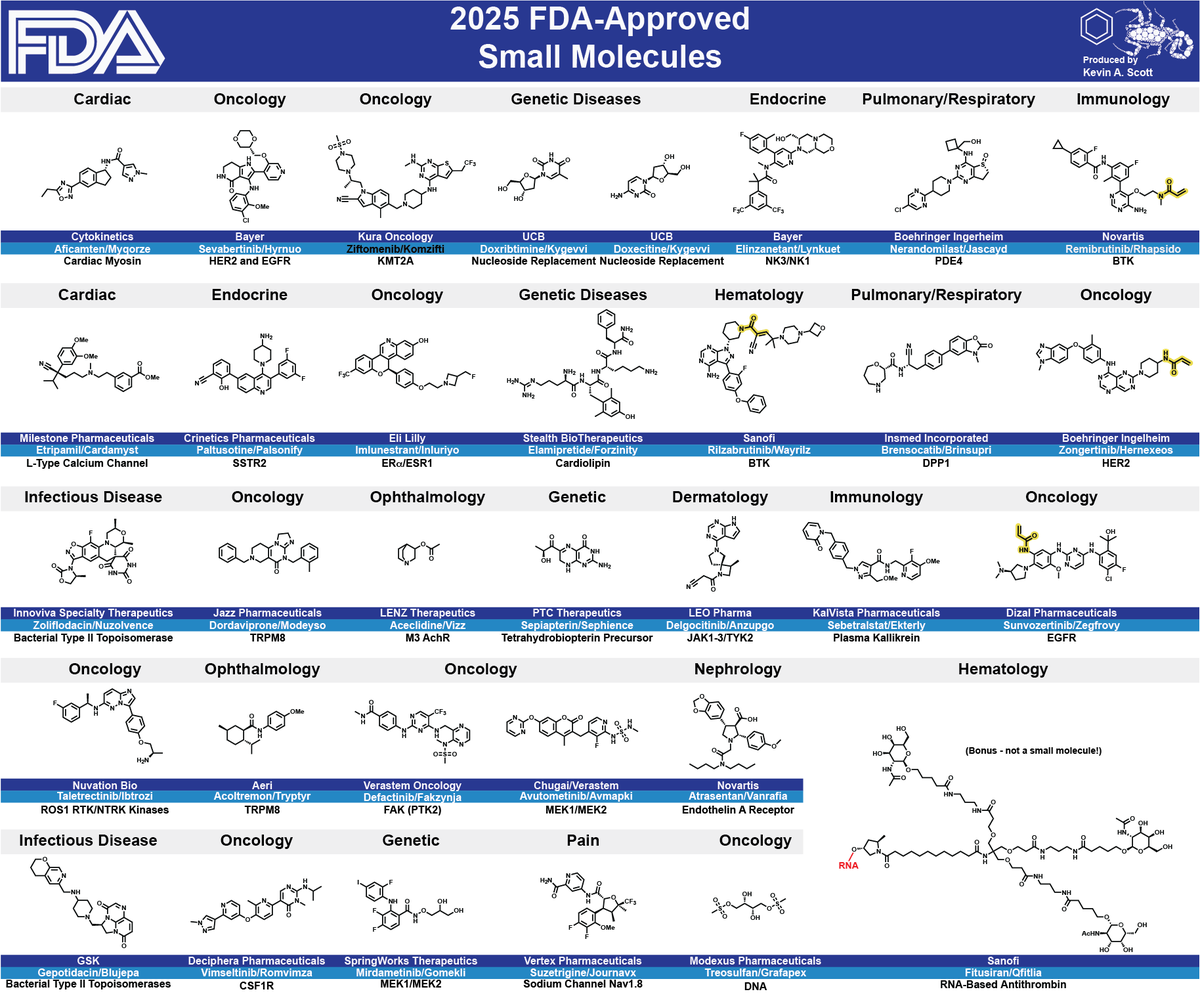
Ok here it is - out of 44 FDA approvals this year, 31 are small molecules (70%), 26 of those are oral drugs (84%), 22 of them are chiral (71%). This is the largest number and percentage of chiral FDA approved molecules in a single year. Fitusiran is not a small molecule, bonus.
💊Accelerating Medicinal Chemistry💊: A C(sp3)-rich Fragment Toolbox for Redox-Neutral Cross-Coupling, appearing today in @chemrxiv: https://t.co/KRpQG8J3iY
A great collaboration with brilliant drug hunters at BMS, Pfizer, and Biogen.
Quick summary: A new toolbox of 15 sulfonyl hydrazide reagents (some of which are already commercial) enables redox-neutral, nickel-catalyzed radical cross-coupling to attach small C(sp3)-rich fragments like methyl and cyclopropyl to (hetero)arenes, streamlining the hit-to-lead phase of drug discovery. These stable, easy-to-synthesize reagents require no additional oxidants, reductants, or costly catalysts, offering mild, dump-and-stir conditions and broad substrate compatibility across over 60 (hetero)aryl halides. Compared to traditional methods like Suzuki or Kumada couplings or radical couplings wedded to redox, this unified approach significantly improves yields and simplifies synthesis, accelerating analog optimization and late-stage functionalization of drug-like molecules.
Aryl Acid-Alcohol Cross-Coupling: C(sp3)–C(sp2) Bond Formation from Nontraditional Precursors | Journal of the American Chemical Society @Princeton@PrincetonChem@TotalSyntheses https://t.co/fxk4sZSkh1
Synergistic LMCT and Ni Catalysis for Methylative Cross-Coupling Using tert-Butanol: Modulating Radical Pathways via Selective Bond Homolysis | Journal of the American Chemical Society @TotalSyntheses https://t.co/9s1g6MDCzI
Check out 'Illuminating Palladium Catalysis'–our recent Account published in Accounts of Chemical Research, presenting our discovery and development of visible-light-induced palladium catalysis since 2016. This account was also selected for the Journal cover! Congrats, Kelvin!
Want to selectively couple two radicals?... You're in luck!
Check out our newest work in Nature where we use dynamic orbital selection to unlock alkylation of native aryl C–H bonds.
Congrats to @GrosskopfJo, Charlene, Robert, and Alex!
Read more at: https://t.co/6DoDJhVVk4
Rational Design, Synthesis, and Biological Evaluation of Novel c-Met Degraders for Lung Cancer Therapy | Journal of Medicinal Chemistry https://t.co/Yy4MkzoJ0X
Congrats to @charis_amber and the team on their highlight in SYNFACTS on their C—C reductive amination work!
Check it out here: https://t.co/soOzFGlONl
Chiral Aldehyde/Palladium Catalysis Enables Asymmetric Branched-Selective Ring-Opening Functionalization of Methylenecyclopropanes with Amino Acid Esters | Journal of the American Chemical Society @TotalSyntheses https://t.co/n6OjlQNdBq
Ni-Cat Cross-Electrophile Coupling of ArOTf/AlkHal: Mechanism-Informed Design of General Conditions | Journal of the American Chemical Society @UWMadisonChem@UWMadison@TotalSyntheses -optimal ligand selection & LiCl avoids deleterious transmetalation https://t.co/ZIqgtl0kR9
It's over for Alzheimer's
Researchers at the Advanced Science Research Center at the CUNY Graduate Center, part of the City University of New York, have discovered a critical mechanism that links cellular stress in the brain to the progression of Alzheimer’s disease.
The study, published in the journal Neuron, highlights microglia, the brain's primary immune cells, as central players in both the protective and harmful responses associated with the disease.
The research team discovered that activation of this stress pathway, known as the integrated stress response, prompts microglia to produce and release toxic lipids. These lipids damage neurons and oligodendrocyte progenitor cells, two cell types that are essential for optimal brain function and that have most impact in Alzheimer’s disease. Blocking either the stress response, or the lipid synthesis pathway, reversed symptoms of Alzheimer’s disease in preclinical models.
Check out our latest work in JACS— Access to a nucleophilic Fe(I) complex allows for activation of 1° electrophiles via an SN2-type mechanism. Subsequent SH2 bond formation enables all-carbon quaternary centers. Congrats Andria, Felix, Wei, and Marissa!
https://t.co/n9f0NCW1ZE
Super-proud of this work by @CharlCrowe and the entire team! It has been my dream since starting working on PROTACs >15 years ago to one day see them working in action, glued to their Cullin RING ligase and target protein. It is dream come true now! Beautiful and Thank you 🙏
Entering our free aryne era! Check out our newest paper on the aminohalogenation of arynes! Congrats to recent PhD @JoshGavin17 and our star undergrad Lars! https://t.co/wfLGY3yzFM
Just published! We've developed a novel method using anthracene as a photoredox catalyst for the direct functionalization of heteroarenes with various alkyl sources. #Chemistry#Photoredox#Catalysis#OrganicSynthesis#Heterocycles
https://t.co/g5Km7V6ETN
Here’s another contribution to our amine synthesis platform. A modular, practical and general carbonyl acylative amination to alpha-amino amides and ketones. Great work by Jianzhong Liu. He’s looking for academic positions and is definitely one to watch. https://t.co/piwVDi7H0v
A challenging project we started 4 years ago, at the very beginning of my postdoc @NoelGroupUvA with @AntonioPulcine1, has finally seen the light in @angew_chem! Personally, a great collaborative effort where I learned a lot about flow and metal catalysis! Check it out! 👇🏻
Expanding the horizons for bismuth as a redox catalyst. Now for cyclopropanation. @J_A_C_S https://t.co/FLZoHqFXI2 with @ShengyangN & @DavideSpinnato2