« Revendiquer le droit d'étudier dans de bonnes conditions » ?
L'Occident a produit les plus grands physiciens de l'Histoire avec des pupitres et des chaises en bois, un professeur et un tableau noir.
Il leur faut quoi à ces lycéens ?
Un accélérateur de particules par classe ?
Ok let me explain how cool this is from my perspective , please RT! I developed one of the first methods to probe RNA structure in high throughput inside living cells, and it takes tons of time and $$ to apply on thousands of viruses - it’s practically impossible. This ML approach is just as good and works in seconds for nearly free ! Not only that, it highlights the MOST IMPORTANT structures that track with function. It’s the future of RNA strucute prediction and discovery across all families 🔥 https://t.co/aAJOXI7xrN
Picornaviruses infect 10’s of millions of children every year. We know the sequences but not the structures. Mapping them is key in understanding how they function.
So, we mapped all the sequences of Picornaviruses we could find. ~75’000 Structures.
Enjoy, it's all Open Source
Si de Gaulle était là en 2026 il prendrait 50 milliards des retraites pour les mettre dans l'IA parce qu'il comprendrait tout de suite l'enjeu historique de cette technologie.
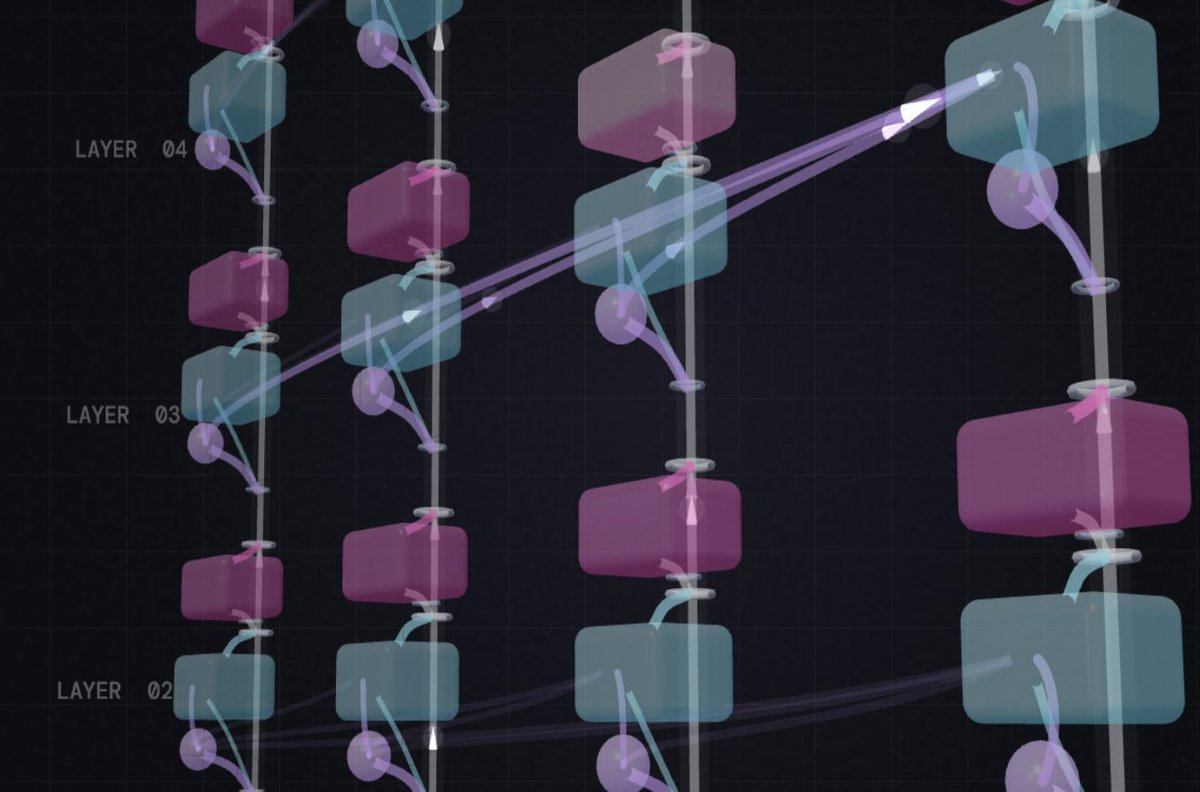
Nice! This ends up being a version of what some of us have called "target prop": every layer's input is a free latent variable that serves as a target for the previous layer.
As this paper points out, this can be derived from an "augmented Lagrangian" formulation of backprop in which the constraints (input of layer k+1 = output of layer k) are turned into penalties (divergence between input of layer k+1 and output of layer k).
I've always hoped more people would pick up on this idea. I'm happy this is happening!
I must say though that target prop, in the end, optimizes the same criterion as backprop and does the same thing as backprop while evaluating the gradient in a different way, perhaps more biologically plausible.
My lab did some work on this idea in the context of "sparse auto-encoders" in the late 2000s. It turns out when the code in an auto-encoder is regularized (e.g. with L1 to make it sparse) target prop seems more efficient than backprop.
https://t.co/uVDmnmFnbQ
I gave the fly brain $100 to trade bitcoin.
Dopamine neurons are stimulated when the fly makes profit. Neuron activity controls buy/sell decisions and makes trades on coinbase.
Will the fly get rich?
🎉 CUDA Rust is here! Team 🟩 ❤️ 🦀
You can now write CUDA kernels in plain Rust, two ways: cuda-oxide (SIMT) and cutile-rs (Tile).
https://t.co/e4AQHUvskP
Terence Tao just posted this really insightful thread which seems to have been written in reaction to the Navier Stokes announcement. Please give it a read. https://t.co/SiuLLyp8jQ
Our group discovered that reasoning models produce fractals when asked to solve hard problems. We can use nonlinear dynamics to probe the thinking processes of recurrent depth models on Sudoku, mathematics, and even ARC-AGI (1/N)
https://t.co/Q3u8OqylZf
Memories can survive even after the brain temporarily loses more than half of its synaptic connections, according to a new mouse study in Science, which challenges the long-held view that long-term memories depend on stable individual synapses.
Learn more: https://t.co/6PbiaMd1F8
New #preprint - @YanboZhang3
"Intelligence from Learnable Novelty"
https://t.co/PQz0lPckcL
What if we optimize Epiplexity (https://t.co/YYjWdlqKzn @m_finzi@andrewgwils ) instead of measuring it? We have derived a closed-form approximation of Epiplexity and discovered a deep connection between it and intelligence. This allows us to reinterpret Epiplexity as a form of learnable novelty, providing a brand-new understanding of what intelligence is. By maximizing Epiplexity across various systems, all of them exhibited interesting behaviors:
Cellular Automata: Maximizing Epiplexity directly generates complex soliton interactions similar to Rule 110.
Image Encoders: It automatically causes the encoding to cluster, successfully categorizing different handwritten digits without supervision.
Reinforcement Learning: Introducing Epiplexity improves the performance of PPO in sparse reward tasks.
We also explored the relationship between the theory of learnable novelty, the free energy principle, and novelty search. We hope this work helps us better understand the nature of intelligence and its origins.