49. Apollo 17 ended with a splashdown in the Pacific Ocean approximately 0.4 mile from the target point and 4.3 miles from the prime recovery ship, USS TICONDEROGA.
47. The largest lunar sample return record was broken when Apollo 17 brought back a total of 115 Kg (249 lbs) of lunar samples! Seen below is the sample Troctolite 76535 weighing in at 156g.
45. The Apollo 17 mission broke the longest manned lunar landing flight record with a total time of 301 hours, 51 minutes! Seen in this photo is the trio coming back after their long journey.
44. Evans’ pressure helmet was a transparent bubble designed by AirLock Inc. to attach to the spacesuit neck ring. It was constructed of a polycarbonate shell with a red anodized aluminum neck ring, a feed port, a vent pad and duct assembly attached.
43. This dehydrated grape drink was easily reconstituted by Apollo 17 astronauts with a water probe which dispensed one half ounce of hot or cold water as required, each time the trigger button was pressed.
42. Food on Apollo 17 had to be nutritious, lightweight, and compressed when possible. These Gingerbread squares were packaged for the flight but weren’t consumed and were returned home.
41. Another permanent marker of the U.S reaching the moon other than the flag was this mission plaque that was left on the lunar surface attached to the leg of the lunar module.
40. Four US dollar bills were signed and flew on the Apollo 17 flight. After the mission, recovering the identifiable bills served "as the basis for certification of the identity of the astronauts on each of the flights."
39. Surface Experiments: The Lunar Seismic Profiling experiment involved strategic detonations of a series of small explosives like the one in this picture. It was done to study the detailed structure of the upper kilometer of lunar crust.
38. Surface Experiments: To determine the electrical properties of the regolith, this transmitting antenna was deployed near the lunar module. This was done to confirm the findings and gather “ground truth” about the Lunar Sounder experiment.
37. Surface Experiments: The Lunar atmospheric composition was measured by a mass spectrometer seen in this image. The three primary gases in the lunar atmosphere are neon, helium, and hydrogen.
36. Surface Experiments: The Lunar Surface Gravimeter was a tool that was part of the ALSEP package of experiments, designed to accurately measure the change of gravity on the moon over time.
35. Surface Experiments: The Lunar Ejecta and Meteorite experiment measured the nature of small particles hitting the moon using three sensor plates aimed at different directions.
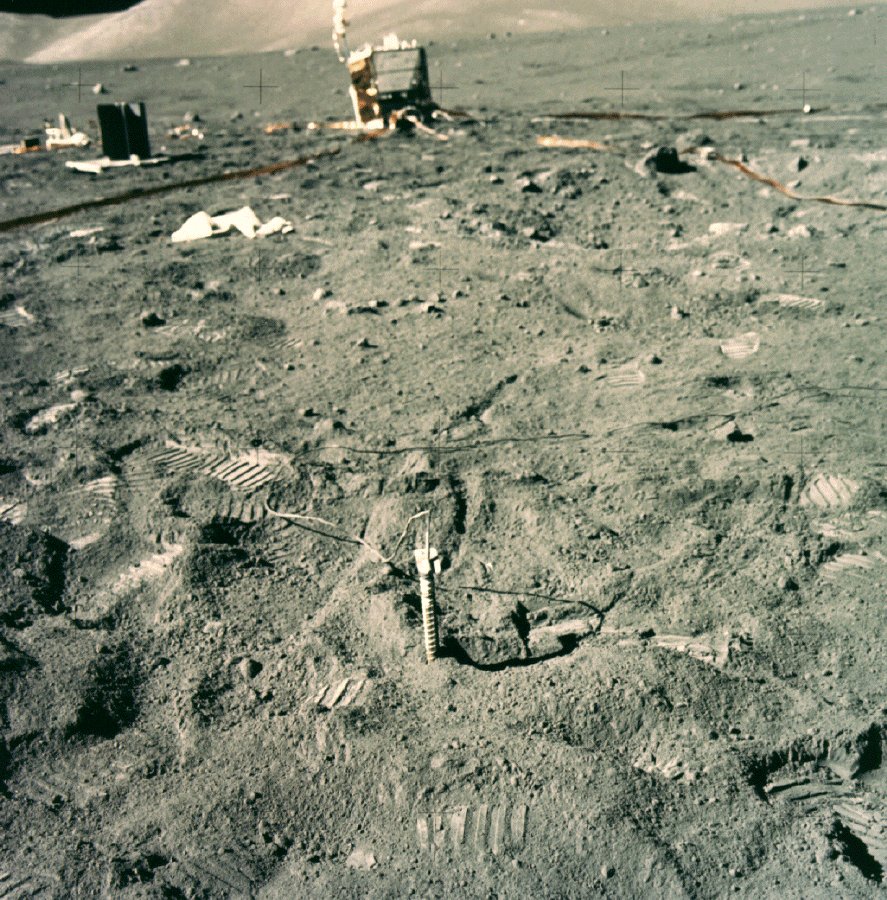
34. Surface Experiments: A Heat Flow Probe was inserted into the lunar regolith to determine the rate at which the moon lost its internal heat to space. This gives valuable information on the level of tectonism of the planet.
33. Surface Experiments: A Cosmic-Ray Detector was attached to the leg of the lunar lander, which measured the composition of the cosmic rays on the surface. The particle composition/energy was determined by the shape/depth of the track it left.
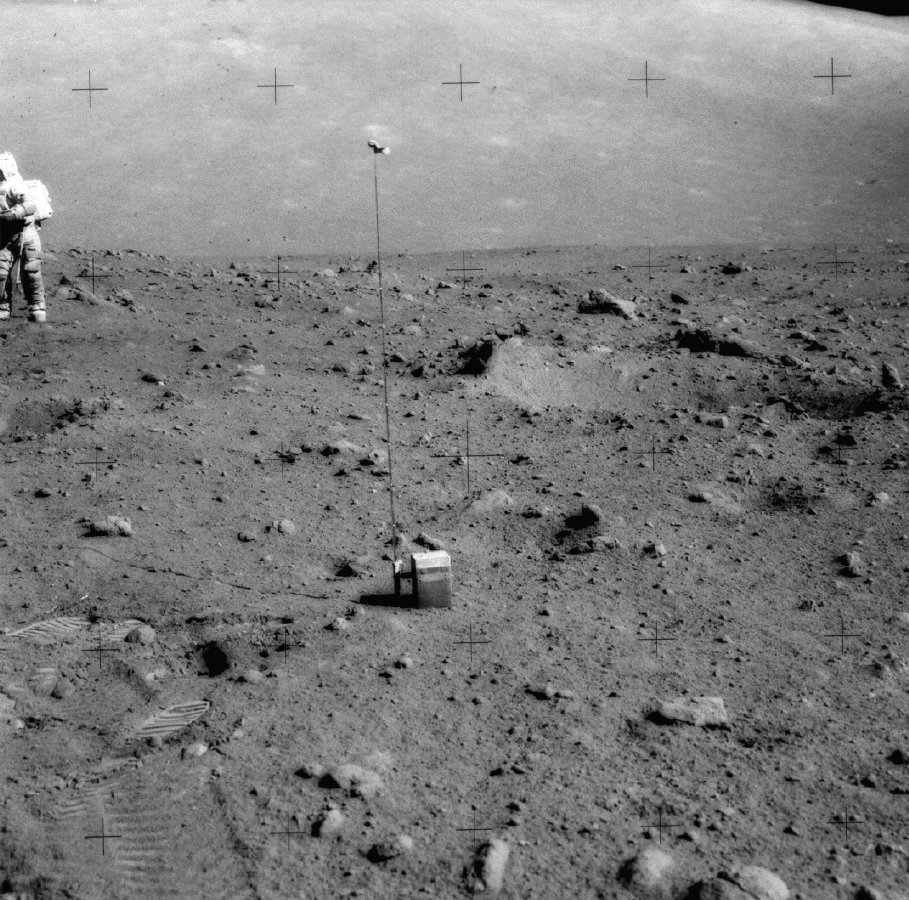
32. Surface Experiments: Apollo 17 used a Lunar Neutron Probe to measure the penetration of neutrons into the lunar regolith, to measure its overturn rate. The lunar regolith is the uppermost few meters of the surface. Seen in the photo is the probe on the surface.
31. Orbital Experiments: The Apollo Lunar Sounder Experiment used a radar that sent radar waves to the moon that reflected back to the service module to study the structure of the upper kilometer of the lunar crust. Seen in the photo is the VHF antenna attached to the module.