Beyond accuracy, AlignAIR provides calibrated likelihood scores that reflect true alignment confidence, a critical feature for interpreting results.
Explore the paper or try our easy-to-use web app!
📄 Paper: https://t.co/PmieHKzjQ6🖥️ Web App: https://t.co/R2dHkk5B97
Big news! Our paper on enhancing immune receptor alignment with deep learning is out in #NAR!
We introduce AlignAIR: a new state-of-the-art tool for AIRR-seq analysis that we've been working on for the past two years.
#Bioinformatics#DeepLearning
AlignAIR sets a new state-of-the-art. Benchmarks show it significantly outperforms existing tools, especially at high mutation rates. #Genomics#Immunology
Explore GenAIRR and generate your custom sequences and datasets, taking your immunogenetic analyses to the next level! Open-source and designed to integrate seamlessly with research routines. Read the paper: https://t.co/cvidcRu9dZ | GenAIRR: https://t.co/hNUe7j2HWo
Big news! I'm excited to share our latest research, "An unbiased comparison of immunoglobulin sequence aligners," now published in Briefings in Bioinformatics! Co-authored with Ayelet Peres, this work sets a new benchmark for Ig sequence alignment evaluations. 🧬✨#Bioinformatics
Our analysis revealed strengths and limitations in each aligner, emphasizing how noise and mutation rates impact their accuracy. GenAIRR now should drive the improvement and future development of new Ig alignment algorithms.
Oldies but goldies: Shepard, Donald, A two-dimensional interpolation function for irregularly-spaced data, 1968. A popular interpolation method based on radial basis functions. https://t.co/FSKi0SZ5Xv
Laplacian eigenmaps perform non-linear dimensionality reduction ("manifold learning") by embedding data points using the eigenvectors of a graph Laplacian as coordinates. https://t.co/fE1B9r1gdi
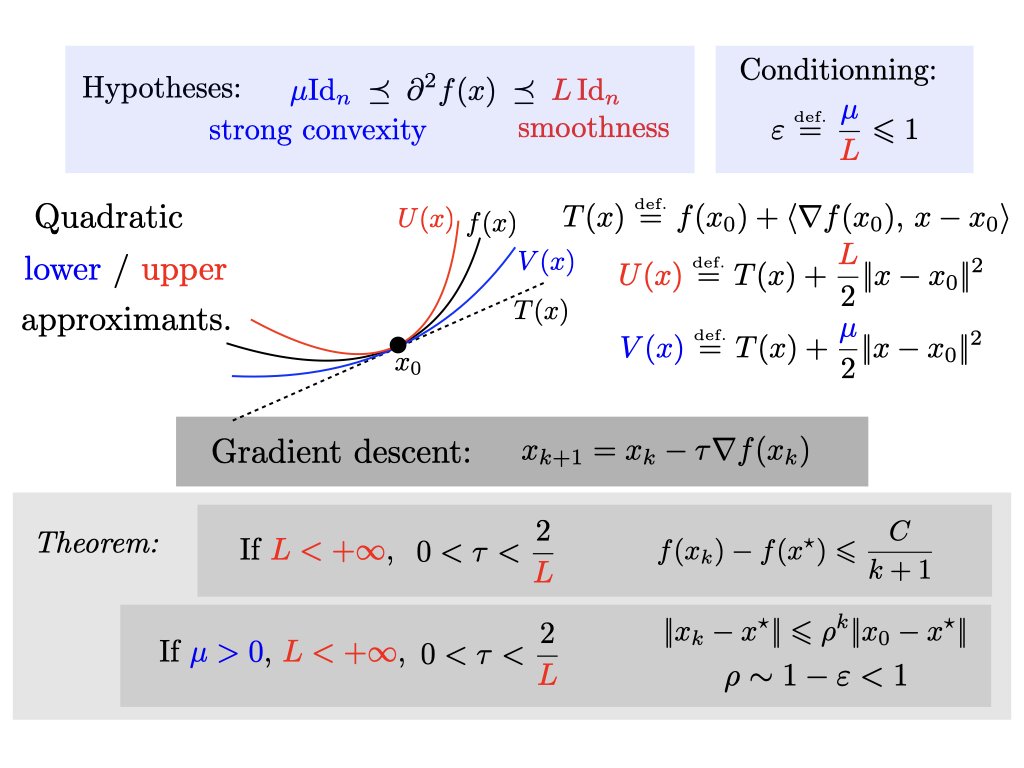
Strong convexity and smoothness are the two key hypotheses to make optimization well-posed and obtain a linear rate of descent schemes. They define upper and lower bounding quadratic approximants. Generalizes the condition number of linear systems. https://t.co/Q0Wh7SNyai
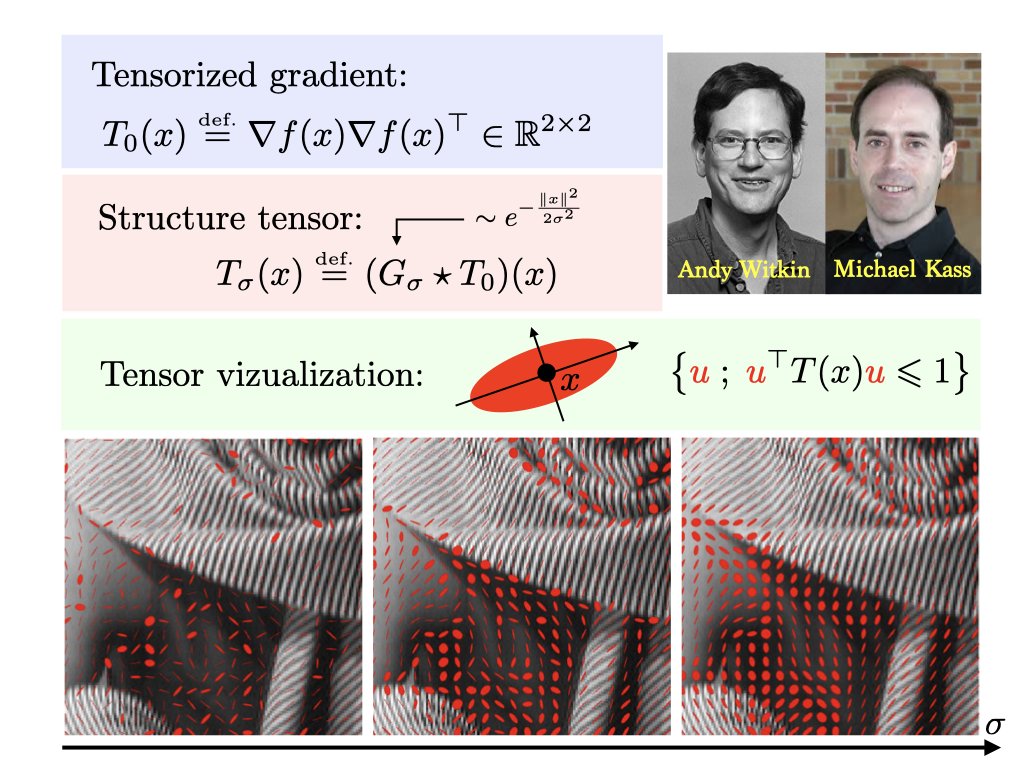
The structure tensor is the local covariance matrix field of the gradient vector field. It encodes the local anisotropy of an image. At the heart of anisotropic filtering and corner detection. https://t.co/RRVod47iMi
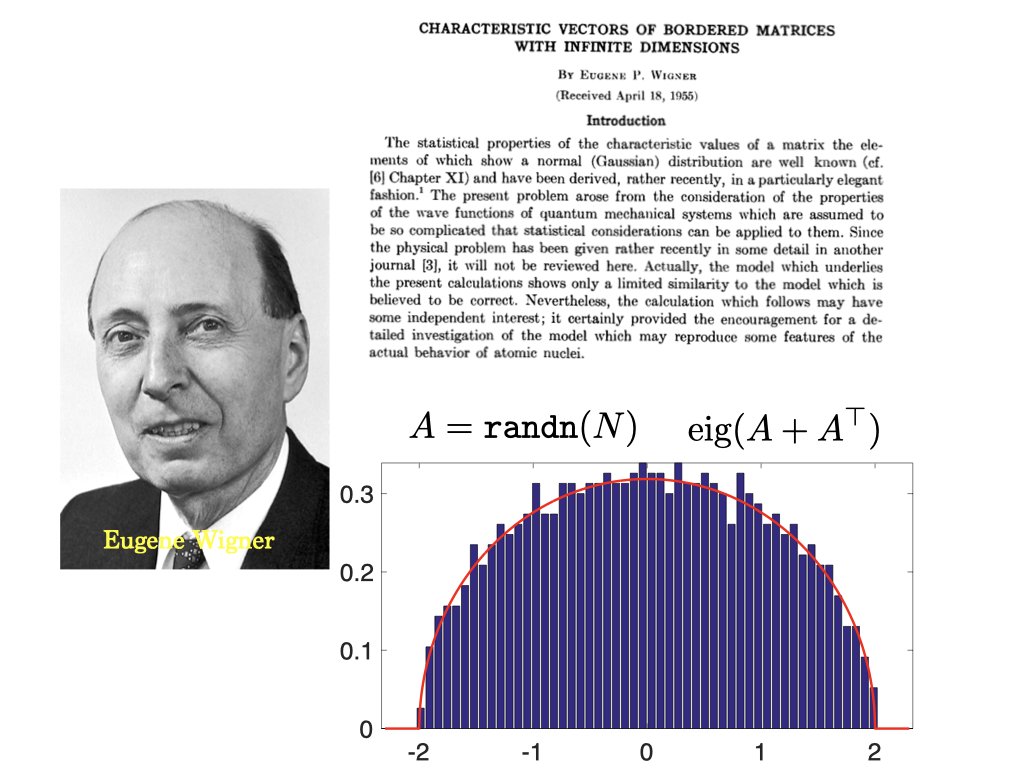
Oldies but goldies: Eugene Wigner, Characteristic Vectors of Bordered Matrices with Infinite Dimensions, 1955. The empirical distribution of eigenvalues of random symmetric matrices converges to a half-circle density. https://t.co/DBYQqzKgjE
Oldies but goldies: Shepard, A 2-dimensional interpolation function for irregularly-spaced data 1968. Shepard interpolation uses singular radial basis functions inversely proportional to distances. Generalizes Nearest neighbors https://t.co/FSKi0SYy7X
New work from my lab on "Weakly supervised identification and generation of adaptive immune receptor sequences associated with immune disease status" led by @rlyhighvariance and @PRobertImmodels. Great collaboration with @SandveGeir and L. M. Sollid. See 🧵 below.
The Ising model is one of the most celebrated model from statistical physics exhibiting a phase transition at a critical temperature in dimension 2 and higher. Models variety of phenomena from ferromagnet to neural networks. https://t.co/LxTOcetGZO