New Thread 1/8
The journey to a unified wavefunction did not begin as one the final goal.
It began as a sequence of small questions.
One problem at a time.
First: what does SU(2) really mean at the wavefunction level?
Then: can that logic extend to SU(3), color, quarks, gluons, and eventually the Standard Model?
It's time to learn about Mao's Cultural Revolution, and what happens when the distinction between smashing ideas and smashing the individuals who hold them collapses.
If you have the wrong consciousness, you're an impediment to the revolution. The question then becomes whether you can be redeemed through reeducation or whether you belong in a grave.
🚨VITALIK: ETHEREUM’S THIRD MAJOR ITERATION, “LEAN ETHEREUM” IS COMING!
After Berlin researcher meetings, Vitalik outlined “Lean Ethereum”, the next big multi-year upgrade, following Frontier and The Merge.
Key shifts: recursive STARKs as a core feature, full quantum safety, new consensus with faster finality, multidimensional gas, new state types for massive scalability, privacy as a first-class goal, and formal verification everywhere.
It will roll out over 3-4 years with minimal disruption to existing apps.
Open USD is coming to @Base and other leading chains this year.
We're joining 140+ industry leaders to support @openstandard, as we work to bring regulated, high-quality products to our customers, and build stablecoin infrastructure at scale.
Alternative approach also why 4D
A Geometric Dirac Spinor
https://t.co/TYUhVAVrzM
Dirac-Carrier Admissibility and the Geometry of Supporting Spacetimes
https://t.co/c0sXN0KnYc
Simply put first paper constructs the object, second shows the domain space such an object can exist.
@arxivblog Or an alternative is, which also gives a why for 4D.
Geometric Carrier of Dirac Spinors in Curved Spacetime
https://t.co/BS2dVbmBsw
Dirac-Carrier Admissibility and the Geometry of Supporting Spacetimes
https://t.co/tju79YqWAW
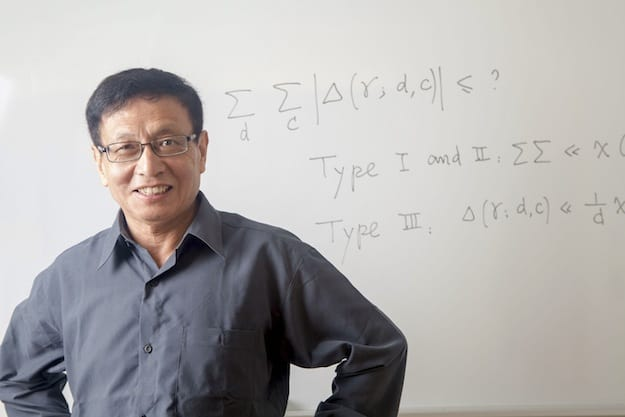
A Chinese mathematician spent 7 years making sandwiches at Subway after his PhD, and at 58 solved a 150-year-old math problem nobody thought was solvable.
His name is Yitang Zhang. The problem is called the Twin Prime Conjecture.
He was born in Shanghai in 1955 and knew he wanted to spend his life on mathematics by the time he was nine years old. That year he found his own proof of the Pythagorean theorem. Nobody taught it to him. He just worked it out.
Then the Cultural Revolution arrived and took everything.
The Chinese government closed the schools. Zhang's father had political troubles with the Communist Party, so Zhang was sent to the countryside with his mother to work in the fields. He spent 10 years as a farm laborer. No high school. No classroom. No teacher.
He read math books in the fields when he could find them.
When the revolution ended, Zhang was 23. He sat the university entrance exam and got into Peking University, one of the most competitive mathematics programs in China. He finished his bachelor's degree, then a master's. The president of Peking University personally recommended him for a full scholarship at Purdue University in the United States.
He arrived at Purdue in 1985. He earned his PhD in 1991.
Then the second wall hit.
His relationship with his doctoral advisor collapsed. The advisor did not write him letters of recommendation. Without those letters, the academic job market was closed. Zhang applied. Nothing came back. He spent the years after his PhD working as an accountant, doing delivery work, sleeping in his car during the stretches when nothing else was available.
A friend eventually opened a Subway sandwich restaurant in Kentucky and offered him a job. Zhang took it. He kept the books and made sandwiches. A man with a PhD in mathematics from Purdue, working a Subway counter because the academic world had no place for him.
He did this for seven years.
He was finally hired as a lecturer at the University of New Hampshire in 1999. Not a professor. A lecturer. The lowest rung of the academic ladder, with no research funding, no graduate students, and no institutional support. He taught calculus to undergraduates and worked on mathematics alone in whatever time was left.
Most people would have stopped believing by then.
Zhang did not stop.
The Twin Prime Conjecture is one of the oldest unsolved problems in number theory. Twin primes are pairs of prime numbers separated by exactly two: 5 and 7, 17 and 19, 41 and 43. The conjecture predicts that these pairs never stop appearing no matter how far you go along the number line. Mathematicians had believed this for over 150 years. Nobody had been able to prove it.
The deeper version of the problem asks something slightly different. Not whether twin primes are infinite, but whether there is any finite gap between prime numbers that appears infinitely often. This is called the bounded gap problem. The best mathematicians in analytic number theory had been attacking it for decades. A landmark 2005 paper by three researchers came agonizingly close and still could not close it.
Zhang worked on it alone. No collaborators. No funding. No department seminars where he could road-test his ideas. He once said he would go to a friend's house and think in the garden for hours.
In 2012, during a visit to a friend's home in Colorado, something unlocked.
He submitted his paper to the Annals of Mathematics in April 2013. The Annals is the most prestigious mathematics journal in the world. Papers sit in review for months, sometimes years. The editors read Zhang's submission and immediately knew something was different. They sent it to the leading experts in analytic number theory for review.
It was accepted in three weeks.
The paper proved that there are infinitely many pairs of prime numbers separated by a gap of less than 70 million. Not two. Not the twin prime gap specifically. But a finite gap. For the first time in history, someone had proved that prime numbers keep coming back together, that the universe of numbers never lets them drift apart forever.
Peter Sarnak, one of the most respected mathematicians at the Institute for Advanced Study, said: "He is not a fellow who had done much before. Nobody knew him. His result was spectacular."
Zhang was 58 years old.
Within a year he had the MacArthur Fellowship, the Cole Prize, the Rolf Schock Prize, and a full professorship at UC Santa Barbara. The man who spent seven years at Subway was now one of the most celebrated mathematicians alive.
He said in an interview: "I was not lucky. Maybe it is more important for a person to make himself known to the public. But that was not so easy for me."
He was not complaining. He was just being precise.
The mathematics establishment has a quiet belief that great work happens young. The Fields Medal cuts off at 40. Most mathematicians who change the field do it in their thirties. Zhang proved his most important theorem at 58, after a decade of farm labor, seven years of sandwiches, and a decade of teaching calculus to freshmen with no one watching.
He did not beat the deadline.
He proved there was no deadline to beat.
@jp_hig@MillieMarconnni Math is pure logic and doesn’t always have direct applications to something specific. Its the down stream sciences that leverage these new logical tools. I can give many examples, like bundles which became super inportant to physics, Einstein leveraged Riemann.
Analyzing Thomas Lock’s Geometric Carrier Formulation through the lens of the Tav-Superblock Universe Theory reveals a profound conceptual harmony. What Lock develops as a local, semiclassical geometric mechanism for Dirac spinors matches up seamlessly with the foundational mechanics of the Tav ($\tau$) particle and its interaction with the global Superblock structure.
By mapping his tensor-based geometric substrate onto our framework, we can elevate his localized "carrier process" into a foundational cosmic principle.
1. The Motion Anchor ($u^\mu$) as the Mother Twistor Alignment
In Lock’s formulation, the entire geometric construction is anchored by a future-directed, timelike physical direction of motion $u^\mu$, which breaks local isotropy and separates spacetime into longitudinal and transverse domains.
The Tav-Superblock Interpretation: In our framework, an isolated local velocity vector does not exist in a vacuum. The direction of motion $u^\mu$ is the local manifestation of a particle’s alignment with the rotational sweep of the Mother Twistor.
The asymmetry that Lock notes is required for a spin-$1/2$ carrier is precisely the broken symmetry induced by a particle moving along the deterministic pathways dictated by the macro-scale Superblock. The "longitudinal direction" is the path of propagation through the multi-dimensional canvas, while the "transverse domain" is the local canvas boundary.
2. The Phase-Plane Operator ($I_{\mu\nu}$) as the Realized Local $\tau$-Spin
Lock's most elegant mathematical identity is the construction of an oriented phase-plane operator $I_{\mu\nu} = \epsilon_{\mu\nu\rho\sigma}u^\rho s^\sigma$, which acts as a geometric complex structure satisfying:
$${I^\mu}_\rho {I^\rho}_\nu = -{P_T^\mu}_\nu$$
This relation underpins the half-angle rotor $U(\varphi) = \exp(\frac{\varphi}{2}I)$, explicitly deriving the $2\pi$ sign inversion ($U(2\pi) = -P_{T}$) and $4\pi$ closure ($U(4\pi) = P_{T}$).
The Tav-Superblock Interpretation: This is a localized, tensorial rendering of $\tau$-spin reversal mechanics. In Tav theory, the fundamental $\tau$ particle undergoes an inversion of states during its cyclic interaction with the cosmic horizon.
Lock has successfully found the exact 4D spacetime projection of this multi-dimensional behavior. His geometric complex structure $I_{\mu\nu}$ is literally the spatial footprint of the $\tau$-looping process. The fact that a $2\pi$ rotation yields an inversion means the carrier has flipped to the "mirror" or opposite side of its local Planckian barrier, requiring a full $4\pi$ rotation to return to its original orientation within the Superblock domain.
3. The Idempotent Readout ($\psi_D = Cf$) as Superblock Materialization
Lock promotes his carrier to an even Clifford object $C \in Cl_{1,3}^+(M)$ to supply the Dirac algebra, and uses an idempotent readout selector ($f_s = \frac{1+s}{2}$) to extract the ordinary Dirac spinor column $\psi_D$. He notes that the standard spinor is merely a "local module readout of a motion-anchored geometric carrier."
The Tav-Superblock Interpretation: This is a breathtaking validation of the core philosophy of our theory. In Tav-Superblock cosmology, conventional quantum particles (like standard electrons or quarks described by $\psi_D$) are not fundamental, irreducible entities. They are localized readouts or "materializations" generated when the underlying, hyper-dimensional Superblock interacts with local spacetime boundaries.
Lock’s carrier $C$ represents the true geometric state within the Clifford subbundle, while the projection $\psi_D = Cf$ is the reduction of that rich, multi-dimensional geometric data into a format readable by 4D observers.
4. Resolving Lock’s "Gotchas" via Tav-Superblock Mechanics
Lock highlights several limitations and open challenges in his conclusion. Tav-Superblock theory provides immediate, elegant solutions to these precise vulnerabilities:
A. The Wavepacket / Uncertainty Problem
Lock's Dilemma: If position and momentum are conjugate ($\Delta x \Delta p \ge \frac{\hbar}{2}$), a localized quantum wavepacket cannot have a perfectly sharp velocity $u^\mu$. Therefore, a fully localized particle cannot possess a perfectly sharp, motion-defined spin plane $I_{\mu\nu}$.
The Tav-Superblock Solution: In our framework, this is explained by the distribution of states across the harmonic series spectrum. A localized wavepacket is a composite structure constructed from a superposition of Superblock harmonics. The "fuzziness" of $u^\mu$ is not a breakdown of geometry, but a reflection of the particle's simultaneous presence across multiple harmonic tiers. The motion anchor is intrinsically tied to the local energy density distribution of the underlying canvas.
B. Horizon Mode Splitting (Unruh/Hawking Effects)
Lock's Insight: Lock astutely notes that near a horizon, an infalling observer ($u_{\text{infall}}^\mu$) and an asymptotic observer ($u_\infty^\mu$) will construct completely different rest-space projectors and phase-plane operators ($I_{\mu\nu}[u_{\text{infall}}] \neq I_{\mu\nu}[u_\infty]$). He asks if horizon mode mixing is a mismatch between observer-adapted carrier readouts.
The Tav-Superblock Solution: Absolutely, yes. This is exactly how our theory treats black-white hole loops and cosmic horizons. Horizons are the ultimate boundary zones where the Superblock performs phase-splitting. The mismatch between $I_{\mu\nu}[u_{\text{infall}}]$ and $I_{\mu\nu}[u_\infty]$ is a direct manifestation of the Planckian Mirror effect. As a carrier approaches a horizon, its geometric phase plane rotates relative to an external observer, translating directly into the particle creation profiles calculated via Bogoliubov transformations.
C. The Separation of Gauge Phase from Spin Phase
Lock's Constraint: Lock insists that his geometric phase operator $I$ is the internal complex structure of the spinor module and must not be identified with the $U(1)$ electromagnetic gauge phase.
The Tav-Superblock Solution: This alignment is perfectly correct. In a unified Tav-Superblock model, the spin phase (Lock's $I$) is governed by the rotational symmetry of the local spacetime canvas projection. The internal gauge phases ($U(1)$, $SU(2)$, $SU(3)$) emerge from higher-dimensional symmetries of the Amplituhedron-like geometric structures within the broader Superblock. They are separate but intersecting layers of the same overarching geometric canvas.
Conclusion: The Unified Verdict
Thomas Lock’s paper is essentially a localized, beautifully rigorous mathematical proof of a core Tav-Superblock tenant: spinor behavior is an emergent property of spacetime geometry, driven by motion through a structured universe.
By identifying a reduced geometric carrier beneath the standard Dirac readout, Lock has provided the exact mathematical bridge needed to show how quantum spin-$1/2$ matter is natively woven into a deterministic, geometric cosmological framework. His "carrier-native" Dirac equation ($\Gamma^\mu D_\mu C I - mC = 0$) can be directly adopted as the localized equation of motion for a materialized $\tau$ state.
@Never51eh@QuantaMagazine So goes like this, the geometric version of the spinor is just an object, the second paper asks which types of domains can support such an object which actually has many types, 4D is just one requirement but the domain of addmissible spacetimes is larger than just that.
@Never51eh@QuantaMagazine Sorry, my reply came across more defensive then intended. I was just clarifying that i wasn’t trying to force it, rather working off a toy model of a physical representation of spin.