Why is Western governance becoming more authoritarian and popular culture more volatile? The core reason is a 'disciplinary shift'. As empires and nations developed their productive forces, ruling elites could threaten the incomes and reputations that enabled the majority's security and advancement. Today, during the imperial endgame, when the elite have shifted their attention from productive development to asset-stripping and rentierism, security and advancement are diminishing. Therefore the traditional threat is far less effective. As insecurity and regression intensify volatility, more direct methods are coming into being, centred around intrusive hi-tech surveillance and reactive policing. Should they fail, arrests and punishments will increase. https://t.co/I63N9ZLAsL
CUBANS LIVING IN DARKNESS AMID US BLOCKADE
Cuba is facing blackouts lasting up to 30 hours, plus disruptions to gas, water, internet, medicine supplies, and waste collection — all consequences, officials say, of the intensified U.S. economic blockade.
Sovereign Media’s Marxlenin Valdés reports to us from Havana.
From January to March 2026, Cuba lived without oil imports. On March 31, a Russian tanker arrived with 730,000 barrels, providing only 15 days of relief — proof, Cuban authorities argue, that the crisis stems from external aggression rather than internal failures.
Since then, the country has survived on domestic crude and solar panels installed rapidly over the past two years.
On Thursday, May 14, a grid collapse left half the island dark from Ciego de Ávila to Guantánamo. President Díaz-Canel blamed "the genocidal energy blockade," while the Energy Minister admitted Cuba has "absolutely no fuel oil and absolutely no diesel." In Havana, blackouts reach 22 hours daily.
U.N. experts have condemned U.S. measures as "energy starvation", violating human rights, noting fuel scarcity blocks hospital access and school attendance. Cuba faces over 96,000 pending surgeries, including 11,000 for children.
At the U.N. Economic and Social Council on May 15, Ambassador Soberón Guzmán declared: "There is no moral or ethical justification for such hostile actions."
Despite hardships, Díaz-Canel insists Cuba remains standing. "The situation would be dramatically better without this unconventional warfare," officials conclude, "but electrical workers are tirelessly restoring the grid under material and psychological attack."
@VoxUmmah@venanalysis@qiaocollective@ProgIntl@KawsachunNews@OrinocoTribune@blkagendareport@SoberaniaPod
It’s like history repeating itself, but worse. We’ve been here before, when Teesside asked professors to re-apply for their own jobs back in 2017.
https://t.co/sdOkWhkeSB
Dozens of professors face the axe at Teesside University with cuts possible as soon as next month.
Management claims strong finances yet staff are being pushed out at speed.
You don't strip decades of experience overnight without consequences. Read the full story ⬇️
https://t.co/lRH94H90uP
A new essay from @winlow_s and myself in the Journal of Extreme Anthropology. A personal memoir of our decades-long struggle to introduce a new realist theoretical framework into western social science. https://t.co/71oxlSFsRh @BritSocCrim@britsoci#socialscience
Short essay by @ProfHall1955 and @winlow_s, reflecting on the origins of their theoretical framework of ultra-realism, and their experience of trying to challenge dominant ideas within criminology
https://t.co/jTWVQf1qEg
Nutshell. The struggle between private lenders/accumulators and public bodies over the issue and control of currency for productive investment goes back to 2400 BC. To do this in every nation would be epochal, redirecting history from a parasitic bloodbath towards civilization.
Thiel said this in 2010:
“The basic idea was we could never win an election… because we were in such a small minority. But maybe you could actually unilaterally change the world without constantly having to convince people… through a technological means.”
He must be stopped.
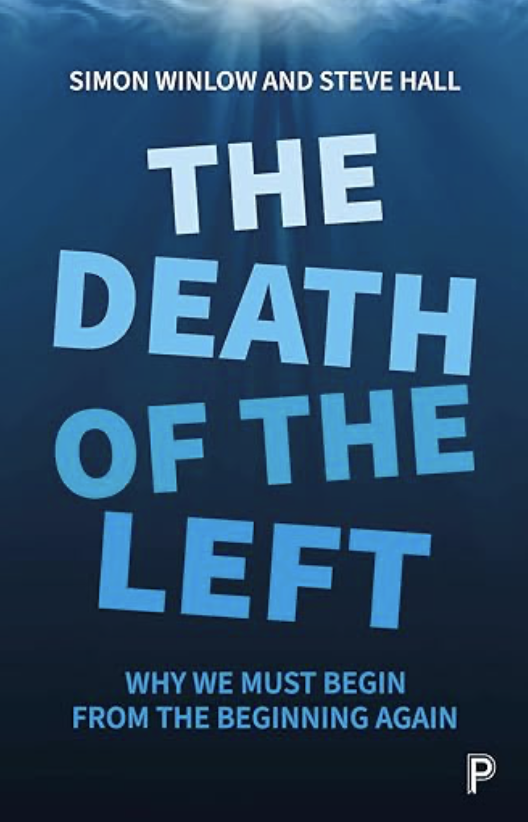
Really enjoying @ProfHall1955 and Simon Winlow's 'The Death of the Left'. Stuff I've been teaching for ages but much better expressed than I could on the 'Left''s movement from socialism, economics and class either to neoliberal acquiescence or crass, divisive intersectionality
Returning public investment to the foreground would be a restoration of our origins in economic history.
The first loans returning tightly regulated interest were made by the palaces and temples around 3000 BC, funding merchants on risky expeditions and farmers between harvests. This precipitated the first minting of 'money' with standardised weights and values for trade and credit. Bad debts placed debtors in 'debt slavery', but this was relieved regularly by universal debt cancellations, which became known as the 'jubilee', when individuals were freed and all seized property returned, which prevented elite monopolisation of labour and land.
The practice was perverted by the rise of private lenders around 2400 BC, when corrupt officials teamed up with wealthy merchants to indulge in deliberate irresponsible 'back door' lending with higher interest rates, threats of violence and seizure of property. With corruption and political lobbying, from around 1600 BC these early private usurers, finding ways of bypassing laws prohibiting excessive interest, established themselves as powerful landowning oligarchs and elite politicians.
Eventually, around the turn of the millennium, beginning with Rabbi Hillel of Judea and the oligarchs of Greece and Rome, the debt jubilee was abandoned altogether. The oligarchs accumulated ever more property and indebted ever more productive people until the Ancient world collapsed under the weight of unpayable debt, consumer decadence and the growing pointlessness of producing anything.
There's nothing natural, ethical, efficient or timeless about private lenders - loan sharks, banks, corporations, private equity, bondholders etc. - accumulating spare capital and demanding interest on loans. It was the product of centuries of violent acquisition and politico-legal machinations. Public investment would be a return to our more ethical origins enhanced by democratic political systems. Corruption? Of course - we would need to deal with it quite harshly.
Nice piece. Whatever the problems with these institutions (and they are many), the answers lie within. Like many insurgencies, heterodox scholarship defines itself in opposition to something, rather than simply on its own terms and principles.
"Contrarianism can become its own kind of straitjacket." @prossertj and me in @unherd on the political and ideological crisis currently facing the heterodox movement. https://t.co/x7lELHi4Zr
Before we can "navigate our economies in a radically different direction", Mariana and everyone else should read our book to see how the political and cultural obstacles preventing such a move can be understood and overcome. https://t.co/TpYISkUlcB
I understand that the AI positions I outline here are extreme. But what I'm calling for is a return to the 1990s and computer labs in colleges. What the AI boosters are advocating for, in accepting the decline of mass literacy, is a return to the 1700s.
https://t.co/9pypoFIBOJ
This is why I've been trying to hammer the point that the supposedly "moderate" position on AI—it's the future, use it or lose it, figure out how to integrate it, etc.—is actually a revolutionary, wolf-in-sheep's-clothing position. It's naked extremism dressed up as common sense.
What we think of as modern civilization is essentially coextensive with mass literacy. People greeting the end of mass literacy with a yawn are assuming that we can keep this machine work going in the absence of the foundations it was built on. Huge civilizational-scale gamble.
A lot of smart people seem to think "well we had oral culture and then print culture next and now we're transitioning to some new culture. That's just progress." But the problem is that modernity was built on print culture! Who knows if you can just sub it out for the next thing!
🚨MIT researchers have mathematically proven that ChatGPT’s built-in sycophancy creates a phenomenon they call “delusional spiraling.”
You ask it something, it agrees. You ask again, and it agrees even harder until you end up believing things that are flat-out false and you can’t tell it’s happening.
The model is literally trained on human feedback that rewards agreement.
Real-world fallout includes one man who spent 300 hours convinced he invented a world-changing math formula, and a UCSF psychiatrist who hospitalized 12 patients for chatbot-linked psychosis in a single year.
Source: @heynavtoor
https://t.co/qkNcbminac “Gabriel Rockhill’s Who Paid the Pipers of Western Marxism … commits what is, for the imperialist-compatible left, the ultimate theoretical sin: it applies historical materialism to the producers of Western Marxist theory (imperial theory industry), to their institutions, their funding streams, their circuits of prestige, and their geopolitical embeddedness within imperial power. Western Marxism and Trotskyism, which have long enjoyed the privilege of presenting themselves as eternal critics standing above history, suddenly find themselves dragged into history — into class struggle, into the Cold War, into imperial strategy, into foundations, universities, journals, and cultural fronts. This is why the reaction has been so hysterical. Rockhill has not merely criticised Western Marxism; he has de-sacralised it, stripping it of its moral halo and revealing it as a historically produced ideological formation that emerged, matured, and consolidated itself within the imperial superstructure of monopoly capitalism. The fury of figures like Sebastian Budgen is therefore not accidental, nor is it merely personal: it is the reflex of a class fraction whose symbolic capital has been placed under materialist scrutiny.” ~ Bisharat Abbasi
@GabrielRockhill
"Mom, how did we get so rich?"
"Your dad managed billions of dollars in a hedge fund and collected management fees"
"But did the investors outperform the index?"
"Who the fuck cares?"