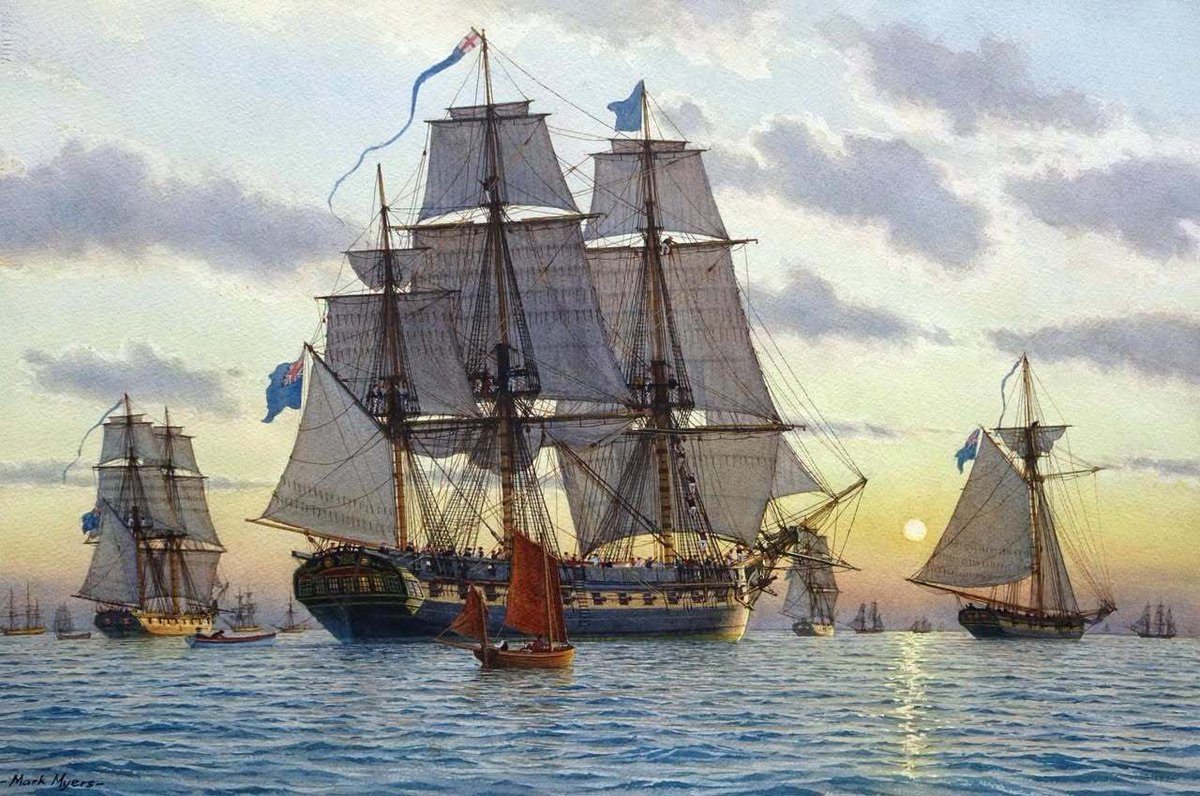
HMS Medusa (32) departs the Downs in August 1801, flying the Blue Ensign, her commission pendant, and the flag of a Vice-Admiral of the Blue from her fore topmast. A striking depiction of the Royal Navy at the height of the Age of Sail.
🎨 Mark Myers
#NavalHistory#AgeOfSail #RoyalNavy #MaritimeArt
A early wartime picture (possibly 1941) of the Revenge class battleship HMS Ramillies at anchor in Scapa Flow. While on Atlantic escort duties on February 8th 1941 she prevented the two Scharnhorst-class battleships from attacking convoy HX-106, which consisted of 41 ships, which was en route from Halifax, Nova Scotia, Canada to Liverpool. In May 1941 she also joined in the search for the battleship Bismarck.
The largest nuclear bomb in outer space exploded 64 yrs ago today.
Starfish Prime was a 1.4 megaton thermonuclear warhead, detonated at the altitude the Space Station now orbits. It created man-made radiation belts that wrecked many satellites & lasted 5+ years.
A year after the test the USA & USSR signed the Partial Nuclear Test Ban Treaty, leading to the global 1967 Outer Space Treaty.
https://t.co/d5XO4Vl0g1
Augusta off Portland, Maine, United States, 9 May 1945.
USS Augusta (CA 31) had one of the most remarkable careers of any American warship in World War II — she was present at more pivotal moments than almost any other vessel in the fleet.
Augusta was a Northampton-class heavy cruiser, displacing about 9,050 tons standard, armed with nine 8-inch guns in three triple turrets, and capable of around 32 knots. She was commissioned in January 1931 at Philadelphia. Before the war, she served as flagship of the Asiatic Fleet (1933–1940), patrolling Chinese waters during the Sino-Japanese War. Her commanding officer during part of that period was Captain Chester W. Nimitz, who would later command the entire Pacific Fleet.
Augusta's wartime fame began before America was even at war. In August 1941, she secretly carried President Franklin Roosevelt from New England to Placentia Bay, Newfoundland. There, anchored alongside HMS Prince of Wales, Roosevelt met Winston Churchill for the first time as heads of government. The resulting Atlantic Charter laid out shared Anglo-American war aims — self-determination, free trade, freedom from want and fear — and became a cornerstone of what would later become the United Nations.
When America entered the war, Augusta became flagship of the Western Naval Task Force under Rear Admiral H. Kent Hewitt during the invasion of French North Africa. Major General George S. Patton was also aboard as commander of the ground forces. On November 8, 1942, off Casablanca, Augusta engaged Vichy French warships in the Naval Battle of Casablanca, helping sink or cripple several French destroyers and damaging the unfinished battleship Jean Bart. Patton famously had to scramble to get ashore after his landing craft was hoisted back aboard during the firing.
After convoy escort duty in the Atlantic, Augusta moved to Britain for Operation Neptune, the naval component of the Normandy invasion. She served as flagship of Rear Admiral Alan G. Kirk, commander of the Western Naval Task Force, which landed American troops on Utah and Omaha beaches. Lieutenant General Omar Bradley used Augusta as his floating command post during the critical first hours of the invasion, watching the brutal struggle on Omaha Beach unfold from her decks. She also provided shore bombardment in support of the landings and during the subsequent advance.
Augusta then participated in Operation Dragoon, the Allied invasion of southern France, providing gunfire support for the landings between Toulon and Cannes.
Potsdam and the Atomic Bomb, July–August 1945
In July 1945, Augusta carried President Harry Truman across the Atlantic to the Potsdam Conference, where Truman, Churchill (later replaced by Clement Attlee), and Stalin met to decide the shape of postwar Europe and the final ultimatum to Japan. On the return voyage on August 6, 1945, Truman was eating lunch in the crew's mess when he received the message that Hiroshima had been successfully bombed. He reportedly leapt up and announced the news to the sailors around him, calling it "the greatest thing in history."
Augusta returned to "Magic Carpet" duty, ferrying American servicemen home from Europe, before being decommissioned in July 1946. She was sold for scrap in 1959 and broken up the following year.
Few warships can claim to have hosted the signing of the Atlantic Charter, fought a surface action against the French navy, served as the command post for D-Day, and carried a sitting president when he learned of the dawn of the atomic age. Augusta did all four.
The eclipse from Orion.
On April 6, external cameras attached to the Orion spacecraft's solar array wings captured the Moon backlit by the Sun during a solar eclipse.
Our Artemis II crew will be going around the Moon, but they'll always find their way back home 🌎
During this complex journey, the four astronauts will travel ~685,000 miles on a trajectory around the Moon and back to Earth.
See their daily agenda: https://t.co/172PVtri2Z
Posted on my birthday as well! 🥰 thank you so much @Iain_MacGregor1@HoZ_Books@GeorginaCapel for having worked hard on the paperback edition of #EagleDays! It will be published on 23rd April 🥰♥️
https://t.co/JOvF6cFiPv