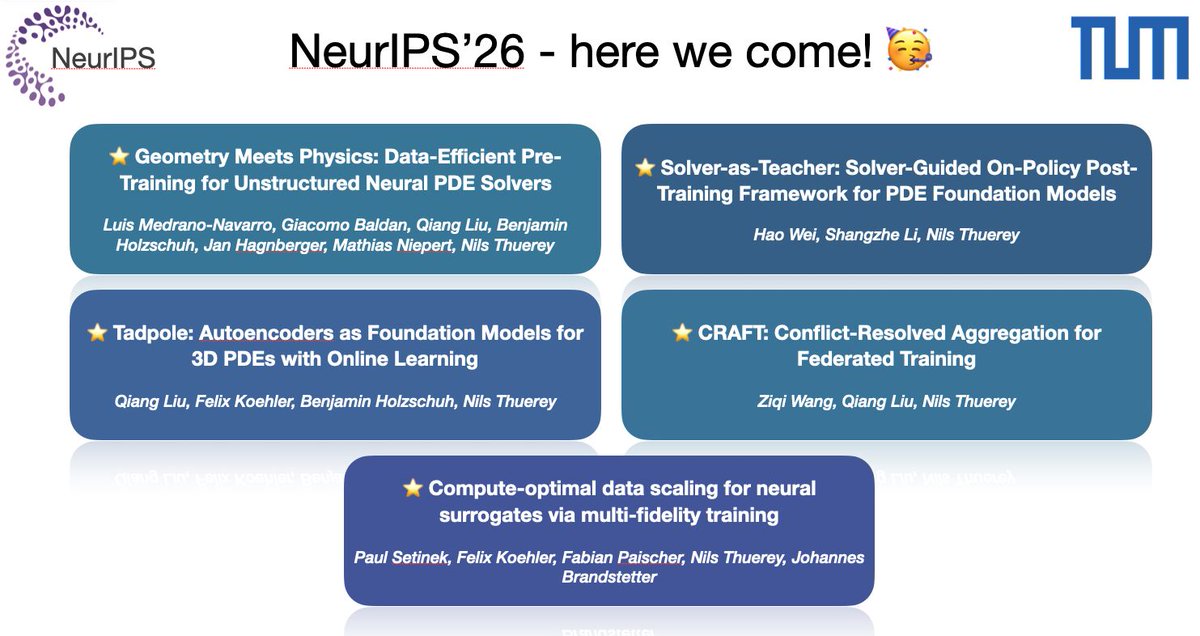
Time to celebrate our 5 accepted NeurIPS'26 papers 🥳 Covering a wide range of exciting topics: from foundation models, over optimizers, to multi-fidelity learning. Details to follow soon! https://t.co/NRTpdHTBzj
Ever wondered how to reliably evaluate your stochastic, temporal GenAI-surrogate? 😀 A brilliant Bachelor student at TUM, Sebastian Pfister, has created a stochastic chaotic system benchmark that combines robustness and ease-of-use, StocBench: https://t.co/4orXOL3uq5
🚀 The NeurIPS 2026 RealPDE Competition is now live!
Advance Scientific ML for real-world physical systems with paired PIV and CFD data.
🏆 Two tracks:
• Sim2Real
• Long-term Test-time Adaptation
💰 $21,000 prize pool
🎤 NeurIPS workshop presentation opportunities
Join us: https://t.co/pFWRnbdCrL
@NeurIPSConf #NeurIPS2026 #AI4Science #SciML #AI4Physics #AI4PDE
Congratulations to Mohammad for his ICML paper developing a novel, sensitivity-based approach for generative topology optimization 👍 https://t.co/Gw6t3wqNhY Our work investigates a fundamental question: What determines whether data-driven topology optimization models generalize?
Congratulations to Bernhard for his SIGGRAPH 2026 Paper 👍 PDF https://t.co/Rpsc8FgsNi , Video https://t.co/lilbSxIMs5
Our key ide: treat particles as samples in four-dimensional space-time. ST-FLIP acts as an effective temporal anti-aliasing mechanism for FLIP-style solvers.
Congratulations to Hao for his ICML Oral on rotationally equivariant transformers: https://t.co/rhLMdehki3 👍 The key idea is to transform physical fields into local canonical coordinate systems, enabling standard self-attention while preserving physical symmetries
I'm happy to introduce "CRAFT": a new federated learning optimizer that treats aggregation as a geometric correction problem instead of naive averaging. https://t.co/vOKMKtWFhT
What if pretraining scientific foundation models didn’t require massive datasets at all?
We show that this is not only possible, but has a range of neat benefits: our "Tadpole" models learn from canonical PDE data that is generated on-the-fly https://t.co/yVWdTaYcqd
For those who already checked out our AeroTransformer last week: please also try Yunjia's live "WebWing" demo at https://t.co/eil1pLK2yH ✈️
For completeness: full sources and more details available at https://t.co/mZ0SaIhD7W
I'm very excited to highlight our recent work on how useful NNs are for stability and resolvent analysis of non-linear systems. Chengyun established a firm connection between the theoretical basis and modern AI methods. https://t.co/gUaUPz9lAV
I'm excited to share our latest work: AeroTransformer — a step toward bringing the foundation model paradigm to real-world aerodynamic design.
Code & models: https://t.co/mZ0SaIhD7W Paper: https://t.co/97Gt64q2m8
Ever wondered if a Transformer model could successively refine a PDE solution, one scale at a time? 🤔 Mario's latest work shows: a single model auto-regressively infers and refines flow solutions over finer and finer sets of sample points https://t.co/9MCodA9JLK
I'm excited to highlight the code release of our scalable & efficient PDE Transformer (P3D) at https://t.co/ciFBd3GIiZ Please try out the pretrained models, and let us know how it works! Highlights are, e.g., stable inference of 1024^3 rollouts on a single GPU with 90GB 😁
We're happy to report that our Physics-based Flow Matching framework got an accept for #ICLR '26! Physics-Based Flow Matching (PBFM) is a principled framework that explicitly targets Pareto-optimal solutions between physics-constraints and data-driven objectives.
Fast rotational equivariance for physics GNNs — the source code is now available: https://t.co/fwbcQOmdWQ
Please check out the full Physics-of-Fluids paper here: https://t.co/U18FYNqyw1
In the paper we introduce a scalable hybrid CNN–Transformer architecture that pushes neural surrogate modeling into the regime of truly high-resolution 3D simulations. The P3D architecture overcomes previous memory and compute barriers that have limited Transformers for PDEs.
I'm very happy to report that our autoregressive predictions with generative diffusion models is _finally_ accepted 😁 Congratulations Georg!
It's been a long journey, this paper was first submitted to NeurIPS'23, and now got into "Neural Networks" https://t.co/UDcE2axYi1
Great to see our paper on physics-constrained reconstruction / super-res with generative models posted online now at https://t.co/N1qUKlWmw7 😁
- PDE Transformer as backbone architecture
- differentiable physics constraints to guide
- and ConFIG as optimizer to resolve conflicts
The SuperWing dataset is a large-scale, open dataset of transonic swept-wing aerodynamics, combining thousands of richly parameterized 3D wing geometries with high-fidelity RANS simulations across the operational flight envelope: https://t.co/vdhciXUkno