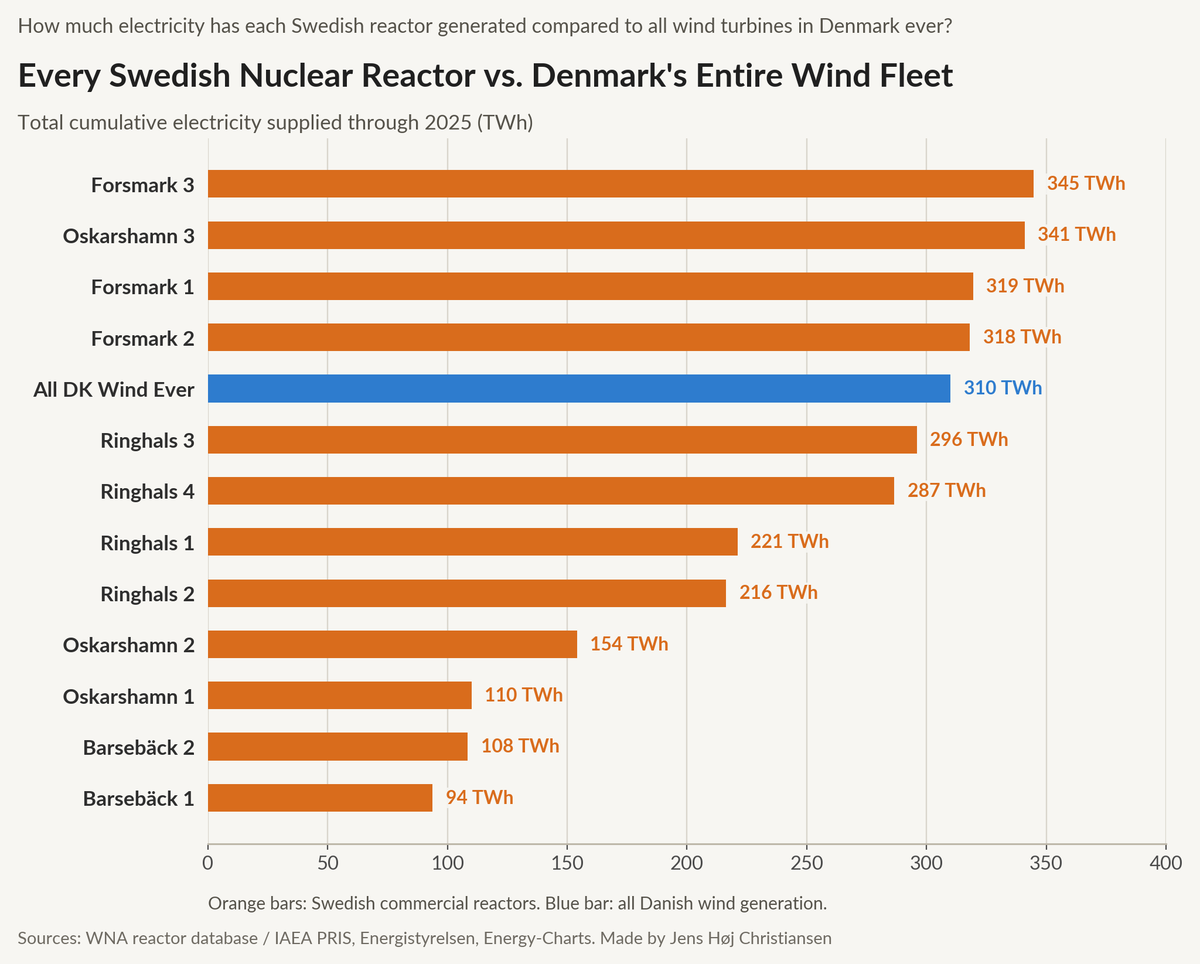
Fun fact: Sweden has four nuclear reactors that have each generated more electricity than all Danish wind turbines ever.
Forsmark 3 and Oskarshamn 3 started in 1985, the year Denmark banned nuclear. Both still ahead of Denmark’s entire wind fleet.
Prices of silicon wafers used in semiconductor production are set to rise in 2027 as more firms ink long term agreements (LTAs), media report, noting capacity expansion for both memory and logic chips is fueling demand.
12-inch Epitaxial wafers: estimated up 15%-25%
12-inch Polished Wafers: seen up over 40% for most, 50% for 2nd tier clients
GlobalWafers, Taiwan’s biggest maker, is seen at $122 average selling prices (ASPs) in 2027, up from $92 for 12-inch silicon wafers this year, and up to $166 in 2028. Shipments are seen rising to 16.174 million wafers per quarter next year, from 11.907 million per quarter this year. https://t.co/HXxlgTiCXx
If you’re an AI bear, idk how you stay a bear after you watch this…Gray of blackstone reveals that his companies grew their Anthropic spend 21x in a single year to a $525 million run rate “We had, amongst these 1,400 companies, $25 million of run-rate revenue in September of '25. That number is up 21-fold, annualized run-rate revenue, to $525 million of spend with Anthropic."
TSMC will begin 1.4nm (A14) trial production in the 1st quarter next year, media report, and equipment is already being moved-in to Hsinchu’s Fab 20 (P3). TSMC’s Fab 25 in Taichung, central Taiwan, will be the second 1.4nm fab, with phase 1 construction to finish in April, and trial production to begin as early as the 3rd quarter-2027. Taichung will be the main A14 cluster. The A14 timeline is ahead of schedule, something TSMC had noted during its 2nd quarter earnings call in July. $TSM #semiconductors https://t.co/4R2aLXQgp0
Korean media reports that Samsung is considering expanding its 4nm capacity and investing in a new 2nm production line to meet surging demand for HBM4 base dies and prepare for HBM5.
Amid strong demand, Samsung has reportedly recently raised prices for new 4nm foundry orders, as well as for HBM4 base dies.
Samsung also expects its Q3 HBM4 revenue to more than triple quarter over quarter, with HBM4 accounting for well over 60% of its total HBM revenue in the second half.
https://t.co/DFsYDF8mdj
The one who has enough CPUs and DRAM to support millions of users
The reason why Meta didn't launch Muse in WhatsApp is cuz they simply don't have enough hardware (CPUs, GPUs, DRAM, SSDs) to support agents for 2 billion people
“During periods of rapid growth, capital expenditures rise faster than Revs. This weakens near-term cash flow. The returns appear years later, after the new capacity is operating + generating Revenue. Investors who focus only on current cash flow see the worst part of the cycle.”
Headline: TSMC prices are up 10%, prompting AMD to hike Q4 chip prices. (Note this story cites last week’s news that AMD will raise prices 10% in response to higher supply chain prices to mean that TSMC has raised prices 10%. Not news.) $TSM $AMD https://t.co/ltEMBqOuqn
We're in Arena with a look at Palantir! Very fun collaboration—we were working backwards from how Palantir has been doing AI differently to how they're thinking about it, and the world, differently.
BofA's Simon Woo has put out a report, and there's some interesting content in it. To quote a portion:
- Recent checks with memory makers, spot market distributors, and OEMs point to firm 3Q ASPs: despite a rising LTA mix, 3Q ASPs for most DRAM products rose 20 to 30% quarter on quarter, and NAND rose more than 15%
- High single digit ASP increases expected in 4Q as well. Also a notable change: hyperscalers have signed new contracts agreeing to pay higher DRAM ASPs in 1Q27 than in 4Q26
- On 2H ASPs, the existing optimistic view is maintained, with no change to estimates. However, the stance on 1H27 has turned more positive given the persistent memory supply shortage and the aggressive race among OEMs and big tech to secure chips
- Accordingly, 2027 to 2028 DRAM/NAND ASP assumptions are raised by 8 to 12% and 2 to 3%, respectively. That said, ASPs are expected to decline around 10% in 2028 (DRAM down 5%, NAND down 13%), which is interpreted as a soft landing phase ahead of renewed growth in 2029 to 2030
Samsung Electronics to Double HBM4 and HBM4E Production Next Year
Samsung Electronics is expected to at least double its production of the HBM4 family next year compared with this year, including sixth generation high bandwidth memory (HBM4) and seventh generation HBM (HBM4E). This follows its plan to raise demand for "glass carriers," the glass supports that hold wafers while DRAM for HBM is thinned, to 2.5 times this year's level.
According to the semiconductor industry on the 20th, Samsung Electronics will increase its outsourced cleaning volume of glass carriers, which are essential to the HBM production process, from 20,000 units per month this year to 50,000 units per month next year. Only 10,000 glass carriers per month were needed last year, which means the volume doubles this year versus last year and rises 2.5 times next year versus this year.
A glass carrier is a support temporarily attached to the underside of a DRAM wafer for HBM to keep the wafer from warping or cracking while it is ground thin and holes are drilled through it. Because HBM must stack multiple DRAM dies within a limited thickness, wafer thinning technology and warpage control processes become more important as the stack count rises.
HBM4 and HBM4E, for which Samsung Electronics is especially preparing to expand production, center on high stack products of 12-High and above. The industry's analysis is that, even after accounting for the fact that glass carriers are reused after cleaning and that usage varies with how they are deployed at each process step and with yield, a 2.5 times increase in the related volume makes it highly likely that HBM4 and HBM4E production will be at least double this year's level.
In February this year, Samsung Electronics began mass production shipments of HBM4, which applies sixth generation 10nm class (1c) DRAM and a base die built on a 4 nanometer (nm, one billionth of a meter) process. In May, it also provided HBM4E 12-High samples to customers including Nvidia.
The industry expects Samsung Electronics' HBM production scale, measured by monthly average wafer input, to grow nearly 40% from about 180,000 wafers this year to about 250,000 wafers next year. In terms of shipment mix by product, some also forecast that the HBM4 family will rise from around 40% this year to about 80% next year as HBM4E mass production gets into full swing. An industry official explained, "As Samsung ramps up HBM production, it appears to be placing HBM4, a high value added product, at the center."
Korean media report that Stanley Druckenmiller is set to make his first visit to South Korea, with plans to visit major Korean companies including Samsung, SK hynix, and Doosan.
https://t.co/B7nLyYCNKN