We’re presenting the FOCUS-01 trial design and new preclinical data for AVA6103 (FAP-Exd) at the AACR Conference on Pancreatic Cancer.
https://t.co/baUM7yaam8
#PancreaticCancer#preCISION#AVCT#NextGenLoading
Delighted to see #AVCT mentioned in the EndpointsNews round up. AVA6103 data this week were received well. Team are thrilled with the progress. FOCUS-01 Trial continues to escalate. #NextGenLoading#LetsDoThis
https://t.co/l5JZGbQLh7
Ask a scientist why they stay in oncology and you will usually hear about a "wow moment". The people behind pre|CISION® share theirs, from the first tumor to plasma data to a new molecule from idea to IND in 12 months. Watch the video here: https://t.co/yQYPRuyU6Y #AVCT
AVA6103. Not just sustaining, but controlling:
Today #avct has shown that the enzymatic cleavage of a precision molecule has a tunable kinetic profile. Different combinations of capping group and linker determine how it binds in the FAP active site, how quickly cleavage happens, the kcat/Km, blood/implied tumour exposure, plasma protein binding etc. Gen 1 was a very efficient FAP substrate, kcat/Km around 39,000. Gen 2 is deliberately the opposite: low Km so it binds FAP tightly, lower kcat so it turns over slowly. And it adds more flexibility around the payloads that can be attached (partnered), either as single or dual-payload versions.
PK is almost the entire purpose of this release. The fundamental question is: how does Avacta extend the exposure of exatecan while maintaining the tumour specificity and biological properties of Gen 1?
ADCs hang around in the blood for days or weeks and sustain payload exposure partly through the long-lived antibody component. Enhertu has an ADC half-life of roughly 5-6 days. A small peptide PDC inevitably doesn't have that systemic residence time. So how do you overcome this?
That's the reservoir effect.
AVA6000 had an almost too quick, too efficient FAP cleavage reaction, resulting in a dose-dependent increase in plasma AUC and limited tumour retention. For exatecan this matters more, it's a potent payload with a very short half-life. If turnover is too fast, increasing the dose increasingly translates into more payload appearing systemically rather than more useful tumour exposure.
AVA6103 is designed to change that kinetic profile. The capping group binds in the FAP active site and anchors the intact PDC, creating a reservoir of intact drug in the tumour and slowing PDC clearance. Rather than the PDC circulating in plasma for days, you put the reservoir in the tumour. AVA6103 demonstrated duration currently extends to at least 48 hours, whether it approaches Enhertu 6 days isn't answered from what has been presented. With an ADC, that long systemic residence is part of the delivery mechanism, but it's also a prolonged window for linker cleavage, deconjugation and catabolism, with payload leaking into the systemic circulation. The #avct approach is different: clear the PDC from blood quickly, retain it at FAP, release exatecan locally over time.
The cohort PK data (slide 19/20). Parent PDC drops fast, "sucked" into the TME, even at low doses there's a very low/ sustained release of exatecan and peptide, both still measurable at 48 hours. The half-lives are what make that meaningful: released exatecan has a terminal half life of 9 hours and the peptide 3 hours, so if this were one early burst that then cleared, both would be gone well before 48 hours. Sustaining for at least 48 hours means cleavage is still happening somewhere. Cmax of released exatecan in blood also looks a little higher than the preclinical model predicted, and the parent PDC is detectable out to 48 hours, much longer than preclinical anticipated (Plasma protein binding ?)
The few hours are interesting. Initially exatecan in plasma is looks roughly the same ballpark as Enhertu, then AVA6103 falls away much faster, around 3x less at an equivalent payload dose. Not a clean head-to-head, and less exatecan in plasma doesn't automatically mean more in the tumour (it is a surrogate.) Whether AVA6103 just isn't sustaining systemic as long as Enhertu, or is creating a genuinely much more favourable tumour exposure profile, isn't really answerable from this (?). But it does mean safety looks much better than Enhertu at a similar stage.
No tumour:blood ratio yet. Would be surprising if they hadn't done at least one, so I don't know why they'd hold it back. Given the widening therapeutic index and ratio increasing with dose preclinically (no idea why), perhaps that's what they're waiting for ?
My hunch on the tumour side (could be miles off): I think AVA6103 has a higher intratumoural Cmax and a much faster tumour Tmax than Enhertu, but doesn't sustain as long.
Haven't seen anyone else flag this. "Extended PDC exposure at DL2 is driven by one patient, previously observed preclinically in a model with very low FAP expression." In that patient the parent molecule circulates for much longer and late timepoints go up rather than down. No idea why or how, but if real/reproducible it has big implications for the TAM. A PDC that stays intact longer when FAP is low, (so still cleavable when it meets sufficient FAP) is self-correcting exposure that could meaningfully increase efficacy in low-FAP tumour types !
Safety
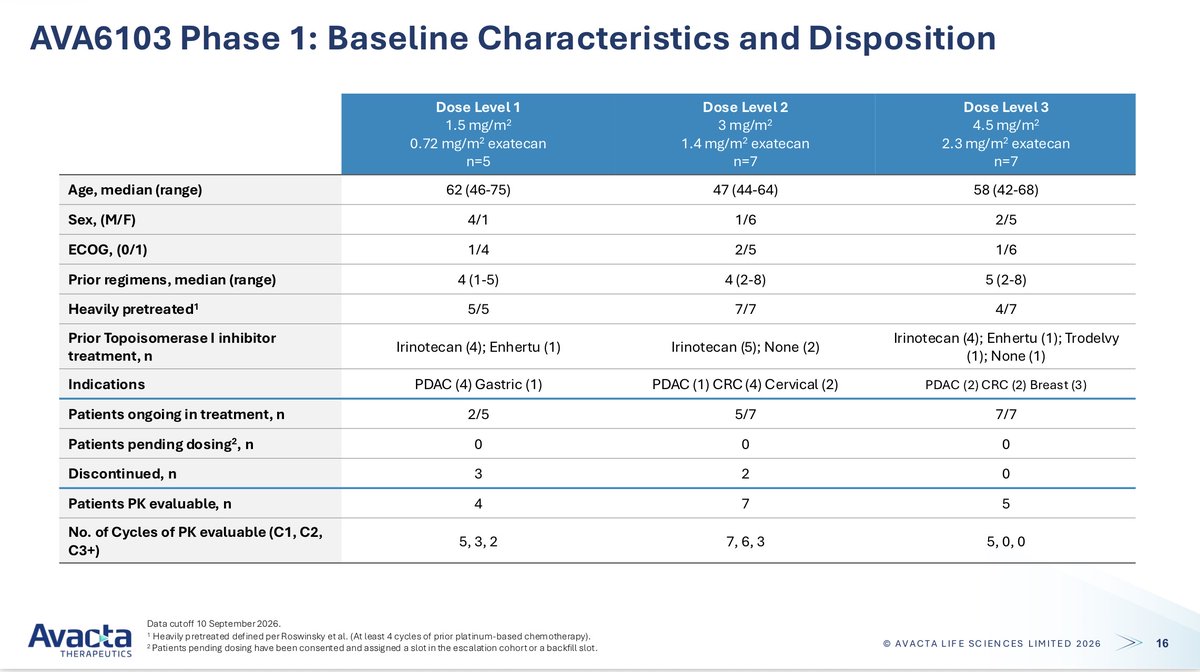
Looks good so far against Enhertu/Ecd. Across the first three dose levels (n=19), any grade: 0% neutropenia, 5% thrombocytopenia, 5% nausea/vomiting, 16% anaemia
Caveat: dosed ≠ released. The dataset is still very small, and newer Topo1 ADCs in development can have better safety profiles. C3 has only just started, cumulative exposure is barely tested, and there are only five PK-evaluable cycles at C3+ across the whole study. On the other side, 16/19 patients meet heavily pretreated definition (median 4-5 prior regimens), which would make the profile worse. Probably fairer/simpler to compare safety at RDE.
Efficacy
Unsurprisingly no meaningful efficacy data yet. I thought there was a chance of a case study, but it was always a long shot; I suppose I'd hoped they might be further along.
Very heavily pretreated patients. The dose levels that could have had a scan are at relatively low doses, and most of DL3 has only had one cycle/just started
Ultimately activity is the best answer to whether 6103 is delivering enough Exd, for long enough, in absolute terms. That's the tumour side. Everything presented so far is blood data, piecing together what's happening in the tumour from the plasma, and it's nuanced/complicated.
Future
The next step is to keep pushing dose until tumour exposure saturates and systemic leakage becomes limiting/myelosuppressive, then find that sweet spot between safety and efficacy: the therapeutic window and the RDE. The DL3 AUC / supra-proportional change is the first very early hint of this.
6103 has enormous potential. Still early + risks, but it's looking very good so far. Good first step on a long road. Next catalysts: a Gen 2/3 deal, 6207 and mature p1a data with efficacy/biopsies guided to H1 27. AACR or ASCO
The miserable reaction is probably a combination of the RNS timing leaking out somewhat, the imminent need for a capital, and the release being a little less mature/substantive than anticipated. A bit of a shame they were forced to bring this forward. A few extra months and it would likely have looked far more meaningful/impressive.
Congratulations to Chris and her team at #AVCT on what is an historic day for the company and pre|CISION.
Thank you to all shareholders for your patience and support along this journey to proving the replicability of our proprietary technology.
A true inflection point for AVCT.
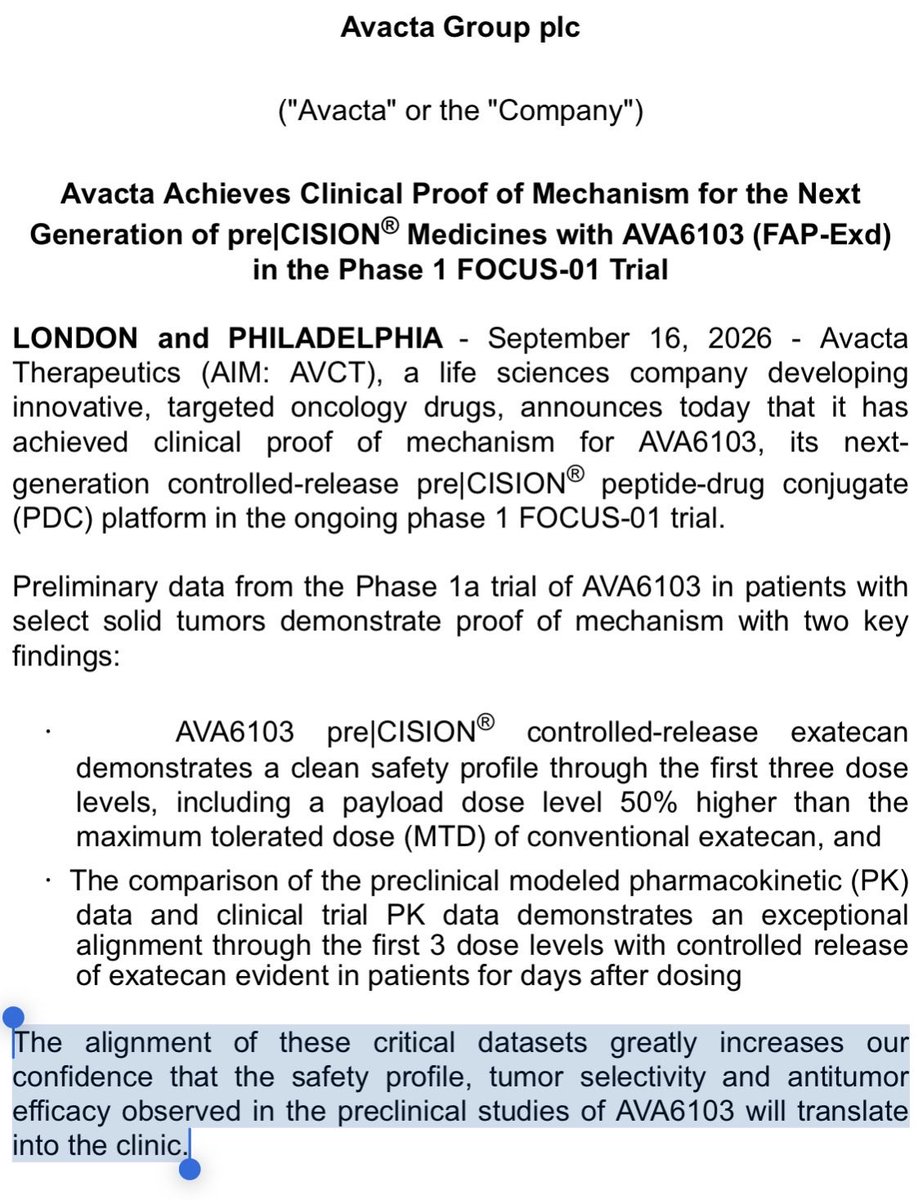
“The comparison of the preclinical modeled pharmacokinetic (PK) data and clinical trial PK data demonstrates an exceptional alignment through the first 3 dose levels with controlled release of exatecan”
All we need to know. Phenomenal. #AVCT
Many congratulation to Chris and her team at #AVCT on this momentous day.
Replication in human and confirmation @avacta now sits on true platform technology within preCISION that can address ~90% of the solid tumour market.
A remarkable achievement, which changes everything.
It is clear to many #AVCT is about to go on a a run.
Why?
preCISION sits on the cusp of disclosing human data which, if confirmed, changes what’s possible with PDCs from every perspective: safety, efficacy, stability, cost and utility.
“It really doesn’t have a lot of limits��
Mining News reports #copper passed the US$15,000/t mark as it continues to enjoy the tailwind of AI demand expectations. #Greatland’s #Telfer copper production, plus future #Havieron copper production, are tremendous addition to our #gold ounces.
$GGP.L $GGP.AU