Citadel: ''Unlike traditional software, where the marginal cost of serving an additional user is close to zero, AI carries a meaningful and ongoing compute cost. The economics therefore depend not simply on what the technology can do, but on whether the productivity generated is sufficient to justify the resources required to deliver it.''
Ang. @Djurvaenn -spaning om $meds i senaste Veckans Trade hittade jag detta i noterna i M2:s senaste rapport (fr. 28/5). Säljtryck på G i något av
$CORE B, $LOGI B, $WBGR B, $DVYSR, $BESQAB, $MEDS ??
Vad säljs först? Sålts ”långfristiga innehav” om 1,15 miljarder under Q1 👀
@Djurvaenn Boom. Frågan är om det räcker, det var rätt stort skuldberg i M2. Knappt 3 miljarder i räntebärande kortfristiga skulder och runt 200 msek i räntor per kvartal (Q1-takt).
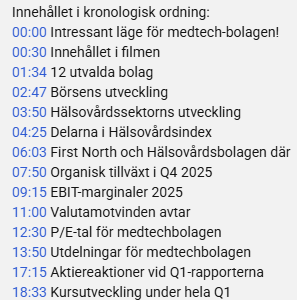
Jag har just publicerat en film om medtech-bolagen inför Q1-rapporterna.
Varning: Den är nästan en timme lång, så häll upp en kopp kaffe och kolla när du har tid. 😊
Innehåll enligt nedan.
Prenumerera och se filmen här:
https://t.co/1v6TSrt4Gw
RT för bättre spridning = ❤️
Something that people making AI economics predictions should take into account is that 1) current AI use is heavily subsidized, 2) demand for smart, compute-heavy models is exploding w/ few price signals to discipline use, 3) we will be hitting serious compute constraints soon.
Translation: We have been living through a period of abundant AI; get ready for the age of compute scarcity. There will be more rationing, multi-tiered markets, new token allocation infrastructure, etc.
Tycker ändå detta är en intressant frågeställning, vad är egentligen den riktiga kostnaden för AI och hur mycket är subventionerat av de stora lånen och förlusterna som AI-bolagen gör? Hur kommer det se ut när de måste gå med vinst?
Conspiracy theory: this isn't the launch of a new feature, it's the soft launch of accurate pricing for Claude, and Anthropic are testing the waters to see when the time is right to drop the full bombshell.
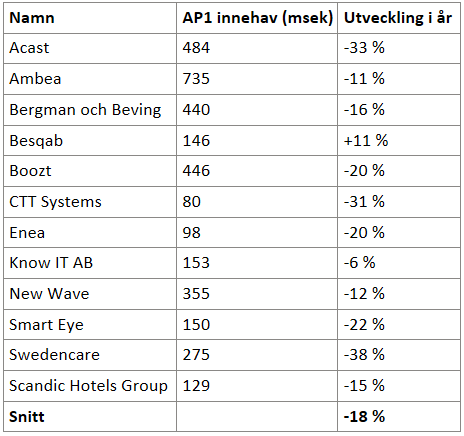
Blev nyfiken att kolla upp Ciceros spaning om att AP-fonderna dumpar de innehav de fick ta över från AP1 vid årsskiftet.
Verkar ligga något i det - nästan alla innehav i AP1 som AP3 och AP4 inte hade har tvåsiffriga nedgångar i år.
JPMorgan launched HALO acronym for stocks: Heavy Assets, Low Obsolescence - "This includes Capex & Supply Chain Bottleneck Beneficiaries, Robotics, and sectors like Staples... Overall, we are starting to see a rotation from the Digital world back into the Physical one."
AI bros and Wall Street have lost the plot again.🤦
Following Google Genie 3’s announcement, gaming stocks dipped as investors panicked over a supposed “disruption” of the industry.
It’s the same kind of DiSrUpTiOn we saw with web3, blockchain, the metaverse, cloud gaming, and esports. How are they doing again?
The reaction to Genie is the clearest indicator yet for what most of us already know: generally speaking, the stock market doesn't have a bloody clue about games.
Yes, it's a cool prototype, but Google will eventually shove Genie back into the bottle – or more accurately, the Google Graveyard.
We saw this pattern with Stadia in 2019, a cloud gaming venture that Google unceremoniously axed. Genie 3 follows the same pattern of a flashy PR cycle followed by a prototype phase with no viable path to a profitable consumer product.
Back when Google announced Stadia in 2019, I made a bet with one of my old bosses that it'd be in the Google Graveyard by 2023. I won that bet, and I’d bet the same thing again here – Genie will be in the Graveyard by 2028.
Genie essentially guesses, frame-by-frame, what the next visual output should be based on your inputs. This lacks the core foundations of game development.
There’s no intentionality here. In a real game, if you press ‘A’ to jump (let’s not argue about facebutton placement…), the game checks your velocity, collision, and gravity. From what I’ve experienced, there’s NONE of this in Genie – only a statistical guess that the next frame should look like a jump.
In other words, because the model is just predicting the next pixels, it has no concept of rules, which are fundamental to games. Hell, they define a game in many respects.
Scrolling through a video that reacts to your thumbstick is not playing a game. The model seems to be training on the visual output of games rather than the source code. That’s sort of like trying to build a working Ferrari by looking at photos of a Ferrari.
And then there’s the plagiarism problem. Google says the model is trained on “publicly available web data,” AKA unlabelled gameplay footage belonging to publishers.
Early user tests have already produced output that rips off Breath of the Wild and Super Mario 64, complete with paragliders and clearly plagiarised environmental assets. Nintendo’s lawyers are ruthless, and they’re not going to like this. I’d have loved to be a fly on the wall of that meeting.
Nintendo has a history of litigating against even fan-made projects using their assets and IP (like AM2R, Pokemon Prism, and Lost in Hyrule). A multi-billion-dollar corporation like Google using its IP to train a commercial AI is a completely different kettle of Magikarp.
Either way, there’s plenty of things to worry about when it comes to investing in AAA games, but Google Genie – and its ilk – isn’t one of them.