Personal finance is more personal than finance. Chief Advisory Officer for @SignatureFD. Write for @CNBC @Forbes; wrote "Simple Money" book; opinions are mine.
The Financial LIFE Planning email newsletter has a new home--on @substack! You can learn more, revisit (hundreds of) old posts, and subscribe to receive new editions every Sunday morning at 7am here:
https://t.co/JLURguAixW
Have you ever actually asked yourself whether you consented to the goals you're working toward?
Are your aims rooted in your intentions, or someone else's?
"The biggest human temptation is to settle for too little." — Thomas Merton
It's just that we often settle for too little by doing too much.
And we often mistake activity for progress.
"The chief act of the will is not effort but consent." — Thomas Keating
Too often our financial plans don't stick — not because people aren't trying hard enough. Because they've never actually consented to the goal.
https://t.co/4acdC5TTgU
"When you ask before you tell, and you're genuinely curious, you're communicating: I care, and I'm not afraid of what you might actually mean."
— Edgar Schein on humble inquiry. Some of the best listening advice I've heard.
https://t.co/vHor27uufz
Alfred Adler had a name for using work to avoid everything else: the life-lie. And his instruction to workaholics is very pointed, and seems to demand our consideration:
"Workaholics are simply trying to avoid their personal and social responsibilities by using work as an excuse."
https://t.co/zPUaC1JGE3
John Glenn became an astronaut--for a second time--in his 70s.
Jim Collins calls it feeding your inner fire, in his new book, "What To Make Of A Life." That doesn't look like escaping work. It's personal evolution with and through it.
FIRE frames work as something to outgrow. Jim Collins' research suggests the most fulfilling lives never tried to — they just kept orienting work toward what they were encoded for.
https://t.co/kKe88hiABz
Jim Collins studied what distinguishes deeply fulfilling lives. His findings caused me to question the FIRE approach to financial planning even further.
The most meaningful lives weren't oriented toward escaping work. They were oriented toward doing the work they were built for.
https://t.co/LIGYCGKvhu
The ordinary distractions of life, when compounded by an attempt to navigate them simultaneously, often lead to a diminishment of moments that could otherwise be enjoyed, if not remarkable. The end result can be a squandering of the scarcest of all the resources we’re capable of possessing—our time.
Let’s call it what it is: a near-life experience. Present in body, elsewhere in mind.
https://t.co/nyar39m6Hu
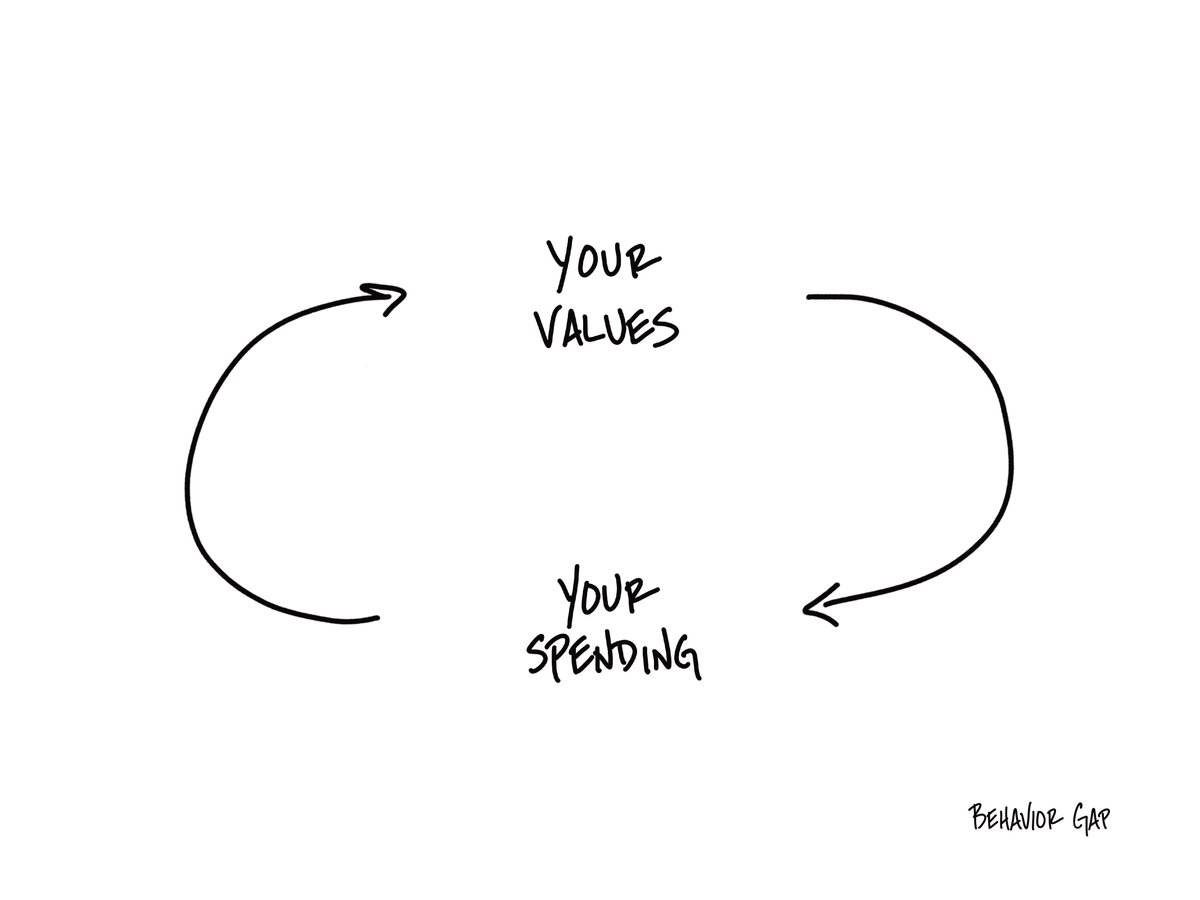
"The goal here isn't to spend less. It's to spend lavishly on the things you value and cut ruthlessly on the things you don't." — Carl Richards @behaviorgap
"Live below your means," the all-time GOAT of financial maxims, addresses a symptom. Michael Stipe of REM addressed the root in 1987's "The Finest Worksong": "What we want and what we need has been confused." https://t.co/ypokgx6T9T
Eliminating the confusion between what we want and what we need is upstream of virtually every financial dysfunction: lifestyle inflation, status spending, over-saving at the expense of meaning, working too long, retiring too early.
https://t.co/ypokgx6T9T
Some of the most precious moments can't be engineered, only received. Good financial planning just reduces the weight enough to keep the door open.
https://t.co/TDLSmNO1CO