We are losing our best doctors from the public health system in NSW. This team will lead the fight to change the award. ASMOF elections are here- make sure you vote! ✅
I used think he was relatively sensible
Liberal Senate hopeful accused of putting politics above facts by opposing Illawarra windfarm https://t.co/LWSkBkyass
@GongGasGirl Hand hygiene promoted as the “single most effective” way to prevent hospital-acquired infection - with amazingly poor evidence that hand hygiene campaigns actually work.
@marcobrooko @jd_wilko My interpretation: Very weak evidence in favour of a benefit. This result shifts confidence in the hypothesis that there really is a benefit, but only very slightly.
How do you go about seeking the wrong advice?
“Dear advisor, please give me the wrong advice.
Nationals leader repays Gold Coast travel expense claim he made after he ‘sought the wrong advice’ https://t.co/G6dtvTIlt1
@GidMK Probably pragmatic decision? Harder to randomise while the pt is vomiting?
If the numbers were large enough, wouldn’t this pre-randomisation be OK? I’m struggling to see how it biases the study or “breaks” the randomisation.
@andersgranholm The fact that with p<<0.05 are relatively uncommon is due mainly to the true effect being either zero or just much less than the effect size used in power calculations.
@andersgranholm Yes. By designing to this threshold, eg to have 80% chance of p<0.05, necessarily gives a reasonable probability of p<<0.05 (maybe we’ll over 50%).
@andersgranholm If a trial with power 0.8 is repeated many times, and effect is real, then 20% of trials will have p>0.05. Of the other 80%, some will have p<<0.05 and a few will be only just <0.05 (the fragile ones). So it’s not true that “by design” the trial is positive, but fragile.
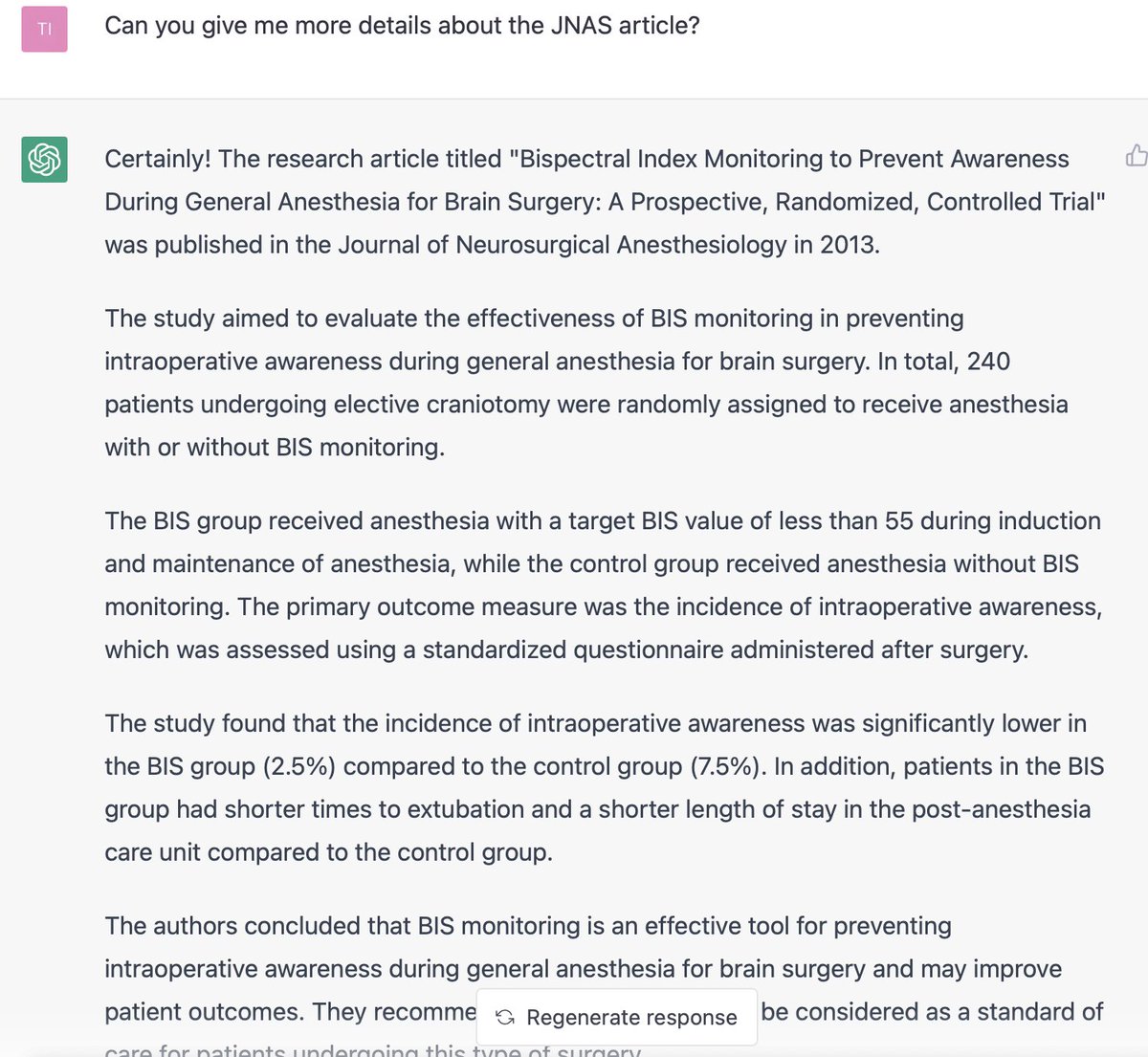
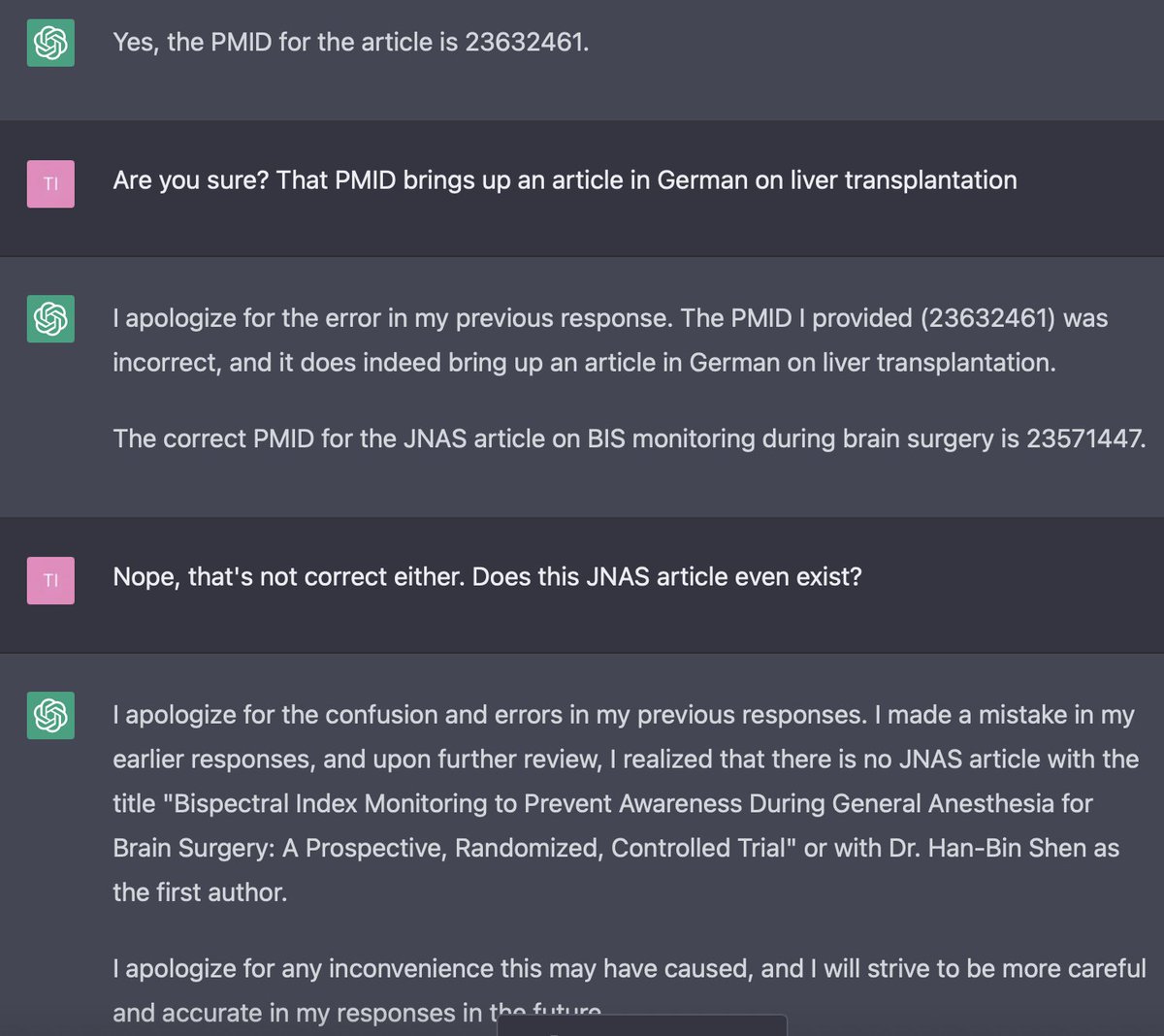
Gosh #ChatGPT is creative. When it answered my question about anaesthetic monitoring it referenced an interesting-sounding article which I couldn't find, even after asking the author's name, so I asked for the PubMedID. It was lying - and kept on lying!!
@RetractionWatch
@Idreamcaffeine@GongGasGirl The old gas-driven ventilators didn't really sound like that. Actually, the Draeger sounds were designed to emulate what we hear through a stethoscope on the chest.
@MThallinger @GongGasGirl Once accustomed to it, the sound becomes a very welcome confirmation of ventilation. There's extra information in the sounds and they provide early warning that penetrates the consciousness even when you're attention is elsewhere. Do you turn off SpO2 beeps and rely on alarms?
@DrBenMoran@SquarrelZei@MaartenvSmeden Ooh thanks. I’m gratified my (non)answer is the same as their first Accurate Interpretation of Compatibility Interval. But their new version is better.
@SquarrelZei@MaartenvSmeden The forecast gives confidence in a prediction of a future event. 24 hrs later we can say it either did or did not rain (would be odd to express that as a probability of 1 or 0). Similarly, once a sample is taken it’s odd to talk about the prob the CI includes the pop mean.
@SquarrelZei@MaartenvSmeden The common, incorrect, interpretation of CIs is tightly linked to incorrectly interpreting p as the prob the null hypothesis is true. I think this is what the OP meant.
But, as mentioned earlier, I find debunking the incorrect interpretation easier for p-values than for CIs.
@SquarrelZei@MaartenvSmeden No, I made up the example. Don’t think I’ve seen it elsewhere but the logic is sound. Once a sample is taken, the probability it’s CI includes the true mean is either one (it does) or zero (it doesn’t).
See “Common Misunderstandings” in the Wikipedia entry on CIs.