@xRegnanTx@awesomekling I think they were talking about any kind of unordered collection (the specific term will vary between languages), and then probably only in a lower-level language where there aren't necessarily out-of-the-box data structures like this.
@wesleytodd@sophiebits@Rich_Harris@elixirphoenix@htmx_org I thought it was just yes to first, yes to second, and the drop-off from the people who currently [have to] use something they don't like is swamped by the people who want to use/learn it. And LOTS of people want to/think they should learn/use a LOT of frameworks out there.
@kubectlget@rcbregman Whether or not the chart above is a helpful extract/representation of the data, the actual study itself seemed to have been very carefully designed and executed - I was impressed by the rigour. See this thread from one of the authors: https://t.co/DmOoav9hw7
We are happy to release the first results of a RCT of a US program that provided $1,000/month unconditionally for 3 years to 1,000 individuals in the treatment group, with a group of 2,000 people receiving $50/month serving as the control.
These are sizable transfers. 1/ 🧵
@ramalhoorg@treyhunner Looking at the origin of these terms... interestingly, wikipedia thinks 'zipping' is primarily about exactly what Python's zip() does: https://t.co/801sDT2lK4
Whereas the file compression article doesn't explain the origin of the term 'zip', just starts using it halfway down 🤷♂️
@akash_ram @s_gruppetta_ct @treyhunner "string parse time" / "string format time" - once someone pointed that out to me, I just say them in my head and I know which one I need. Obvs, I still always fire up https://t.co/54TWIUeVKj - no chance I can remember the right % codes 🙈🤣
@patricksrail@bbelderbos@driscollis Yes, though just be aware that it's not exactly the same as in other languages - it's "structural pattern matching". I'm hazy on the details, so I think you actually just use it like in other languages (matching against particular values), but it can do a lot more as well!
@Spazzzie@Rainmaker1973 Yes and no. Yes in the sense that the process is not specific to this picture. No in the sense that it needs to not be too detailed so that you can still understand/recognise it when you've only got a quarter of it. This other reply explains well https://t.co/0WFIcjnvC6
@Amariih1@Rainmaker1973 Our brains identify patterns.
But also this wouldn’t work as well on a more detailed image. The pixel-to-detail ratio needs to be within a certain range.
Sections of the main features, like the eye, need to be large enough to show up in all 4 versions.
@simeonesp@TheHolyKau@andreasklinger I think it's kind of bundling the latter with the former. But perhaps the original tweeter doesn't realise you could have the former and turn off the latter (or at least, ought to be able to IMHO!)
@Alex_RodVz@Joshstrangehill@Steampunk_T I think you mis-read "aren't" as "are". They were saying "dust still exists in the world so why don't we still use these", not "there's still dust in the corners on the stairs, so why have they bothered keep using them" 😊 (ie you and OP agree 👍)
@davidvujic@mathsppblog Oh, that *would* be the icing on the cake! So you can be using the REPL to experiment and be making changes to your code, but you *don't* have to then restart the console and re-import the module to start using those changes?! 🤯
@sarojbono@mathsppblog@raymondh But you can go one step further than this: if you prepend an attribute with *two* leading underscores, Python will perform "name-mangling", which means that from *outside* the class, that attribute is only available at `_classname__attributename` (search "name mangling" for more)
@sarojbono@mathsppblog@raymondh captures this very well in saying that "Python is an adult-consenting language"...the door to the room is closed but it isn't locked; however, you are the one responsible for the consequences if you open it and go in (or something like that!)
@mathsppblog@davidvujic I do most of my development with this. It's very useful for data work - PyCharm has a pop-up view for pandas DataFrames so you can experiment to get the filters/transformations right, check it looks correct and then add it to your script. I can't imagine developing without it! 🤯
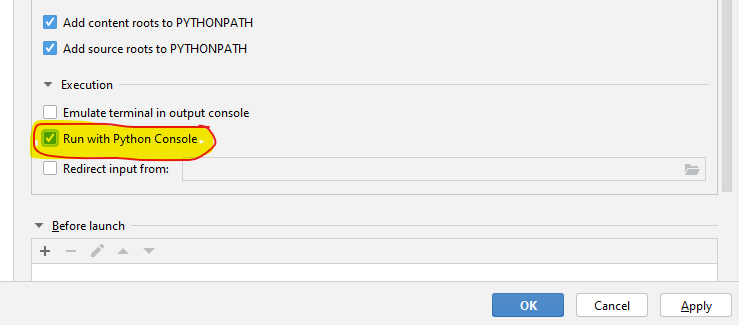
@mathsppblog@davidvujic If you set the 'Run with Python Console' option in the Run/Debug Configurations settings, you can run a script and leave the Python session active with your local variables still there, e.g. to then experiment/develop your script further (like running Python with the -i switch)
@mathsppblog PyCharm has a whole load of refactoring shortcuts as Ctrl + Alt + <letter> (on Windows).
For example, for letter...
V = introduce Variable
P = introduce Parameter
C = introduce Constant
F = introduce Field
M = extract Method (select a block of code)
N = inline