Join Padre and trade on SOL, ETH, BASE and BSC.
Better than Axiom and Bullx Neo!
35% cashback – highest rewards on the market!
Fastest orders, great UI and UX!
Use my ref link below:
https://t.co/EyTfFGw3TP
Tighter spreads and more depth just landed in the latest upgrade.
We remain focused on the liquidity hub, with btc and stock pairs arriving over the next week. The next billion dollar hub to follow is (spot) compute.
There are countless ways to address state growth if the first/second order effects would actually be understood
Who is responsible for much of the ongoing state growth?
Maybe it is PropAMMs, dozens of them doing hundreds of writes per block
Solution
- Global storage contract or opcodes, maybe a good place to introduce state expiry there. Make SSTORE expensive the first times, and cheaper as it warms and remains in use (SLOAD’ed). More state would end up shared too.
What drives sstore cost? (at exec)
Book keeping r/w and reverts. Or uncertainty of completion.
Solution
- Allow, bulk read / writes. And charge less for that. See what monad is doing
Why do devs seem to “waste” storage?
- (un)packing state grinds on code size / gas, so devs use more storage
- devs with demanding use-cases fall back to diamond pattern galore. Effectively causing more state growth as more contracts are needed + cross contract call codec overhead
Solution
- 64kb max contract size. Charge more here, it’s ok. Jumpdest still fit into two bytes, absolute no brainer change
5x SSTORE is the laziest and least informed way to do it
try 10 to 200 eth.
----
btw: side-by-side by hand is really not the best way to compare
1. You get surplus in any tx and block going forward. usually is not passed on to the user; except over at @CoWSwap (and still not to the full extent). The most accurate bench is a realistic 4 to 14 sec delayed sim, mid block. That is where it shines most with wide gaps.
2. off-chain aggregation is always a delayed view:
-> Sequencer
-> Node / Indexer / ETL
-> Receiving request from UI
-> Solving then simulating
-> Sending back to UI
with an on-chain router you fire the simulation right away and get a fresher view / quote
hence, it will always look outperforming when market goes up, and the opposite if the market is going down.
that aside, if some propAMMs would be kind enough to match whitelist / fees aggregators get, for an arguably less toxic flow--amortized risk over all liquidity sources when routing BBO; that would help to close the gap (in a fair way)
Even with missing rebates and outstanding propAMMs integrations you should see a 1 to 10bps gap at 10-200 eth.
We've added 13 new @aeroxyz pools to the router today.
Widening the bps lead, at the cost of a higher gas footprint.
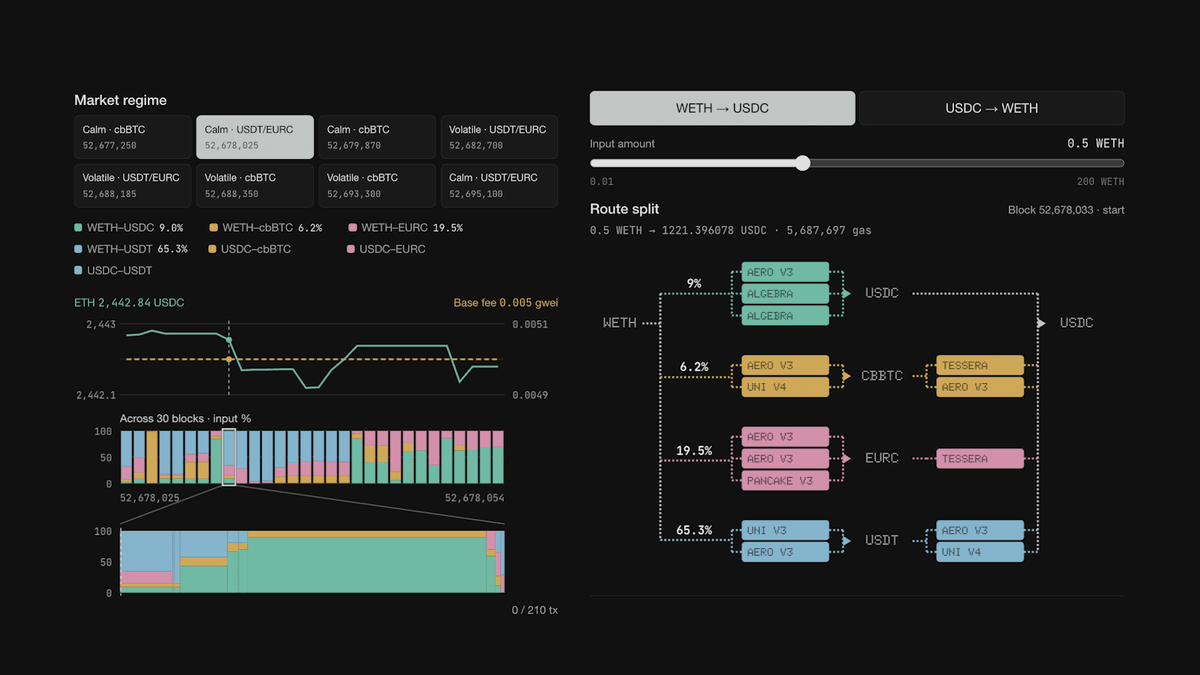
What makes routes go stale—an interactive (and gentle) intro to how Frok’s JIT-router turns volatility risk into positive surplus.
https://t.co/COA4QPqEFX
What makes routes go stale—an interactive (and gentle) intro to how Frok’s JIT-router turns volatility risk into positive surplus.
https://t.co/COA4QPqEFX
Today we unveil our first JIT router for ETH/USDC, available on https://t.co/YsUAS4IHZb — setting a new bar for optimal aggregation — operating exclusively on-chain, at execution time.
The pre-release router executes BBO against a ~300m TVL hub on @base , spanning over 100 liquidity sources including propAMMs.
We went top-down with ETH/USDC as the first and most traded pair with the highest routing complexity. More pairs and chains to follow in due time.
Integrations and feedback is welcome. We would love to hear your thoughts as we stabilize the interface. Bls dm.
1/4