Always such a pleasure seeing the arrival of a new book you & colleagues have put a lot of blood, sweat & tears into👌
HUGE effort, led by Matt Butler getting this 2nd edn of Pocket Prescriber Psychiatry out with @BAPsych
Builds on success of 1st edn led by @drjprogers👏👏💪💪
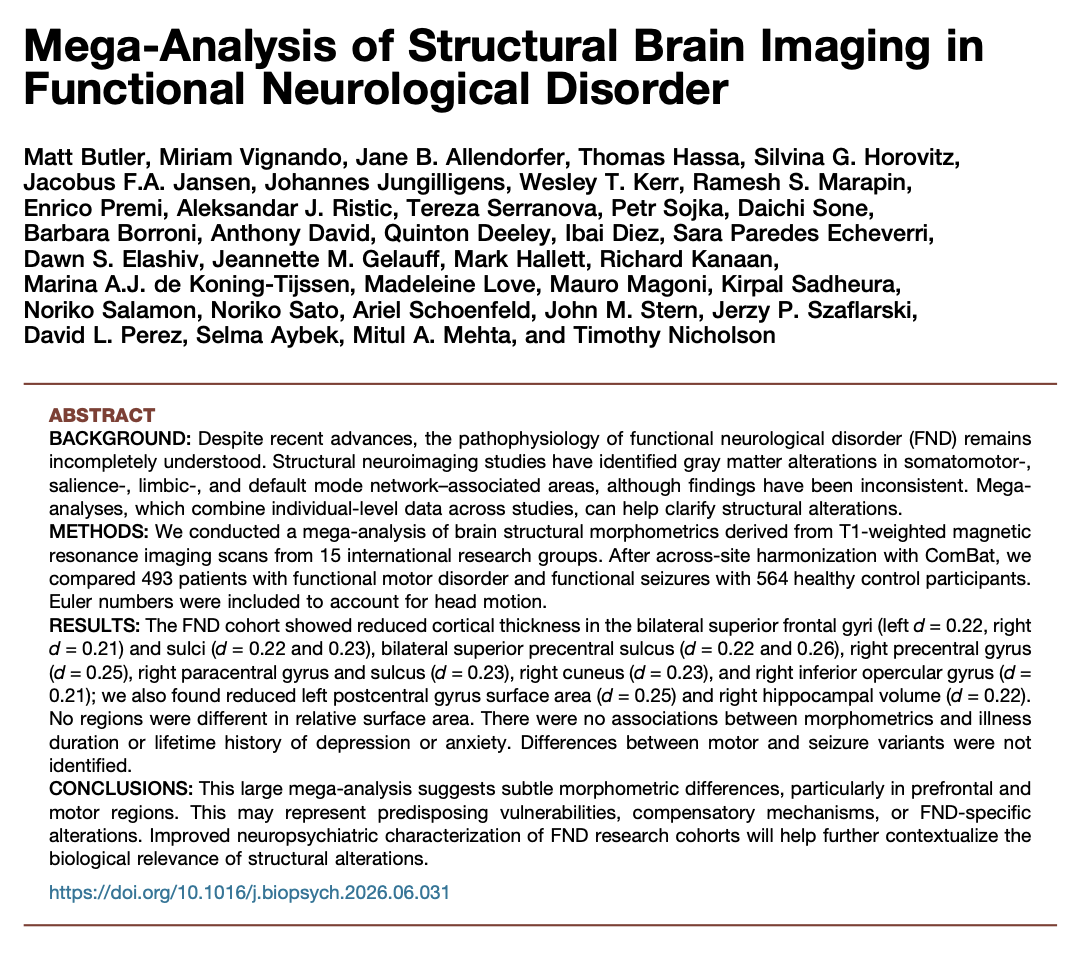
Sharing new @BiologicalPsyc1 structural brain MRI mega-analysis in Functional Neurological Disorder. This international effort was led by #MattButler & @Tim_R_Nicholson in collaboration with the @FNDSociety Neuroimaging SIG. Check it out. @KingsIoPPN https://t.co/96MEqsP2WF
Very grateful to be here in London giving a talk tonight
@KingsCollegeLon on Placebo, Nocebo & Mind-Brain-Body Circuits. This field has come a long way over the past 5 years...hoping to highlight the practical implications for clinical care and society.
https://t.co/R9PHdaLZIX
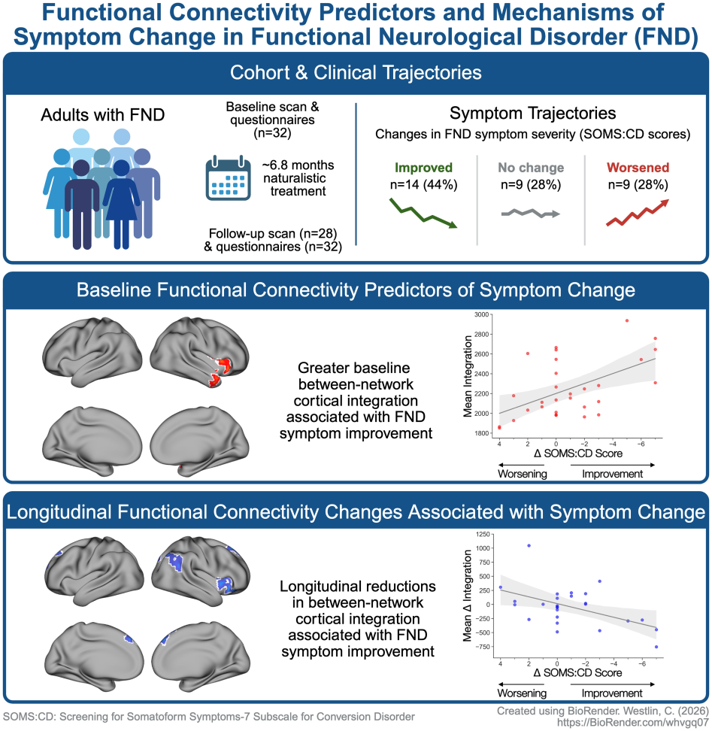
Westlin et al. report that resting-state functional connectivity predicted and tracked with symptom change in functional neurological disorder over ∼6 months of naturalistic treatment.
Read it at 👉 https://t.co/g9ifwQXxcM
#neuroscience#braincommunications
Following the one-sided piece on ECT in the Observer last week by Jessica Rawnsley, a couple of colleagues who can attest to the clinical effectiveness of treatment get to put an alternative view. Thanks to the Observer for wanting to support balance. https://t.co/VUtoYLGYT5
@M_Moutoussis@jonstoneneuro@TheLancet Yes, we are asking in good faith for views on what we genuinely believe is the best way forward
We've had lots of positive feedback on Linked In and other forums but also very keen to hear, and discuss/engage with, polite and well articulated counter-arguments & evidence👍
@ZemanLab@jonstoneneuro@LFeldmanBarrett We’ve summarised (as best we can in limits of 1k word count!) the arguments for & against this change
We are genuinely interested in discussing/debating the arguments against our proposal - so please do let us know why you disagree or what your concerns might be!🙏
Great to see this small but mighty paper out
Calls for unification of neuro & psych diagnostic categories
It’s increasingly obvious to those of us working across these ‘2 specialities divided by the same organ’ (to misquote Churchill😆) that this makes sense & good for both
Cardiologists and cardiac surgeons share the same organ and the same ICD-11 category.
Our new editorial @thelancet.com explores what would happen if neurologists and psychiatrists had a joint classification in ICD as well. 1/
https://t.co/WW1LC7UJ3w
Paper led by psychiatrist Peter White & neurologist @ZemanLab who first called for this in 2012 with Hugh Rickards https://t.co/3fKDsEmAmN
With @jonstoneneuro & @LFeldmanBarrett we’ve updated & expanded rationale & benefits for this key/historic unification of brain, body & mind
I'm so excited to share the Pain Psychology Centre UK's new website. HUGE well done to Vanessa and team. This is going to make some waves. I can't wait to see that happen
https://t.co/I5BUagiP9g
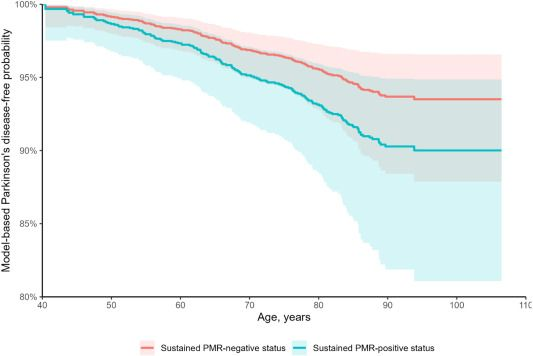
Psychomotor retardation looks a bit similar to parkinsonism. In this paper, we examine whether it might be a prodromal feature as part of depression: https://t.co/tLUoR3aKzw.
Massive study published yesterday in @NatureHumBehav for anyone in the neuropsychiatry/mind-brain-behavior spaces
Direct in vivo evidence for how attention can modulate the immune system in ways that seem almost unbelievable
https://t.co/PKuVQXp7rg
@M_Moutoussis@jonstoneneuro@TheLancet Thanks for your feedback Michael
Could you kindly explain why a joint neuro/psych classification system, from your perspective, isn’t a good idea …and why you presumably think our arguments for its benefits are flawed?
Territorial disputes about FND, Dementia, & Tourettes could be improved.
Psychiatric care for MS and Epilepsy, and neurological care for those presenting with psychological symptoms could be more integrated.
Thanks to Peter White @LFeldmanBarrett@Tim_R_Nicholson@ZemanLab
New @braincomms paper led by Christi Westlin & Cristina Bleier - longitudinal resting-state fMRI study investigating predictive & mechanistic markers of symptom change in #FND. @MGBResearchNews@FNDSociety@FNDHope 1/n
https://t.co/VzrfimrmMm
🧠 Our new paper!
We show brain state entropy—derived from dynamic resting-state fMRI—captures the loss of network flexibility after traumatic brain injury.
It reflects injury severity, is profoundly affected by propofol sedation, and predicts recovery.
https://t.co/buu5fDYjqN
New from us:
We gathered psychologists, psychiatrists, neurologists, and individuals with lived experience to develop...
A neuropsychiatry curriculum for clinical psychologists and neuropsychologists: An e-Delphi study https://t.co/vk4kltlrVT