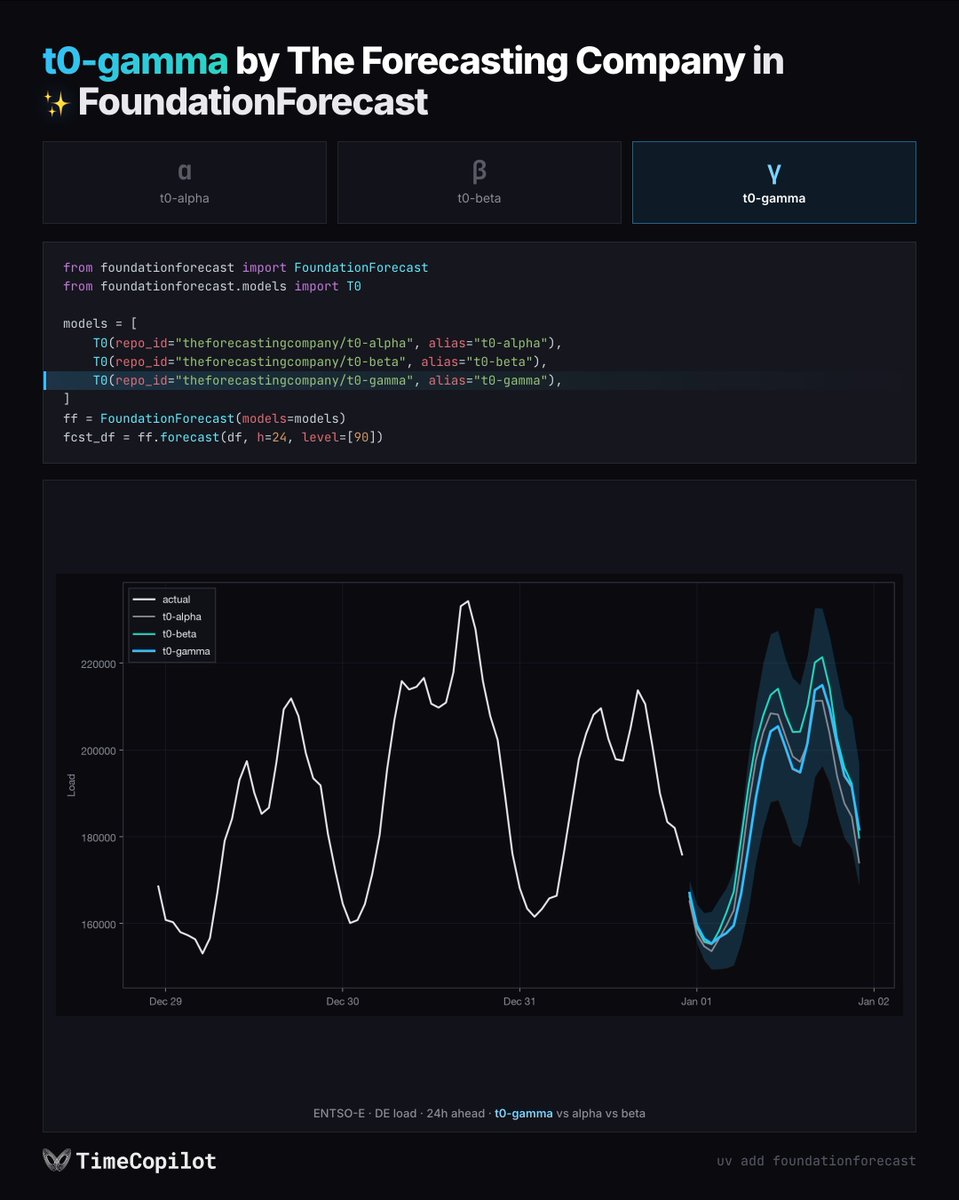
@datadoghq@TimeCopilot@rerosillo 👉 tutorial: https://t.co/MBbLvRLdNR
⭐ star the repo: https://t.co/WaICWWab6F
💬 join the community: https://t.co/TWNvmTxzTv
we’re very pleased to welcome @datadoghq's new Toto 2.0 family of models to @TimeCopilot! 🔥🐶
this new family is a major step forward for time series foundation models, including one of the largest forecasting foundation models released to date with 2.5 billion parameters, strong performance in the GIFT-Eval benchmark by the @salesforce AI research team, and early signs of scaling laws: within the family, accuracy improvements appear to be positively correlated with model size.
by adding Toto 2.0 to TimeCopilot, practitioners can now test whether those scaling laws hold for their own data and whether the models meet their accuracy and latency requirements.
but not just that.
TimeCopilot is the universal agentic framework for time series forecasting.
practitioners can compare Toto 2.0 against other foundation models, deep learning and classical models, and simple baselines:
in the same pipeline.
without changing dependencies.
with just one additional line of code.
agenticly. ✨
and the best part?
forecasting, cross-validation, anomaly detection, and prediction intervals are natively supported for the new Toto 2.0 family.
and yeah: open source. 😎
let us know how it goes! tutorial in the comments.
what would you like to see next?
happy forecasting! 🫶
what an amazing time @rerosillo and i had at #PyConUS 2026 in Long Beach! 🏖️
@TimeCopilot was selected as one of 8 startups for the Startup Row, and we had the opportunity to learn and share more about time series and Python with applied scientists, researchers, developers, founders, infrastructure engineers, and members of the open-source community.
huge thanks to Jason D. Rowley and Shea Tate-Di Donna for organizing such a special event for the community 💙
this was my second PyCon and my second Startup Row, and i couldn’t feel more humbled seeing how far agentic forecasting has come in such a short amount of time, and to be building all of this together with Renée. and in the open. ✨
one thing became very clear during the conference, time series in the agentic era is still a nascent field, and there is an enormous opportunity ahead for the ecosystem.
we can’t wait to share more of what we’ve been building at TimeCopilot.
stay tuned! :) 🫶
Rio, see you soon. @TimeCopilot will be at @iclr_conf 2026 ☀️
if you’re interested in agentic forecasting, foundation models, live benchmarks, the impermanence of everything, going for a run along the beach, or simply sharing coffee and talking about the important things in life while watching the sunset after a swim, reach out 🫶
for @rerosillo and me, Brazil is more than a chance to gather with one of the brightest tech communities in Latin America. it is also one of the places where our partnership as founders truly began to take shape.
we couldn’t be more humbled, and more excited, to be there.
we’ll be presenting a paper, but just as importantly, we want to meet people: researchers, practitioners, builders, and curious minds thinking about the future of forecasting and complex systems.
we’d love to fill our days in Rio with great conversations.
and yes: we know how to surf too 🏄♀️
see you in Rio!
#iclr2026 #forecasting #agents #timeseries
today, we’re very happy to publicly release the code
and the live leaderboard behind the first live forecasting benchmark. 🥳🫶
forecasting is impermanent.
we built a live benchmark because something felt off
about how we evaluate models today.
the goal of time series foundation models
has always been temporal generalization.
but we haven’t really had the tools to measure it.
most claims are still made
on static datasets.
but the world changes.
people change.
companies change.
systems change.
and the future will never look exactly like the past.
today, we’re releasing Impermanent,
the code and the live leaderboard are public.
links in the comments.
if you have questions, comments, concerns,
or collaborations,
we’d love to hear them.
we invite practitioners and members of the community
to submit models or pipelines.
happy forecasting! 💙
life has felt electric lately.⚡️
just a few months ago, the @TimeCopilot crew started an important conversation around agentic forecasting and the future of forecasting systems.
now, that category is proving itself.
it’s showing that time and text are just an artificial separation of something bigger: how we experience reality.
and noticing that artificiality is the starting point for the next breakthrough in the forecasting field: time series superintelligence.
but the TimeCopilot crew understands a particular nuance.
progress is not centralized.
it never has been.
it comes from different laboratories, research groups, software engineers, systems…
and from open source.
and from collaboration.
we wouldn’t have the powerful technology we have today without the open knowledge humanity has accumulated since we first began sharing ideas.
the same will happen with time series superintelligence.
and it’s happening now.
the proof is in the pudding.
just a few days ago, IBM released a new time series foundation model: a pretrained PatchTST architecture. early evaluations show strong performance against models like AWS Chronos-2, NXAI TiRex, and Google’s TimesFM.
but that immediately raises a practical question:
which model should we actually use?
the baseline? the classical model?
the univariate one? the multivariate one?
with external regressors? without them?
the latest checkpoint? the one tuned for our horizon?
and how do we even integrate all of them in the same workflow?
and this will keep happening.
as recent live benchmarks in the field, such as Impermanent, have started to show, there is no such thing as universal temporal generalization.
no single model wins everywhere. not always.
the TimeCopilot crew understands this.
every use case needs to be validated across multiple models.
not just once. always.
and now we have agents that can orchestrate those workflows for us, efficiently, while letting us interact with them in plain English.
that’s TimeCopilot.
today we’re excited to share that PatchTST is now part of the TimeCopilot time series model hub.
another model.
another perspective.
another step toward time series superintelligence.
and we believe, this is how the future of forecasting gets built.
in the open. 🫶
New collaboration with the @TimeCopilot team on a live benchmark for time-series foundation models, to be presented at @iclr_conf.
Kudos to @azulgarza_ and @rerosillo for driving this.
today we are very happy to share that Impermanent, the first live benchmark for time series forecasting, has been accepted to the #ICLR2026 TSALM workshop. ✨
change.
we all experience it.
it shapes us. it reveals who we are.
it is in the very essence of life.
we are but impermanent beings.
change is the only constant.
but change also terrifies. it destabilizes. it forces us to adapt.
over the past decades, change has accelerated through technology.
computers increasingly support decisions.
agents are becoming more capable every day.
organizations rely more and more on systems that reason about the unknown.
and at the heart of these systems lies forecasting, a fundamental discipline for understanding uncertainty just a little bit better.
yet forecasting evaluations still assume a world that does not change.
most benchmarks train a model once, test it once, and report a single number.
a static snapshot that can hide temporal overfitting.
but real systems do not operate this way.
data arrives continuously.
distributions drift.
forecasts are made again and again.
evaluation of forecasting models should itself be a time series.
so an important question remains open:
do forecasting models actually generalize across time?
how can we claim, as a field, to be approaching foundation time series intelligence without answering that question?
until now, we did not really have a way to test this.
this is why, with a group of peers and folks i consider forecasting rockstars that i deeply admire, we co-created Impermanent, the first live benchmark for time series forecasting.
my sincerest thanks to my coauthors @rerosillo, Rodrigo Mendoza-Smith, David Salinas, Andrew Robert Williams, Arjun Ashok, @MononitoGoswami, Martín Juárez.
Impermanent tracks performance across successive evaluation times, making temporal persistence explicit rather than assuming a static test set.
code, data, and more details coming soon.
forecasting is impermanent, just as life is.
and this is a step forward toward building time series superintelligence.
questions? comments? concerns? collaborations?
happy to hear them all.
💙
what does a truly unified agentic forecasting system look like? 🤔
at @TimeCopilot, we believe it should be able to add, compare, and reason over new models,
whether foundation models, deep learning, machine learning, or statistical,
as soon as they appear.
with one line of code.
yes. one line.
and open source. 🫰
that’s why we integrated with @sktime_toolbox.
sktime offers 200+ forecasting estimators, spanning classical statistics, deep learning, foundational models, hierarchical methods, conformal prediction, and more.
and with TimeCopilot, you can import any of these models and include them directly in an agentic workflow,
for diagnostics, comparison, evaluation, and iteration.
and yes.
just one line of code. 🥰
forecasting and text-based reasoning were never separate.
we’re just making that explicit.
what would you like to see next? ✨
i’m excited to announce that in collaboration with @sktime_toolbox, we are launching the largest open source agentic time series ecosystem in the world. ✨
collaboration changed the world.
and it keeps doing so.
time. what is time?
there was a time when this question was asked alone.
when uncertainty was faced in solitude.
then people began to think about it together.
and with collaboration, something precious emerged.
the questions didn’t become easier,
but they became more bearable.
and more fun to approach.
that’s why the @TimeCopilot crew is excited to announce our partnership with sktime.
through this partnership, TimeCopilot users will be able to access hundreds of time-series estimators directly from sktime, spanning classical statistical models, deep-learning methods, foundational forecasters, causal models, hierarchical reconciliation, conformal prediction, and more.
and this goes beyond forecasting.
sktime provides a rich ecosystem for time-series data transformations and forecasting today, and we will soon extend the integration to include its classification, regression, and clustering workflows.
combined with TimeCopilot’s agentic capabilities, users will be able to reason over these tasks end to end:
selecting methods, applying transformations, evaluating results, and iterating,
all as part of a coherent, transparent, and production-grade system.
at the same time, sktime users will be able to benefit from TimeCopilot’s agentic workflows:
from diagnostics and pipeline selection to evaluation and interpretation, coordinated through automated natural-language reasoning.
this partnership brings together two complementary philosophies:
- sktime as one of the largest and most mature open-source ecosystems for time-series tasks
- TimeCopilot as an open agentic layer that treats forecasting and time-series analysis as a systems problem, not just a model choice
sktime represents years of careful community work, with 14k+ GitHub stars and 40M+ downloads, and a deep commitment to openness and rigor, with hundreds of organizations using it in production.
we’ll be sharing examples, notebooks, and integration details soon, including end-to-end workflows for production and enterprise settings, so the community can explore what this enables in practice.
huge thanks to the sktime maintainers, and especially Franz, Marc, Felipe, and Simon Blake for making this collaboration possible.
as we enter a new forecasting era,
one where the boundary between language models and time-series models becomes less rigid and more interoperable,
we believe open-source collaboration will shape what the future looks like.
it cannot be otherwise.
we are open beings.
happy forecasting! 💙
a few days ago, Google and Apple announced something historic:
Gemini will power Apple’s ai features.
this confirms what’s been clear for a while:
@Google doesn’t just have the data and expertise to train strong models,
it can deploy them, at scale, into everyday products almost immediately.
what does this have to do with forecasting?
everything. ✨
as agentic forecasting moves into production,
the choice of the brain behind it stops being cosmetic.
it becomes infrastructure.
the llm is no longer just answering questions, it’s coordinating analysis, diagnostics, model selection, and reasoning across the entire forecasting workflow.
that’s why we’re excited to announce that @TimeCopilot now officially supports Gemini.
users can run full agentic forecasting pipelines on Google foundation models, end to end.
we’re not chasing models.
we’re building forecasting infrastructure for the next era.
we’d love to hear thoughts from the community.
what would you like to see next?
happy forecasting! 💙
I've been digging into why my groceries spoiled last month.
I asked someone from the supermarket whose cheese and meat went bad.
His answer: "We do everything manually. There is no system in place. THAT IS MY DAY TO DAY."
I could hear the frustration in his voice.
Turns out the problem is way bigger than one supermarket.
The global food supply chain will waste $540 billion by 2026. Most of it from forecasting errors.
What I learned:
Food waste costs 33% of revenue across the supply chain. For retailers: 2% of net sales. That's nearly their entire profit margin.
A $500M grocery chain has $10M annual waste from perishables alone.
The core problem: demand forecasting for perishables is brutally hard.
3-7 day windows to sell dairy, meat, produce. Miss by a few percentage points and you're either throwing away product or facing stockouts.
Traditional approach:
- Historical averages
- Manual adjustments
- One model for everything
The issue: different products have completely different patterns.
Milk on Tuesday ≠ ground beef on Saturday
Seasonal produce ≠ stable SKUs
Now the Super Bowl is coming. Avocados, tortilla chips, chicken wings will go through the roof.
One model can't handle all of that.
Better forecasting systems cut perishable waste by 30-40% while keeping shelves stocked.
For a $500M chain: $3-4M annual impact. Straight to bottom line.
This is what we're building at @TimeCopilot. Multi-model agentic forecasting. Test 30+ algorithms, pick the best fit automatically.
Yesterday's gym forecast? SeasonalNaive won (predictable pattern).
Perishables with high variance? Different models win.
That's why multi-model testing matters.
Working on forecasting for perishables or high-turnover inventory?
I'd love to hear about your challenges.
https://t.co/uND9XadG0l
What's the biggest waste problem you've seen in supply chain?
the agentic forecasting wave is real.
as real as the waves @rerosillo, @ao_sebhgtz and i learned to surf during #NeurIPS2025.
as real as the paper we presented, with the same name as the company we’re building.
as real as the conviction we have that this is the next breakthrough in the forecasting field.
and just as real as what the @TimeCopilot crew did in one single week:
– announced a company
– shipped community-requested features
– built product
– presented our poster at NeurIPS
– learned from researchers, founders, and practitioners
– hosted events in Mexico City and San Diego: 1,200+ RSVPs, 120+ attendees
– ran, swam, and learned to surf
– watched Home Alone
– and heard (more than once) that we might be the only forecasting startup publishing at this conference
it still feels surreal.
and i couldn't be prouder to be part of this team.
but you know what was the most real thing of all?
the love.
the friendship.
the kindness.
from some of the brightest minds in the world: researchers, engineers, founders, students, scientists.
who shared their time, their ideas, their convictions, and their hearts with us this week.
grateful to the people who opened space for deep conversations.
you know who you are. 💙
and yes, the foundation time-series space may look fragmented from the outside.
but what’s not fragmented is this community’s genuine desire to collaborate, learn, and build openly.
to all of you: my respect and admiration.
not only for your brilliant work,
but for your kindness and honesty.
to show up as you are.
let’s surf the waves of change and agentic forecasting together.
it’s going to be fun. 🌊✨
how do you share news like this?
@TimeCopilot is becoming a startup 💙✨
and i'm happy to share that i'll serve as co-ceo & co-founder together with @rerosillo.
we’re also publishing our first manifesto:
Forecasting, the Agentic Way.
💙✨
🧵