Evolution timelines of tech, companies and science. Sprinkled with some practical wisdom & philosophy. Curious PM connecting the unknowns of the world around.
Everyone knows the school meme: 'the mitochondria is the powerhouse of the cell.'
I was reading about cell biology recently and realized that textbook line missed out all the interesting parts of the story behind the mitochondria.
Your cells actually contain the descendants of an ancient bacterium that was engulfed 2 billion years ago, and never left.
Looking into the biology of aging, it turns out the primary clock of our lifespan might not reside in our human genome at all.
It is ticking inside the ancient bacterial descendants living inside us.
For a long time, we viewed aging as a vague, inevitable wearand-tear of the body. But modern biology is pointing to a single, central culprit: mitochondrial decay.
Because mitochondria have their own separate DNA, they lack the robust repair mechanisms found in our main cell nuclei. Every time they convert food into energy, they release highly reactive molecules that damage their own genes. Over a lifetime, these mutations accumulate 10 to 17 times faster than they do in our nuclear DNA.
Eventually, these microscopic power plants begin to sputter. They produce less energy and leak more toxic chemicals, triggering a cellular downward spiral linked directly to Parkinson's, Alzheimer's, and type 2 diabetes.
But we are not entirely helpless against this decay.
We always hear that exercise keeps us healthy, but the biology behind it is surprisingly direct. Regular high-intensity movement triggers a cellular cleanup process called mitophagy: your cells actively dismantle the wornout, mutated mitochondria and build brand-new ones from scratch.
It makes one look at health differently. Staying young is really just a matter of keeping a 2 billion year old cooperative partner happy.
The next time you see the 'powerhouse' meme, remember that you are a walking cooperative colony.
You have trillions of ancient bacterial descendants living inside you, making energy, deciding when your cells die, and carrying a genetic record that connects you to every other human on Earth.
Everyone knows the school meme: 'the mitochondria is the powerhouse of the cell.'
I was reading about cell biology recently and realized that textbook line missed out all the interesting parts of the story behind the mitochondria.
Your cells actually contain the descendants of an ancient bacterium that was engulfed 2 billion years ago, and never left.
By transferring the parents' nuclear DNA into a donor egg with healthy mitochondria, they created the first 'three-parent babies' in 2016.
They have DNA from three people, though 99.8% comes from their parents.
Dostoevsky was 28 when they stood him in front of a firing squad. Blindfolded. Hands tied. He could hear the rifles being loaded.
At the last second a messenger on horseback arrived. The Tsar had commuted the sentence. The entire execution was staged. Psychological torture designed to break him.
It worked. He had a seizure on the spot.
They sent him to a labour camp in Siberia. 4 years. Freezing. Starving. Sleeping on wooden planks next to murderers. His epilepsy got worse. He had no paper. No pen. Nothing.
When he got out he was broke. His first wife died. His brother died. He inherited his brothers debts. He was so desperate for money he signed a contract with a publisher that would have given away the rights to everything hed ever write if he missed the deadline.
He wrote The Gambler in 26 days to make it. Dictated it to a 20 year old stenographer named Anna. Married her three months later.
Then the real work started. Crime and Punishment. The Idiot. Demons. The Brothers Karamazov. The greatest novels in the history of the Russian language. Maybe any language.
The man who stood blindfolded before the firing squad, who convulsed on the ground while soldiers watched, who slept next to killers in Siberia for 4 years, who was buried in debt and grief.
That man wrote: "every minute can be an eternity of happiness."
He earned the right to say it.
its never over. never give up fren.
Humans are now widely considered the most feared species on the planet. Evidence suggests that many apex predators will retreat simply upon hearing human voices. As a result, researchers have described humans as a “super predator,” whose presence alone generates a powerful “landscape of fear” capable of reshaping ecosystems.
A study published in Ecology Letters found that carnivores such as mountain lions and bobcats respond more strongly to human speech than to the sounds of other predators, fleeing at roughly twice the speed. This avoidance behaviour has far-reaching ecological consequences. When dominant predators vacate areas to avoid human contact, prey species and smaller mammals often increase in number, leading to cascading effects throughout the food web.
Scientists suggest this behaviour has developed over long periods of evolutionary pressure. Predators that attempted to approach or hunt humans were frequently removed from populations, while those that were more wary had better survival and reproduction outcomes. Over time, this has reinforced an instinctive avoidance of humans in many species. Across diverse environments, from North America to African reserves, wildlife today often treats human presence as the highest perceived risk, exceeding that of other large carnivores.
source: Suraci, J. P., Clinchy, M., Dill, L. M., Roberts, D., & Zanette, L. Y. Fear of humans as apex predators has landscape-scale impacts from herbivore to carnivore. Ecology Letters.
Old television, known as CRT (Cathode Ray Tube) TVs, were essentially big, vaccum-sealed glass bottles that used a beam of electricity to "paint" pictures on the screen.
The cost of sequencing a human genome dropped from $100M to less than $100 in about 25 years.
That's a million-fold decrease, which outpaces even Moore's Law.
We're about to enter the era of personalized medicine.
Most people quit because they forget that you have to be bad at something before you can be good at it. It's so obvious. You suck. Of course you're not going to win in 2 weeks. But if you can learn to enjoy extended periods of failure, you will make it very, very far in life.
the craziest part now is that the modern computer probably has to be entirely reinvented, from scratch. pretty much like how jobs & co brought apple ii to market.
like not improved. not given a chatbot sidebar or something but really from the ground up like the iphone redefined what it meant to be a pocket computer.
the current paradigm for computers was built around a human staring at a screen, moving a cursor, opening apps, managing windows, naming files, remembering where things live, & manually translating intent into interface actions.
that made sense when the human was the runtime. but in an ai native world, it starts to look kinda ridiculous.
you can see this ridiculousness when you use computer use agents… they are useful sure, but they’re also obviously transitional. they’re teaching ai to operate machines designed for humans, which is clever, but also kind of absurd. it’s like making a robot hand so it can use a doorknob instead of asking why the door needs a knob at all. yes i know humans also need to use a door knob, but maybe in the future humans don’t need to use a computer, or at least what we think of a computer today at all.
this all leads to some interesting questions:
- what is a file when the system understands context?
- what is an app when intent can route itself?
- what is a desktop when work can be decomposed, executed, monitored, & summarized by agents?
- what is a browser when the agent can retrieve, compare, transact, & remember?
- what is an operating system when the primary user is no longer just a person, but a person plus a swarm of delegated intelligences? or no person at all.
the old computer assumed navigation.
the new computer has to assume a new kind of intention. the old computer organized information. the new computer has to try to organize agency.
we’re still in the hacky middle stage at the moment with sidebars, copilots, agents clicking through legacy ui, & automation layers sitting on top of 40 year old metaphors.
the new computer is likely one where memory, context, identity, permissions, tools, agents, & interfaces are native primitives. this means desktop, mobile, browser, apps, files, folders deserves another first principles look.
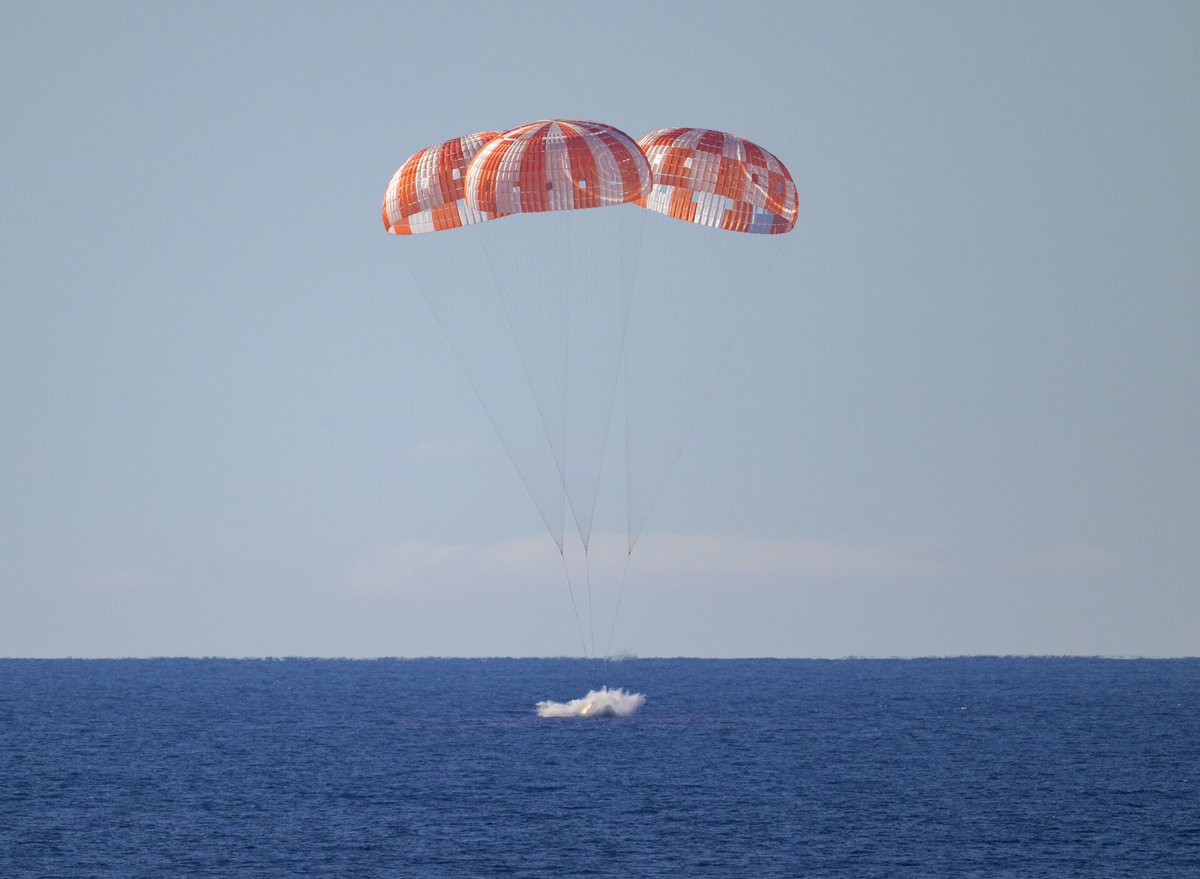
On April 10, four astronauts splashed down in the Pacific after flying around the Moon.
The last time humans went that far from Earth was December 1972. Apollo 17.
That's a 54-year gap. In that time we invented the internet, smartphones, AI, gene editing, and reusable rockets. But nobody left Earth's orbit.
🐋 Mind officially blown.
That gross-looking lump some people call “whale vomit” is actually ambergris — and it can sell for $40,000 to $65,000 per kilogram.
A single beach find has turned fishermen into millionaires overnight.
Why? It’s insanely rare, ages for years in the ocean like fine wine, and is the ultimate natural fixative in luxury perfumes (think Chanel-level scents that last forever).
Fresh = stinky.
Aged = sweet, earthy, priceless “floating gold.”
Nature’s weirdest luxury good. Who’s going beachcombing? 😱💰
🎥 inventionshark