Ti Oluwalase ✌🏽
...know that all things work together for good to them that love God, to them who are called according to his purpose.
God bless Nigeria🙏🏽
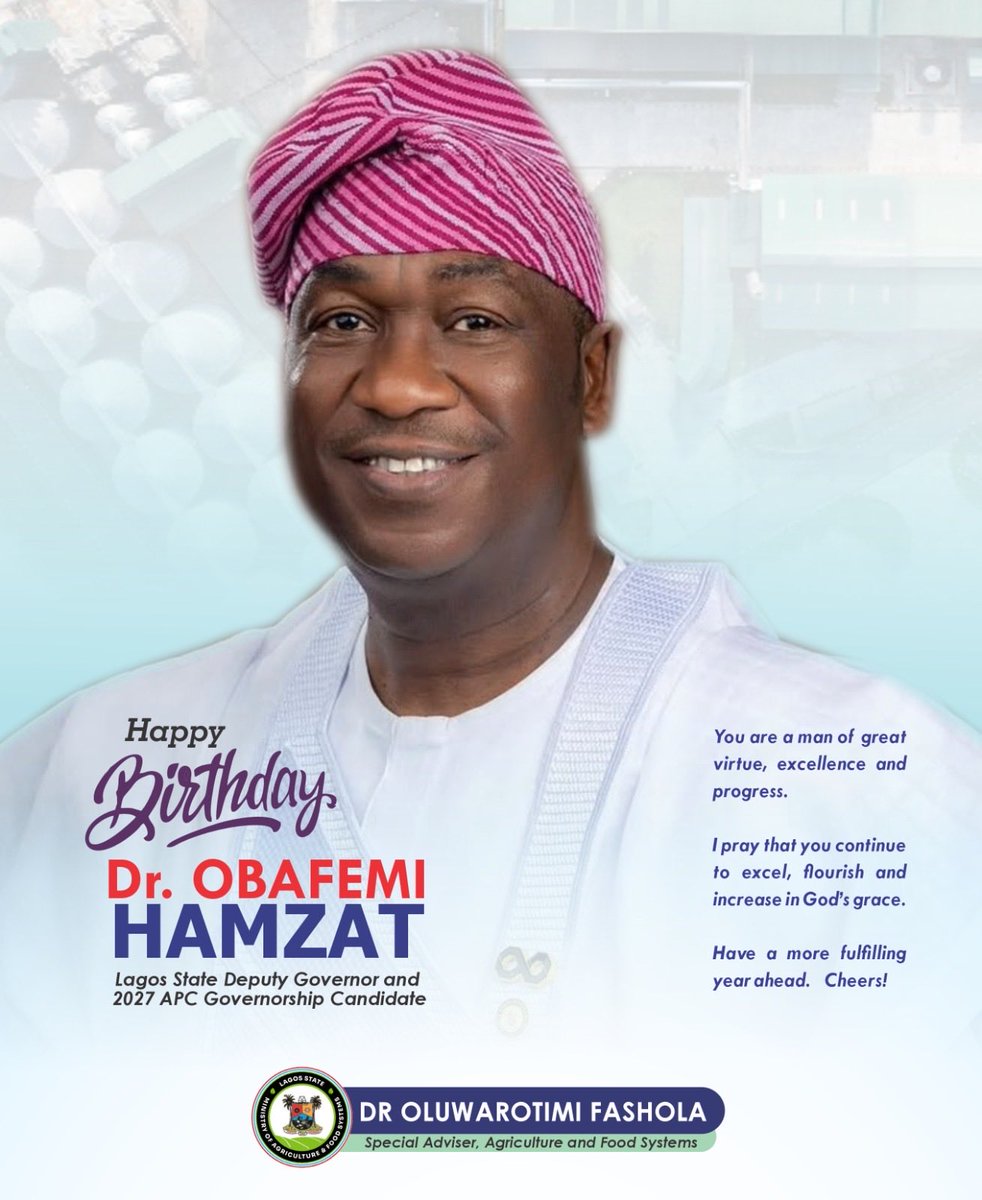
Happy Birthday Sir! Dr. Obafemi Hamzat 🎊🎉 @drobafemihamzat
You are a leader who pays attention to detail, an agricultural engineer🫶🏽 and the best deputy governor so far💯💯
Omo Eko pataki🇳🇬
May God bless you and grant you a more fulfilling year.
#KOH Our Next Governor 🙏🏽🙏🏽
Today, I warmly celebrate a trailblazer, a visionary leader, an agricultural engineer, and an exemplary public servant, Dr. Kadri Obafemi Hamzat.
Your remarkable track record, vision, excellence, and unwavering dedication to the development of Lagos State continue to inspire.
…what are we producing (non-oil) in Nigeria that the rest of the world genuinely cannot resist?
Spent some time at the FirstBank Agric export expo today…
Not asking for much
One of the things I have learnt from spending time with farmers, traders and others who make their living from food is that they rarely ask for what you expect them to ask for.
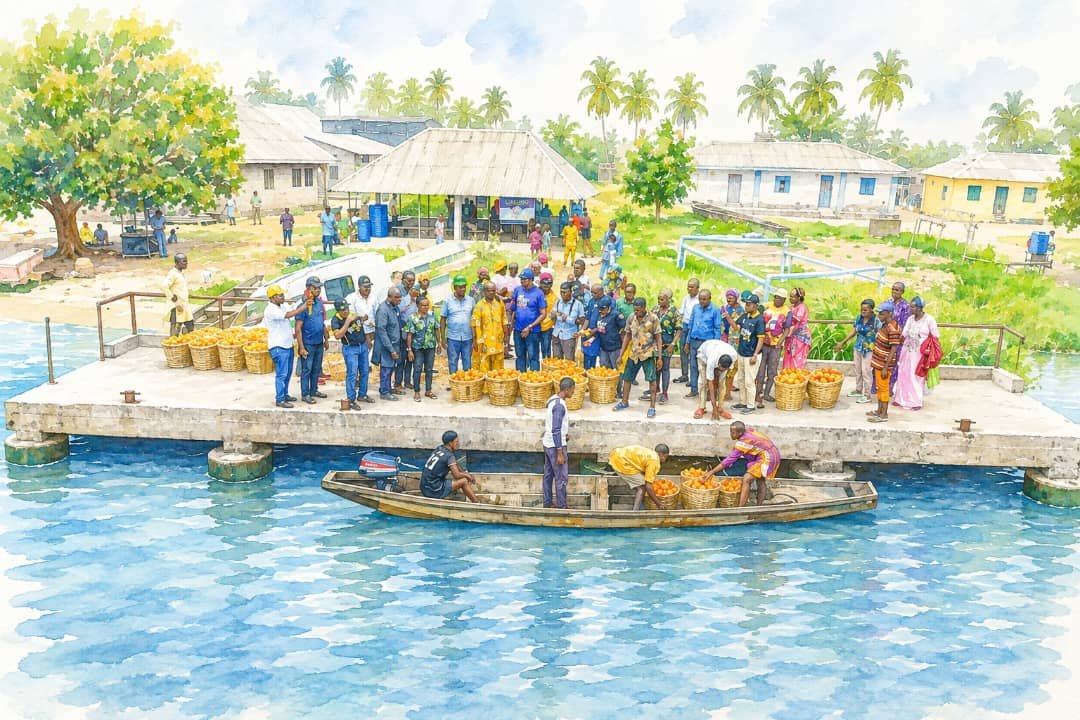
We have become accustomed to describing food security in big language, around financing, infrastructure, productivity, market access, supply chains and investment, and while all of these matter, conversations with the people who actually grow, move and sell our food tend to be far more ordinary. A farmer wants to know that when his tomatoes are ready, there will be someone to buy them; the woman selling fish needs enough ice to keep it fresh through the day; a trader wants to get her produce into the market without spending hours in traffic; and for a say a Dadi Luis farmer working in a riverine community, a reliable boat can make the difference between getting produce to market in good condition and losing a good part of what has taken months to grow.
The more time I spend around food system stakeholders, the more I find that the enormous problem we call food security becomes a collection of very ordinary problems when you get close enough to it. It is water, power, storage, transport, a decent place to trade, a road that works, information about where demand exists, and the reasonable expectation that after putting so much into producing food, there will be a market for it.
I wonder whether, in trying to solve problems at scale, we (this includes myself as HC Ag. & FS, Lagos state) begin too far away from the people experiencing them. We design around the size of the challenge, when some of the most useful interventions are simply those that remove the everyday difficulties that make growing and selling food more expensive, more
uncertain and much harder than they need to be.
This is particularly important in a city like Lagos, where feeding millions of people every day depends on countless individual decisions made long before food reaches a market or a kitchen. Someone has to decide to plant again, a trader has to decide how much to buy, a transporter has to make the journey, and each of those decisions is affected by whether the basic things around them work reasonably well.
There will always be a place for the large investments and ambitious ideas that a food system of our size requires, but its pertinent that we become just as interested in fixing the ordinary things, because when you listen closely to many of the people who feed us, they are really not asking for much.
...members of the Lagos Agrinnovation club @lagos_agriclub and the Ministry of Ag & food systems @lagosagric1 at the China-Nigeria Agricultural Technology cooperation summit - a 2 week training programme in the heart of China's Agricultural belt.
A big thanks to the PRC consul general @china_cg_lagos and the LASG SSG @BSaluHundeyin for facilitating the programme
Our delegates gave sang at the farewell dinner today!!!
APC’s loss in Osun is very healthy for the internal democracy of the party…
Never again should people be ridiculed from primaries!!!
A political party must be rooted in consensus ideologies not mere individual egos or power play.
Congratulations to the people of Osun State!
Water, e no get enemy!
There is a farming community in Lagos called Dadi Luis that I have visited a number of times and, for reasons that have very little to do with the size of their farms or how much they produce, I have developed a particular fondness for the people.
Dadi Luis sits on a rather unusual stretch of Lagos, with the lagoon on one side and the Atlantic Ocean on the other, so getting there already tells you something about the lives of the people you are going to meet. They grow tomatoes and peppers, they fish and do some shrimping, and the farmers themselves cut across generations, with older people who have clearly been doing this for years working alongside much younger people who have also chosen to earn a living from the land and water around them.
What amazes me is how contented they are. I use that word carefully because it is easy to visit a rural community and romanticize a life whose difficulties one does not live with every day, however, there is a steadiness about Dadi Luis that is difficult to miss. The community has strong leadership, people seem to trust one another and, despite the obvious difficulties of farming in that environment, there is a quiet focus on simply getting on with the work.
This is why I started thinking differently about their request for boats. On the surface, it is straightforward enough, because they farm in a riverine community and their produce needs to leave the community, but it reminded me of how easily we use words like market access and logistics in agriculture without always appreciating how differently they translate from one place to another. We usually think about trucks, roads, warehouses and aggregation centres, whereas for a tomato farmer in Dadi Luis, the journey to market begins on water.
By the time those tomatoes reach a road, the farmer has already incurred the cost of moving them across the lagoon, handled them several times through loading and unloading, and taken the risk that comes with moving highly perishable produce over water. The road journey that we would ordinarily describe as logistics is therefore only one part of a journey that began much earlier.
Dadi Luis has also made me think about agricultural infrastructure in a slightly broader way because, while we easily recognize a feeder road, irrigation system or storage facility as infrastructure, in a community like this, a suitable boat and a safe landing point are doing much the same thing. They provide the connection between production and the next stage of the food system, without which producing more does not necessarily mean getting more food to market.
There is also something already working in this farming community that I think is equally important. The farmers operate on contiguous land, they have established leadership and there is a community around production rather than a collection of farmers scattered across different locations. This makes shared solutions much more possible because a boat, an aggregation arrangement or eventually a cold-chain service will still require people to decide how it is used, how it is maintained and how the costs are shared. Government can provide an asset, but whether that asset remains useful long after it is provided will depend considerably on the community around it.
It is probably impossible for a Nigerian of my generation to spend this much time thinking about water without Fela's “water, e no get enemy” humming in one’s head, and the expression feels particularly appropriate here, because the water surrounding Dadi Luis is part of both its opportunity and its reality. It provides fish and shrimp, shapes how people live and farm, and also determines how what they produce must travel.
My visits have left me thinking less about how to make farming in Dadi Luis look like farming elsewhere and more about what would allow what already exists there to work better. If the route to market begins on water, then my job is to make that part of the journey safer, cheaper and more dependable, while ensuring that what happens when the produce reaches land connects properly to aggregation, transportation, storage and ultimately the market.
What happens after?
I have been thinking a lot lately about what happens after an intervention ends, because in government we spend so much time dealing with the problem immediately in front of us that there is not always enough time to think about what the same problem might look like six months or a year later. Food prices are rising, farmers are complaining about the cost of inputs, consumers are struggling with what they are meeting in the market, and naturally there is an expectation that government should do something about it. Sometimes we simply have to, because people are dealing with the problem today, farmers still have to plant when the season comes, and households still have to find a way to put food on the table while the longer and more difficult solutions are being worked through.
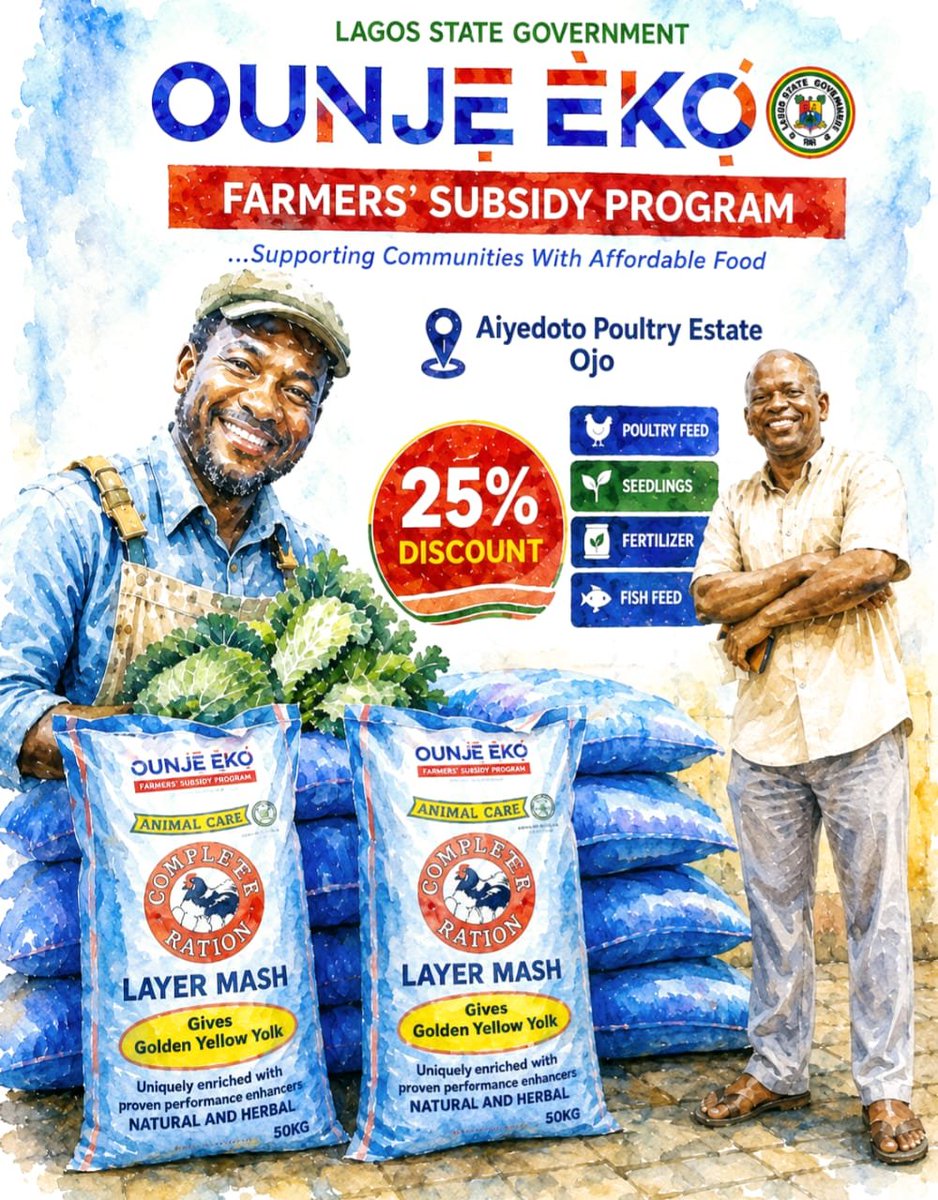
We saw some of this with the Ounje Eko farmer subsidy programme, where we were trying to address food prices from the production end by reducing some of the costs farmers were carrying. The thinking made sense because feed, fertilizer, seedlings and several other inputs had become increasingly expensive, and there was only so much of that additional cost a farmer could absorb before passing it on. Eventually, the cost moves through the food chain and arrives in the market, where the consumer experiences it simply as another increase in the price of food.
Our intervention was therefore to work with manufacturers and suppliers to subsidize some of these inputs for farmers, rather than waiting until the food had been produced and then trying to intervene only at the point where the consumer was buying it. If we could reduce what it cost the farmer to produce, then we had a better chance of influencing the price at which that food eventually entered the market, and for a period we saw exactly that happen. Farmers got some relief on their production costs and prices responded, which was important at a time when both producers and consumers were under considerable pressure.
A few months later, however, many of those farmers were back in the same market buying the same inputs at prices that remained high, and gradually we found ourselves confronting much of the same problem again. I have thought about that quite a bit because it made me question what exactly we had changed. The intervention had done what it was intended to do during the period in which it operated, but the price of the inputs themselves had not fundamentally changed; what we had changed, for that period, was how much of that price the farmer had to bear.
There is an important distinction there which I probably understand better now than I did before. If fertilizer is expensive because the components required to produce it are expensive, or because energy, transportation, foreign exchange and financing have increased the cost of getting it to the farmer, subsidizing the final price certainly gives the farmer some relief, but it does not necessarily change any of those things. The same applies to feed. If the cost of maize and soybean is rising, energy is expensive, transportation costs have increased and the manufacturer is financing production at a high cost, then helping the farmer pay less for feed during one production cycle does not remove the factors that made the feed expensive in the first place.
None of this means that the intervention was unnecessary or that I would not support a similar intervention when circumstances require it. There are periods when the pressure on farmers and households becomes so significant that waiting for every structural problem to be resolved before the agency of government acts would make little sense, particularly with food, where the consequences of doing nothing can be felt very quickly. What it has changed for me is how I think about what that intervention is expected to achieve and, perhaps more importantly, what must continue after it has ended.
Sometimes what an intervention gives us is enough breathing room for a farmer to get through another production cycle, for production not to fall as sharply as it otherwise might have, or for consumers to experience some relief while more fundamental problems are being addressed. There is real value in that, but I have also become more careful about confusing that relief with a permanent change in the system, because the two are not necessarily the same thing.
When the same pressure begins to return after an intervention has ended, the conversation has to move beyond how we subsidize the next production cycle and towards why the cost keeps returning in the first place. That takes us into questions that are inevitably more complicated because the answer may lie in how much of what our farmers use is produced locally, what manufacturers themselves are paying for their raw materials, the cost and reliability of energy, transportation, access to finance, foreign exchange exposure, the scale at which inputs are being produced, the number of intermediaries between the manufacturer and the farmer, and even the way farmers purchase inputs, often individually, in relatively small quantities and at the point in the season when everybody else is trying to buy the same thing.
Once you begin to look at it that way, the issue is no longer simply the price of an input. It becomes a much broader question about the system that produces, finances, distributes and eventually sells that input to the farmer, and it also begins to explain why reducing the price at the very end of that chain can be effective for a period without necessarily changing the economics that created the price.
This has probably been one of the more important shifts in the way I think about food policy since coming into government. Earlier on, I was naturally very interested in whether an intervention achieved the objective we had set for it, and I still am, because government must be able to demonstrate that programmes have delivered what they were designed to deliver. Increasingly, however, I also find myself looking several months beyond the intervention and asking what remained after we stopped supporting it, because that often tells me something quite different about how much of the underlying problem we actually addressed.
If farmers can continue producing at a lower cost after an intervention ends, then something more fundamental may have changed. If a new distribution arrangement continues to reduce the cost of getting produce to market without government having to support every transaction, then we may have altered part of the system itself. If farmers begin aggregating their demand and buying directly from manufacturers because an intervention brought them together in the first place, then the value of the programme may continue long after the subsidy has disappeared. On the other hand, if every participant simply returns to exactly the same conditions that existed before the intervention, then we may have provided very necessary relief without yet changing the structure that made the relief necessary.
I think there is room for both kinds of government action, particularly in a food system as large and complicated as ours. There will be periods when immediate intervention is necessary because the pressure is happening now and people cannot wait for solutions that may take several years to mature, but there also has to be a point at which we return to the problem that made the intervention necessary and begin the slower work of changing it.
For the Ounje Eko farmer subsidy programme, that means going back beyond the amount the farmer eventually paid and looking again at why those inputs cost what they did in the first place, whether there are parts of that cost that can be permanently reduced, whether local production can be expanded, whether farmers can purchase differently, whether aggregation can improve their bargaining position, whether financing can be structured better, and where government intervention can help create changes that continue even when government is no longer paying part of the bill.
This is what I now mean when I ask “What happens after?”. I am not only interested in what happened while an intervention was running, because that tells us whether we responded to the immediate problem; I am increasingly interested in what the food system looks like when the intervention is no longer there, because that is often where we begin to see whether we changed the problem itself or simply made it easier to live with for a while.
@mrsanwo@NigeriaStories She is not a flower, she has a brain… and she must not be encouraged to dance on the median
Even billboards are regulated… not to pose safety issues
@mrsanwo@Asake_Alagbo@NigeriaStories You are trying to twist the narrative to her dressing
I am talking about her safety and the safety of road users
You proposed capital punishment for the driver, okay and I asked you what you will propose to someone posing safety hazard
Foolishness must not be encouraged…
@mrsanwo@Asake_Alagbo@NigeriaStories Dancing on the road is a safety issue
Her dancing can distract drivers. That is dangerous to her and commuters
The focus isn’t on her dressing… stop what you are trying to do
She poses a road safety risk and should be sanctioned by the @FRSCNigeria
The driver is wrong, but what she did is too dangerous for other road users.
We need to uphold discipline and rule of law!
Asake's Red Bull Symphonic
In the course of simply living my truth, I seem to have developed an almost unhealthy affection for Asake's music. If I happen to be in one of those slightly funky moods that long days occasionally produce and someone decides to play an Asake song, my disposition changes almost immediately. I have listened to his Red Bull Symphonic so many times, and have it on repeat play – one would think I no longer listen to my other fave artiste - WizKid (hey, I am still your fan).
What keeps drawing me back to that performance, however, is not just the music. I always stop focusing only on Asake and find myself paying closer attention to everyone else. My eyes wander from the orchestra seated behind him to the bàtá drummers whose rhythms give the performance its unmistakable Nigerian soul, then to the dancers, the backing vocalists, the conductor, the sound engineers and the production crew, each one performing a role that is so distinct, yet so seamlessly woven into the whole that it becomes impossible to imagine the performance without them.
We naturally applaud Asake because he is the face at the centre of the stage, yet the more I watch, the more I realize that what the audience iwas applauding was not simply an artiste, but the harmony created by dozens of people whose contributions become almost invisible precisely because they worked so well together.
As someone who spends a great deal of time working on food systems initiatives, it probably won't surprise you to know that my mind wandered almost immediately from music to food, because what I was watching on that stage was remarkably similar to the way we often think about agriculture.
Take something as simple as a basket of tomatoes. The farmer, much like Asake stepping onto the stage, is where the journey begins and understandably where our attention is first drawn. But from the moment those tomatoes leave the farm, an entirely different cast quietly takes over. Roads determine whether the journey is smooth or painfully slow, transporters move the produce across hundreds of kilometres, fuel keeps the trucks moving, cold chain preserves freshness, electricity keeps storage facilities functioning, finance enables farmers, processors and traders to continue operating, wholesale markets connect supply with demand, retailers place food within reach of consumers and regulators work quietly to ensure safety and quality.
By the time that basket of tomatoes eventually arrives in your/my kitchen, the farmer has performed an indispensable role, but so too has everyone else whose contribution has quietly shaped the outcome.
We however instinctively celebrate the farmer always because farming is the most visible part of the food system, much like we celebrated Asake standing under the spotlight. Yet, visibility has never been the same thing as responsibility, and being the face of a performance has never meant carrying the performance alone.
It struck me that this is exactly what made the Red Bull Symphonic so compelling. The orchestra carried the melody, the bàtá drummers added rhythm and identity, the dancers transformed music into movement, the sound engineers ensured every note reached the audience exactly as intended, whilst the production crew somehow made an extraordinarily complex performance feel effortless.
Food systems operate in much the same way. Transport carries food just as the orchestra carries the music. Cold chain quietly preserves freshness in the way sound engineers preserve quality. Markets connect producers with consumers much as the stage connects performers with their audience, while infrastructure, finance, regulation and energy each play roles that are rarely celebrated but become immediately noticeable the moment they fail.
This is why I am an advocate of “food does not really belong to any one ministry”. It belongs just as much to transport, energy, finance, trade, health, urban planning, even environment. Seen this way, food is no longer a sector to be managed by one institution; it becomes the outcome of how effectively many different institutions perform together.
This distinction matters because it changes the questions we ask. Rather than asking what one ministry is doing, it should be “how well interconnected are our ministries/institutions whose decisions ultimately determine whether food reaches our tables safely, efficiently and affordably?”.
Just as Asake, regardless of how bountiful the farmers’ harvest is, all effort is lost if the other players behind the scenes are not given commensurate attention/importance.
Perhaps, our collective mistake has not been expecting too little from agriculture, but expecting too much from it. Great performances are never remembered because of one extraordinary person alone, and great food systems are never built by one extraordinary ministry either. Both succeed because many different people, each performing an entirely different role, work together so seamlessly that all we notice is the experience itself, and by the time the applause begins or food is served, the real work has already been done by countless people we may never know, yet without whom neither the music nor the meal would ever have been possible.
Long live Giran Republic!!!
@Abi_Olusanya Yes! 100% on point
Even security structure plays a role in how affordable / available food becomes.
Agriculture is interconnected with virtually every profession…