What would you ask a trader who generated +522% across two U.S. Investing Championships?
🎙️ We’re hosting an AMA (ask me anything) with @Clement_Ang17, who posted +522% across the 2024 and 2025 U.S. Investing Championships and topped the 2025 million-dollar division.
Drop your questions below 👇
Like the ones you want him to answer.
The top questions will be answered in a thread on Wednesday, Sept. 23.
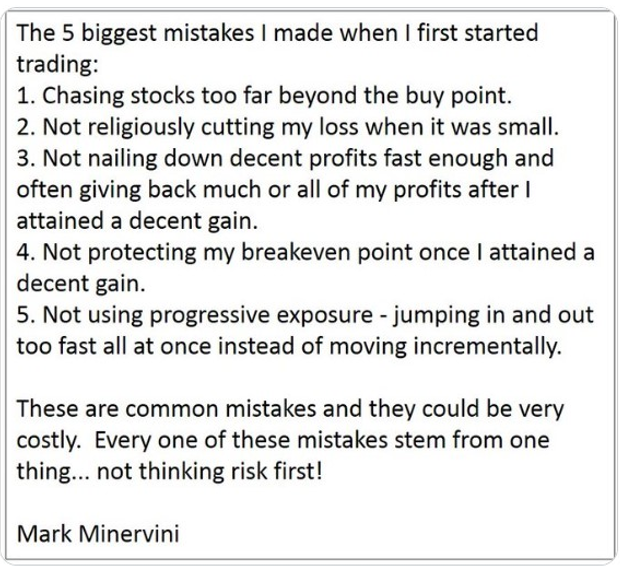
Here are some of the biggest mistakes I made when I was new to trading and very likely the same mistakes you will make a well. They all stem from one thing!
traders who find consistent success in the mkts have a solid foundation that is based on repetition in execution of edges and strong habits and routines to consistently perform in the markets.
There is no need to sit and stare at the screens.....
There are no setups for me....
Watching active markets can make me emotional and cause mistakes....
Emotional management....
Taking a walk instead .....
In life and in trading, you are always going to make mistakes. In trading, you are going to have losses. The fear of losing is like the butterflies you have before a high-pressure situation. The goal isn't to get rid of the butterflies... it's to get them to fly in formation.
Understanding themes or group dynamics in the market can be either deductive or inductive.
Top-down (deductive) involves isolating the top sectors and/or industries by relative strength, then drilling down to the stocks in those groups. Essentially, you're assuming that the top stocks will be in the top groups.
Bottom-up (inductive) means looking at the top stocks by relative strength and making assertions about groups or themes based on plurality and participation. You're assuming that stocks move like schools of fish in groups, and by isolating these themes, you'll be in the top areas.
You can probably combine these two approaches and ensure your bottom-up analysis matches your top-down. If there's a conflict, then you have to decide what to do about that. Either approach is a valid way to look at the market, and top traders have found success with both.
For newer traders, the top-down approach easier to understand, and it provides a "right" answer more quickly. You're essentially looking at maybe the top three sectors and/or the top 20-30 industry groups. However, there's often a lag factor. By the time a group ranks high on the RS charts, the move has often been ongoing for a while. This method is often easier for newer traders, keeping them in the top-performing groups and away from the underperformers.
The bottom-up approach is more anticipatory, allowing you to "see things coming." However, it requires sifting through hundreds, sometimes thousands, of stocks. You also need to be adept at building a weight of evidence in your mind, understanding and reading plurality to get an accurate sense of what's happening. Patterns and clues emerge and proliferate across stocks, building themes from the bottom up. This method is often favored by more experienced traders who have the time and expertise to assess numerous charts.
Trading and market analysis are all about trade-offs. If the top-down approach provides 80% of the solution less time, then maybe it's worth leveraging that advantage. Will it yield the same results as the bottom-up approach? Usually, but not always. I tend to combine the two, using both trend of the indices/sectors and breadth/participation of groups of stocks.
📢 My first article is out! 📢
I discuss how to use charts for both Traders and Investors and 3 Keys For Using Technical Analysis Properly 📈
Check it out and drop some feedback in the comments 👊
👍 Like and Retweet! 🔁
https://t.co/SxkGI1qxmu
traders who find consistent success in the mkts have a solid foundation that is based on repetition in execution of edges and strong habits and routines to consistently perform in the markets.
"Anything worth doing is worth doing badly." — G. K. Chesterton
This isn't a call for mediocrity but a powerful reminder of the value of taking action, even small action, to gain experience and understanding. For some reason people get paralyzed with fear and hesitation at the thought of being wrong. In doing so, they aren't even willing to do basic experimentation and trial and error.
They either want to be spoon-fed the answer or, given multiple scenarios or options, take no action rather than taking partial action. Sometimes it's essential to act, even if conditions aren't 100% ideal. This mindset can lead to growth and success in momentum trading.
While I've certainly had influences, most of what I do is from my own experimentation and trial and error. I've "competed" numerous strategies against each other. I'm constantly fiddling and trying things. "What about this?" "How do I do that?" - sometimes you just get in there and try it. What's the worst that can happen? You have to close out the indicator and try again? You lose $5 on the trade? Ok, so what. Now you have more experience and information than before. If the risk is "too high", then do the experiment with a smaller amount of risk.
I'm not suggesting throwing caution to the wind and doing stupid things or risking insane amounts of money. Use a level of risk you can accept. This experimental account I'm doing is a great example of what I'm talking about. I wasn't waiting around for someone to give me the answers. I had questions, so then I set the conditions to help answer my questions. That is the heart of learning and experience. It is the essence of "failing forward".
Experimentation Fuels Learning:
Testing Theories: Trading hypotheses and strategies can be vetted only when they're tested in the live market. Experimenting allows for real-world validation.
Practical Over Theoretical: Sometimes, the gap between theory and practice can be vast. Experimentation narrows this gap, offering real insights.
Embrace Imperfection:
Reality Check: There's no 'perfect' trade in momentum trading. Even the best traders have had trades that didn't go as expected.
Learning in Action: Every trade, whether successful or not, offers a lesson. By avoiding trades out of fear of imperfection, you're also avoiding the learning that comes with it.
Understand the Cost of Waiting:
Missed Opportunities: While waiting for the perfect setup or condition, the market moves. Momentum, by definition, is about capturing movements, and hesitation can mean missed profits.
Analysis Paralysis: Overanalyzing can lead to inaction. Sometimes, the best insights come from real-time decision-making and adaptation.
Accept Losses as Part of the Game:
Fixed Mindset vs. Growth Mindset: Instead of viewing losses as failures, see them as growth opportunities. What can you learn from this trade that can be applied to the next?
Risk Management: Instead of aiming for zero losses, focus on managing them. Use stop losses, diversify, and always assess your risk tolerance.
Consistency Over Perfection:
Habit Building: Regular trading, even if not always perfect, helps inculcate discipline and builds habits crucial for long-term success.
Compound Knowledge: Just as compound interest works for investments, compound knowledge works for traders. Every bit of experience adds up over time.
Failures as Stepping Stones:
Building Resilience: Embracing failure not as a setback but as feedback fosters resilience. It conditions traders to bounce back from losses more effectively.
Refining Strategies: Not every experiment yields the desired result. Failures highlight what doesn't work, helping to refine and enhance strategies.
Reflect and Adjust:
Iterative Process: After each trade, take a moment to reflect. What went well? What could have been done differently? Use these insights for the next trades.
Continuous Improvement: Instead of aiming for perfection, aim for continuous improvement. With each trade, the goal is to be a little better than the last time.
Conclusion:
The pursuit of perfection can hinder progress, especially in momentum trading, where the landscape changes swiftly. By embracing imperfection and valuing consistent action over perfect action, traders can navigate the markets more effectively, learning and growing with every move. Remember, in trading, as in life, progress is more valuable than perfection. So, take action, reflect, adjust, and keep moving forward - and stop being a little bitch.
"When people tell me that trading today is too difficult, that the market is too complex and the pros have the edge, it makes me chuckle. It's a much more level playing field today between the amateurs and the professionals."