My article 'Evidencing alethocide: Israel’s war on truth in Gaza' in Third World Quarterly is currently free to access, download it while you can! https://t.co/iJDKFAKD5N #GazaGenocide
🧵One more thread on EU trade with Israel's illegal settlements.
Lot of people ask - would an EU ban on such trade require unanimity or qualified majority (QMV) of EU states?
Together with @CIDSE@DorienVdb50 we asked this question to experts on EU constitutional law.
@JouniManty67146 Lähi-idässä on todella paljon upeita keskiaikaisia linnoituksia. Kaiken muun lisäksi on harmillista, että myös kulttuuriperintöä tuhotaan.
https://t.co/6GRrVanGdB
Israelin armeijan Libanonissa valtaama Beaufortin linna oli myös 1982-2000 Israelin miehittämä. Sieltä vetäytymisestä tehtiin 2007 varsin katsottava leffa. Siinä seurataan läheltä pientä joukkoa israelilaisia sotilaita ja heidän kipuiluaan sodan turhuuden ja sen järjettömien uhrauksien kanssa.
I hate to be the guy to pour cold water on the reports of IDF troops reaching the Beaufort Ridge in Lebanon, but I struggle to understand why this is being celebrated.
For anyone who lived here in the 1990s, the Beaufort is not a symbol of success. It represents Israel's long and costly presence in Lebanon - something that claimed too many soldiers' lives and ended without Israel achieving its strategic goals.
The fact that the IDF can reach the Beaufort today is obvious and - despite the media festival - is not even close to a victory. The real questions are different: How does Israel eventually leave? What is the political endgame? And are we possibly witnessing the beginning of another prolonged military presence in Lebanon without a clear horizon for how it ends?
Because here is what we already know way too well - getting into Lebanon is always easier than getting out.
"What I did in Gaza: an Israeli soldier’s reckoning," as he helps to debunk the Israeli government’s narrative that atrocities and war crimes were committed by only a few bad apples. “It’s the entire system. It is systematic crimes that we are doing.”
https://t.co/fW09cR4vyt
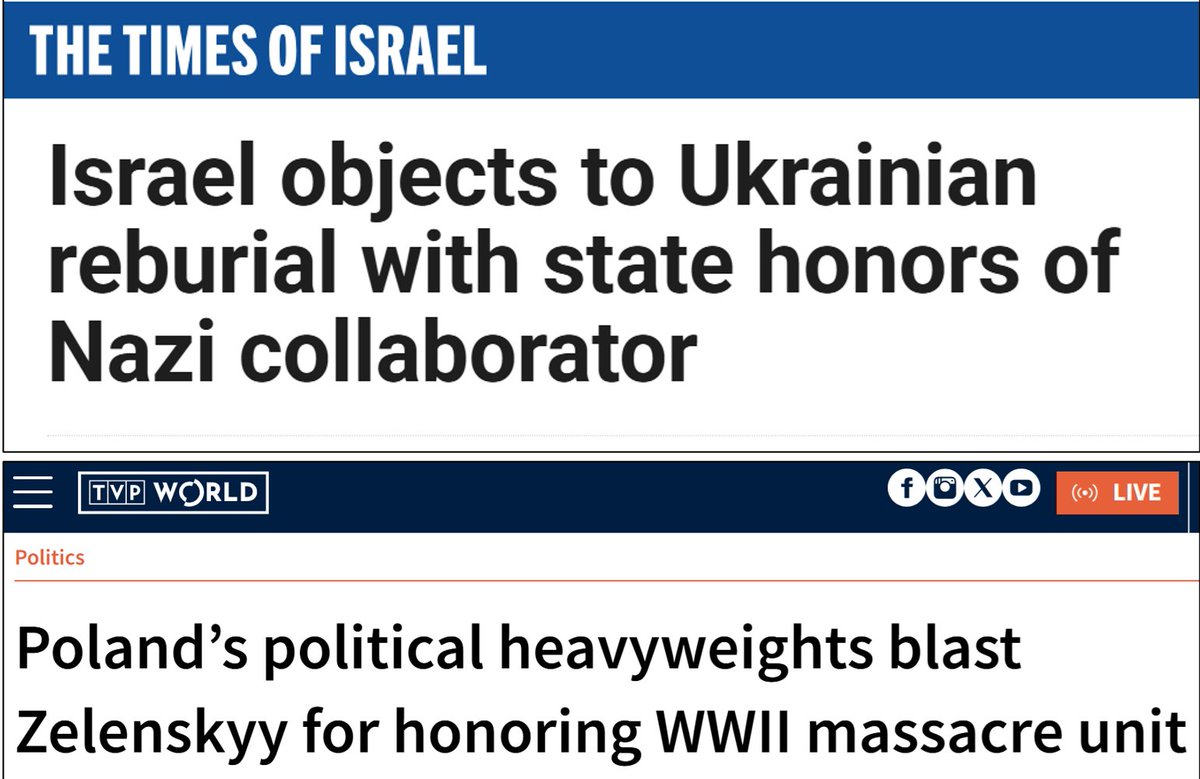
Kaksi asiaa tapahtui Ukrainassa toukokuussa, ja molemmat aiheuttivat kansainvälisiä protesteja. Jälkimmäinen, allaoleva uutinen on tuore, ja huomioitu Suomessakin. Mistä on kyse?
Tässä voi kerrankin olla hyödyksi historiantutkijana, joten teen nyt näistä ketjun. Hyvin pitkän.
The genocide case at the ICJ is proceeding predictably slow.
So, a reminder: the Convention on the Prevention and Punishment of the Crime of Genocide obligates states to **prevent** genocide where a risk of it exists.
In Gaza, that risk is years old and patently clear.
Horrifying report that will of course be instantly attacked, dismissed, belittled and mocked by the same shameless apologists for the Israeli govt who went after @NickKristof following his own shocking and very similar recent report.
Noa Tishby is an actress who doubles as an influencer for genocide.
I'm a historian who wrote a ph.d dissertation on the subject of Tishby's blockbuster 90 second history lesson.
Let's debunk the main claim. Tishby is narrating well-trodden hasbara, namely, that the Roman Emperor Hadrian vengefully erased the name 'Judaea' in 135 CE & replaced it with 'Syria - Palestina' to "sever the Jewish connection."
The first thing to ask yourself is why the microscopic focus on one alleged administrative nomenclature change in 135 CE in a 90 second summary of 2000 years of history. But we digress.
Tishby presents this erasure story as fact. But it's not a fact. It's a theory at best if not simply mythology.
The evidence for the theory is that some inscriptions in the Roman Empire start to refer to the land as Syria Palaestina sometime after 135 CE.
That's the closest direct evidence we've got. We don't even know if Hadrian issued an imperial decree or not ... that's already speculation.
Instead, "Syria Palaestina" gradually came into use after the Bar Kokhba Revolt was crushed in 135 CE to refer to the area.
So happened? Let's assume it was an imperial decree.
It's further speculation that the reason for the name change was in of spite the Bar khokhba revolt (what Tishby calls 'the Jewish connection').
Yet, it seems equally plausible that Hadrian changed the name to Syria - Palestina for the same reason he changed Antigonea to Mantinea, or Sepphoris to Diocaesarea. He revered ancient Greece & revived many Greek customs, traditions & names.
Or, perhaps Hadrian changed the name to Syria Palaestina because the province was now larger, and Syria Palaestina was a better term to describe what was now a larger administrative district.
Or, perhaps there was no imperial decree at all. Perhaps it was a process of dynamic evolution, evidenced by the fact that the names Palaestina & Judaea were both in use before & after the ostensible name change.
Indeed, official inscriptions bear the name Judaea from after the alleged change: 1 inscription in Austria referring to a procurator of Judaea; 1 in Ephesus, Turkey, identifying Sextus Erucius Clarus as governor of Judaea . Wouldn't that have been awkward, indeed, blasphemous, if Tishby's erasure theory was true?
Other sources like Galen, Celsus, Dio Cassius, Festus, Eutropius, Martianus Capella, Orosius, Epiphanius, & the Epitome de Caesaribus used the term Judaea synonyms ly w Palaestina centuries after “Judaea” had putatively been erased. All those writers spat in the face of Rome?
We don't know why 'Judaea' was gradually superseded by the name Syria Palaestina. There are many plausible theories.
The one presented as fact by Tishby is not a fact, it's a hypothesis, developed to support the Zionist law of the universe, namely, that everyone, everywhere in all times and all places always has and always will hate the Jews.
For sources to all points made above, see pages 103-111 of my dissertation here: https://t.co/S2yTTb4DdU
@YaronNadbornik Tätä keskustelua käydään paljon perusteellisemmin Fosterin väitöskirjassa, johon linkki yllä.
Joka tapauksessa Tishbyn väite siitä, että Palestiina nimenä olisi roomalaisten keksintöä, on virheellinen.
Mielestäni pointti oli tämä:
Tishby väittää, että "the name Palestine came from the Romans", vieläpä niin, että sillä olisi pyritty häivyttämään Juudean nimi.
Tämä on melko yleinen väite. Tarkoituksena sen käyttämiseen nykyisessä poliittisessa kontekstissa näyttää olevan, joko eksplisiittisesti tai implisiittisesti, korostaa Juudean ensisijaisuutta ja Palestiinan keinotekoisuutta, sekä luoda rinnastus Hadrianuksen toimien ja tämän päivän palestiinalaisten poliittisten vaatimuksien välille.
Foster huomauttaa molempien nimien (Palestiina ja Juudea) olevan paljon tätä vanhempia ja haastaa Tishbyn häivyttämisväitettä. "Perhaps it was a process of dynamic evolution, evidenced by the fact that the names Palaestina & Judaea were both in use before & after the ostensible name change."
Eli Tishby pyrkii käyttämään historiaa koskevia väitteitä tavalla, joka ei ole perusteltua.
Kutsuin olkiukoksi, koska omiin silmiin ei ole osunut kenenkään vakavasti otettavan väittäneen, että Palestiinan valtio olisi "aina ollut olemassa" tai piilottavan saatikka kiistävän juutalaisten asumisen alueella v135 jälkeen. No, kaikenlaista pöhköä mahtuu kai nettiin.
Nähdäkseni asia ei myöskään liity varsinaiseen pointtiin, jonka Foster teki tuosta Tishbyn videosta.
This is likely what @ForensicArchi spotted Israel and the Board of Peace building on the ruins of Khan Younis: An ISF 'Mission Support Support Site' to control southern Gaza.
@antiantioedipe Foster lainaa tuossa Princetonissa hyväksyttyä väitöskirjaansa. Itse asia ei edes ole erityisen kiistanalainen.
Muuten jätän tuon kommenttisi arvottomana ad hominem heittona omaan arvoonsa.