⭕️ @Polkadot is launching something new Polkadot Cloud | ( @TheWeb3Cloud )
Essentially, it's an attempt to build a Web3 cloud where decentralized applications can be developed, deployed, and scaled on top of the Polkadot infrastructure.
It's still a soft launch, but the ambitions are clear:
🔸 up to 150,000 tx/s,
🔸 over 150 MB/s data throughput,
🔸 100+ execution cores,
🔸 support for DA, rollups, object storage, and even private blockchains.
They’re also promising rollup as a service, full application hosting, and the ability to run native smart contracts directly on the Relay Chain all under Polkadot shared security model.
Development is promised to be fast, cheap (up to 95% cost reduction), and as seamless as Web2 just on Web3 rails. Plus, there’s staking letting users secure the cloud directly and earn rewards.
If this actually delivers, Polkadot could, for the first time, become a home not just for protocol level infrastructure, but for end user products.
This isn’t about modularity for blockchain engineers anymore it’s about creating a competitive environment for dApps, rollups, and Web3-native cloud solutions.
Here’s why I find it especially interesting:
for the first time, it’s possible to launch entire Web3 products without leaving the ecosystem.
If Polkadot used to be the backend layer, Cloud gives it a shot at becoming the visible layer of Web3 infrastructure.
Watching closely how fast this evolves and which real projects will dare to move to Polkadot Cloud.
Promises sound loud.
But Polkadot always works quietly and then simply releases news not just with an update, but with the result. Therefore, in this case, for some reason I am more than sure that all this will work out.
It takes time and patience.
JUST IN: 🇺🇸 The SEC has approved the conversion of the Bitwise 10 Crypto Index Fund into an ETF, including assets such as $BTC, $ETH, $XRP, $SOL, $ADA, $SUI, $LINK, $AVAX, $LTC, and $DOT.
Frequency has crossed 2 million new user activations. 🔥
Frequency is building an internet where people—not platforms—own their social relationships.
Own your connections. Own your social graph.
Get live updates any time ↓
https://t.co/TzmD2Dkhlj
Artificial Superintelligence Alliance to Adopt $CHEQ Trust Infrastructure for AI Agents
The @ASI_Alliance is integrating @cheqd_io decentralized identity infrastructure.. including DIDs, verifiable credentials and trust registries into its AI ecosystem..
Ensuring every AI agent has a unique, on chain identity that can be independently verified
https://t.co/sEhHuqhRu2
🟠 “As AI agents begin acting independently across industries, trust in their identity is non‑negotiable” @fraser_again
⚪️ “Maintenance and validation of identity… is utterly foundational to the effective functioning of decentralized networks… The integration of cheqd… will significantly boost our capability to provide robust, secure, decentralized, AI‑friendly identity management” @bengoertzel
I personally have my reservations on $FET.. but there is no doubt this is a great endorsement for $CHEQ and Verifiable AI 🔥
$CHEQ
This $500M raise for $FET shows the #AI stack is shifting towards decentralisation. 🌐
CUDOS powers the compute layer of @ASI_Alliance using $FET to drive decentralised AI.
Curious why $FET is at the centre of #Web3-native AI?
Read more via @CoinDesk 👇
https://t.co/XJ9aIbEuMo
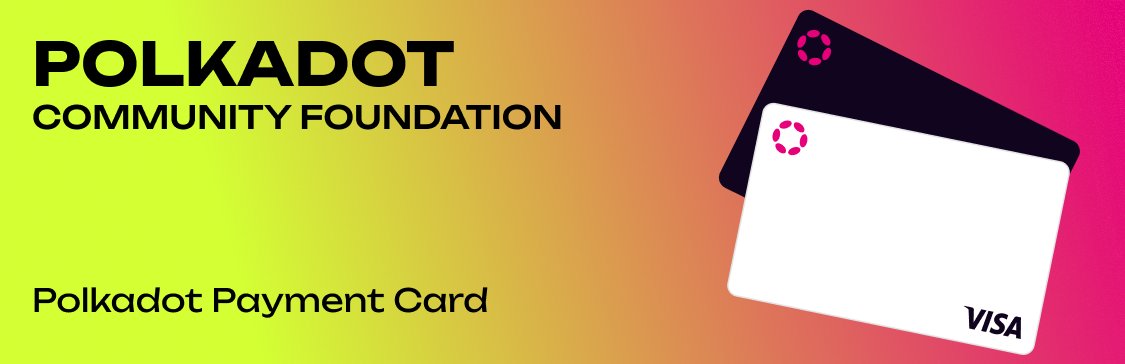
💥BOOM! $DOT | Bye-Bye Bank Accounts? @Polkadot's Non-Custodial Card Is Here, Fueling the Web3 Economy
A groundbreaking new proposal has been launched to bring a Polkadot-branded payment card. This isn't just any card; it's designed to be non-custodial, meaning you maintain full control of your assets, and it's set to launch globally, working anywhere Visa is accepted.
This initiative promises to significantly improve how we use our digital assets in daily life, offering seamless off-ramping and boosting Polkadot's utility for payments and DeFi.
Key Benefits
🔹 Improved Usability & Off-Ramping: Seamlessly spend Polkadot ecosystem digital assets in the real world.
🔹 Non-Custodial: Users retain full control of their funds; no topping up or moving assets out of your wallet, significantly reducing risk compared to most crypto cards.
🔹 Global Issuance: Designed for near-global availability, accessible to almost anyone.
🔹 Cost-Effective: No monthly account fees, minimum fees, or other holding/management charges (only gas for fund approval and a small transaction fee, under 1%).
🔹 Alternative to Traditional Banking: Especially beneficial for those earning income in stablecoins, offering greater financial flexibility and control.
🔹 Cashback
Launch
🔹 VIP User Launch: Estimated 6-12 weeks after governance proposal approval.
🔹 Full Public Launch: Weeks thereafter, assuming no issues.
Get ready for a new era of financial flexibility within Polkadot!
Bitcoin gave us a calculator.
Simple, powerful, but limited. Store of value... digital gold.
Ethereum built the computer.
Programmable money, smart contracts, DeFi, NFTs... an entire financial OS.
But now, Polkadot is creating the cloud.
Not just another blockchain... an interconnected, scalable ecosystem:
JAM: Decentralized execution environments, not just smart contracts.
Asset Hub: Seamless asset management and cross-chain bridging.
OpenGov: True decentralized governance, on-chain decisions.
POP (Proof of Personhood): Privacy-first digital identity at scale.
Polkadot isn’t just competing.
It's reimagining what blockchains can do.
Welcome to the next evolution of crypto infrastructure.
🚀 ASI:One is on mobile. Genius fits in your pocket!
✨ What’s new?
• Built for real life: Take @Fetch_ai 's agentic LLM anywhere.
• Pro tools, zero barriers: Everyone gets unlimited premium access to https://t.co/sxJHxsgMTZ
📲 Download now 👇
Android: https://t.co/Id00f7oWDt
iOS: https://t.co/v3fWGNTiaR
Finally, a Personalized Intelligent AI that goes wherever you go.
ASI: One's mobile app means you can get intelligent help during your commute, while waiting in line, or walking between meetings.
No more saving questions for when you're back at your computer. Your personal AI assistant is literally in your pocket, ready to help the moment you need it.
Try it Today👇
Android: https://t.co/LUudPPVCJ1
iOS: https://t.co/v3fWGNTiaR
The next critical evolution for humanity is trust and transparency. We see the lack of both all over X and the news everyday
Governments, banks, democracies, financial institutions… currently non of them can truly be trusted
And It’s why truly decentralized systems like Polkadot matter
We don’t need another wickedly fast
centralized system. We need a wickedly decentralized, transparent, and trustworthy system like Polkadot
Over the coming decades if decentralized systems succeed and beat government regulations. The general public will demand we move everything on-chain
They will demand a world of transparency. Hell, they are demanding it now. they just don’t know the solution is already being built
🔥 JUST DROPPED! 🚨
My debut video reveals the game-changing potential of @ASI_Alliance's ASI-1 Mini, powered by $FET!
🌟 Explore the latest updates, partnerships, and revolutionary tech with me. WATCH NOW and be ahead of the curve! 🚀🔴
👇 Link in the next tweet!
⭕️How to make Polkadot Great Again? Chapter2⭕️
Many people are saying that no matter how well the parachains on @Polkadot perform, it has little to do with whether $DOT will increase in value.
What's your opinion on this?
Our answer is that currently, the relationship is indeed not significant, but it can be improved.
However, this involves an important issue related to the development of Polkadot:
💥In terms of the development path, Polkadot Must Avoid Becoming “Just a Useful Infrastructure”.
To understand this issue, we need to add a bit of background information.
In July 2024, @mythicalgames , the company behind the NFT marketplace @DMarket , decided to migrate from @ethereum to #Polkadot and launched its own parachain, @EnterTheMythos Chain.
When asked why they chose Polkadot, Mythical Games highlighted four main reasons: system stability, which is crucial for ensuring the continuous operation of applications; scalable throughput, as Polkadot not only meets their current needs but also provides a clear roadmap for future performance improvements; and finally, true decentralization and a robust on-chain governance system, where Polkadot excels.
Although some have questioned the complexity of Polkadot’s system, Mythical Games believes that this complexity actually brings a high degree of customization, fully meeting their needs and supporting long-term growth.
The Mythical Games case is a great example. As a successful project in the industry, Mythical Games’ main focus is on high-frequency interactions like NFTs and blockchain-based games, which require a more selective choice of underlying blockchain infrastructure. After considering many of the industry’s top blockchain solutions, Mythical Games chose Polkadot for its relative advantages in areas such as performance and cost efficiency.
This sets a great example for other projects looking for better underlying infrastructure. Moreover, the upcoming #JAM proposal from @gavofyork promises to further enhance performance and support a wider range of applications, making Polkadot’s future look even brighter.
However, on the one hand, Polkadot has advanced technology and is attractive to well-known projects. On the other hand, its overall development and market performance have shown a stark contrast, which is less than satisfactory.
This is also why many Polkadot fans have mixed feelings — loving the tech but frustrated with its progress. Aside from some flaws in its technical design concepts, the biggest issue is Polkadot’s direction for development.
Now, let's discuss this crucial topic: how to avoid Polkadot becoming “just a useful infrastructure” and ensure its value matches its technology and potential.
⭕️Polkadot Must Avoid Becoming “Just a Useful Infrastructure”⭕️
What does “just a useful infrastructure” mean? Simply put, it refers to a blockchain project that, while extremely useful as an infrastructure, supports other application projects and helps them achieve great commercial success. However, these application projects’ revenue is either unrelated to or only minimally connected with the blockchain itself, meaning the blockchain doesn’t receive enough benefit or “dividends” from the success of these applications.
A classic example of this is @NBATopShot on the @flow_blockchain . NBA Top Shot was once the number-one ranked NFT application, with a peak monthly revenue of over $100 million and more than a million users. However, despite its tremendous success, there was little to no direct connection between NBA Top Shot’s success and the Flow blockchain. Flow blockchain didn’t benefit from the success of NBA Top Shot, and this has been one of the main reasons Flow blockchain has struggled to gain more momentum in the market.
Polkadot’s development shows a similar trend. While Polkadot itself boasts excellent technology, and its performance and fees are more competitive compared to other blockchain projects, along with its outstanding scalability, interoperability, and ongoing updates like the JAM protocol, it enjoys significant industry recognition in terms of its technical capabilities. This is why well-known projects like Mythical Games are drawn to the Polkadot ecosystem.
Now, with Mythical Games migrating to Polkadot and launching its Mythos Chain, along with the steady growth of other projects in the ecosystem, which has helped push the number of monthly transfers on the Polkadot chain to a new high.
But amidst what seems to be a thriving scene, Polkadot followers are starting to question: even if parachain projects are successful, how much actual value can they really add to Polkadot?
From an economic perspective, the most direct impact might be that parallel chain projects need to purchase Polkadot’s block space, by buying Coretime to access the blockchain’s resources. But currently, Polkadot has 100 Cores available, and their price is relatively low. Only when demand exceeds supply, making Cores scarce, can the price of Coretime significantly rise.
Based on the current rate of 100 DOT(estimated) per month for Coretime, the annual revenue from these sales would be 120,000 DOT. Although all of these DOTs are burned, this number is negligible compared to the annual inflation of DOT (total supply of 1.4 billion DOTs, inflation rate of 8%, and 112 million new DOTs per year).
This sense of powerlessness is like Polkadot being an incubator that helps nurture a highly profitable company, but only collects a small amount of rent in return. This is exactly what we don’t want to see. Although Polkadot advocates decentralization, the development of decentralization doesn’t mean interfering with the development of ecological projects as little as possible. Instead, it should consider itself as an ecosystem and grow sustainably together with ecological projects. This is the way for long-term development.
Therefore, we must consider other approaches. We should achieve that the success of the parachains on Polkadot will also empower Polkadot, and the development of Polkadot itself will intuitively reflect the real value of Polkadot. 💥Polkadot can’t just be useful without value. This is the core issue that we need to avoid.
⭕️Key Strategies to Empower Polkadot Ecosystem and DOT⭕️
1⃣Strengthen Polkadot to Strengthen the Ecosystem
Despite examples like Mythical Games migrating to Polkadot, we must recognize that for many projects, technology is not the primary factor when choosing a blockchain infrastructure. Because whether it’s Ethereum with its age-old technology or @solana , which has long been ridiculed as the “crash chain” that least resembles a blockchain, they are, on the contrary, the blockchain infrastructures that have developed the best and are the most attractive.
The main reason lies in the fact that they have both developed certain ecosystems. There are not only large amounts of capital, users, and projects, but also numerous money-making opportunities emerging constantly, thus forming a powerful network effect and being highly attractive.
Therefore, Polkadot needs to establish its own network effects. However, this requires addressing specific challenges:
Firstly, Polkadot did not directly support smart contracts, forcing many applications to deploy on parachains instead. However, this meant that the success of applications was closely tied to the development of the parachain itself. If a parachain migrates to another ecosystem, it could harm Polkadot and disrupt the application teams’ operations. Polkadot needs to capture and control these network effects and directly link them to DOT.
Fortunately, this issue is being addressed with the development of Plaza and JAM, which will soon provide a system-level, Polkadot-native platform that supports smart contracts (including Solidity), with DOT being used as gas fees. This would allow DApp to be deployed directly on Polkadot without relying on parachains.
Secondly, once Polkadot natively supports smart contracts, thriving ecosystem applications will generate more transaction fees.
Based on strategies from the article we posted “How Can Polkadot Accelerate Growth After the 8% DOT Inflation Adjustment?”(https://t.co/WZD4x9xIuu), Polkadot could use OpenGov to modify its current mechanism. Instead of directing 80% of fees to the treasury, these fees could be burned. This would create a direct link between application success and DOT value, with greater application usage driving higher DOT burning.
Thirdly, Polkadot’s current OpenGov operation is in a somewhat chaotic state, with no clear plan for fund usage or development. We believe that Polkadot’s first goal should be clearly established: building its own native network effect. Rather than spending large amounts of resources on unnecessary or inefficient areas, Polkadot should concentrate its efforts on this key goal, which also aligns with first principles.
To achieve this goal, the main logic centers around fulfilling the basic conditions required for the first two points: the readiness of Plaza or JAM, and the adjustment to burn 80% of transaction fees. With these in place, Polkadot can further leverage OpenGov to allocate a fixed annual percentage of funds to support applications built on Plaza or JAM.
This approach would encourage these projects to use DOT at scale or high frequency while airdropping rewards to eligible projects. Such incentives would benefit all DOT participants and quickly establish Polkadot’s unique network effects. Using treasury funds in this way is far more efficient than spending large amounts on low-impact advertising before a strong network effect is established.
A robust Polkadot can then drive the development of its ecosystem.
2⃣Leveraging XCM to Ensure Parachain Growth Empowers Polkadot
XCM is one of the key techs enabling secure cross-chain interoperability on Polkadot. It is essential when parachains interact with other parachains or the relay chain (or JAM). However, cross-chain transfers using XCM require more processes and additional fees. If we only conduct transfers on a single chain, such as Assethub, only one transaction fee is needed.
But if we send assets from Assethub to Moonbeam, we need to pay a transfer fee on Assethub and an XCM execution fee (including processing fees on Moonbeam). We can find that there will be additional fees when using XCM. If assets are transferred back and forth once, then due to the mechanism of XCM, there will definitely be one XCM fee for using DOT and another XCM fee for using GLMR.
Suppose that we burn a certain portion, say 80%, of the XCM fees through the OpenGov approach, and the parachains make the same adjustment. Then, as long as XCM transfers are made, there will be token burning. As long as there is more frequent interaction between Polkadot (Plaza or JAM) and the parachains, the value of both will grow from it.
Similarly, we can allocate a fixed percentage of funds from the treasury to support users who have conducted XCM transfers. This would reduce the negative feeling of XCM’s extra costs and transform it into a rewarding experience, encouraging more interaction. It also avoids the dilemma of many projects reinventing the wheel, such as not needing to recreate DeFi, as Polkadot offers abundant tools and sufficient trading depth (on JAM).
If Polkadot establishes a strong network effect, especially with well-developed financial infrastructure (DeFi), it will be like an incubator for parachain projects, providing not only a venue but also comprehensive financial services. This can support the efficient utilization of assets on parachains. Combined with incentive mechanisms, the development of parachains will become closely related to Polkadot. This is how the parachain ecosystem empowers Polkadot from the demand side, a more immediate and efficient empowerment approach compared to Coretime.
3⃣Policies and Incentives to Accelerate Polkadot Ecosystem Growth
Once the two foundational elements above are in place, Polkadot will have established a value flywheel that empowers both its ecosystem and DOT.
The next step is to leverage the treasury to accelerate this process. The core logic is to incentivize DOT use, encourage #XCM adoption, and support the creation of parachains.
In addition to using a fixed proportion of funds from the treasury to support projects that use DOT on a large scale or with high frequency on Polkadot and support users of XCM as we have already mentioned, at this time, based on cases like Mythical Games, we can propose support policies to attract mature projects to migrate to Polkadot and support policies to attract startup teams to build on Polkadot.
Provide these projects with technical support, marketing and promotion support, financial support (such as liquidity support, targeted airdrop incentive support, etc.), Coretime support, and resource support (connecting with investors, partners, etc., and even making investments in them.
Although there have been corresponding supports before, and even now the Polkadot official is making efforts to migrate more projects to Polkadot, what we hope is to first focus more energy on realizing the former two, and then improve the third point better, so that the effect will be better.
⭕️Afterword⭕️
Will Polkadot be able to develop into a successful ecosystem? Many people may have doubts, but examples of both new and established blockchains rising in the industry are still emerging. Polkadot has all the necessary elements that previous successful blockchains had.
Therefore, we, at the research institute, are highly confident in Polkadot’s potential for growth, and this success needs to follow a well-defined development path, or it may take longer to realize.
Fortunately, we have been actively working to clarify this path, ensuring that Polkadot develops in the way we envision. Of course, we can’t do it alone; blockchain is about consensus, and Polkadot’s success requires the support of more stakeholders.
If you agree with our analysis and strategies, we hope you will support us in engaging more deeply with Polkadot’s governance.
Together, we can help transition #OpenGov from its current state to one that truly drives progress. We hope the Polkadot treasury to no longer be seen as a flawed design, but as an excellent mechanism that supports Polkadot’s long-term viability and positions it as an industry leader.
The saying goes, “Many hands make light work.” Let’s set aside old biases and support Polkadot one more time.
Polkadot 2.0 is becoming a Web3 Cloud.
allowing access to scalable, decentralized & permissionless computing power at a fraction of the cost
deploy your Web2 app on Polkadot’s ubiquitous supercomputer, like currently on AWS & enjoy the Web3 benefits
ultra thread🧵
[1/22]
👇
ASI-1 Mini is evolving fast.
Image-to-text capabilities have launched, and text-to-image generation is coming soon.
With rapid multimodal advancements and continuous updates, Fetch is setting the pace for decentralized AI. Stay ahead— https://t.co/L41agLyPgO













![EmilKietzman's tweet photo. Polkadot 2.0 is becoming a Web3 Cloud.
allowing access to scalable, decentralized & permissionless computing power at a fraction of the cost
deploy your Web2 app on Polkadot’s ubiquitous supercomputer, like currently on AWS & enjoy the Web3 benefits
ultra thread🧵
[1/22]
👇 https://t.co/bfETo4SKKe](https://pbs.twimg.com/media/GlrG_JUXMAAzieJ.jpg)


