@drussellmrichie@_johnsonator I think maybe I’d say - “I wouldn’t force everyone to live in an un walkable place. “ People should of course be free to live in whatever community they want - but we shouldn’t create laws that make it impossible for walk ability to develop in new places
I keep hoping that “affordability” gets translated in to supply side / regulatory reforms - this would actually reduce cost growth and improve government revenue. But, frustratingly - it seems to be an excuse to use public money to subsidize these inefficient systems instead of reforming them. I’m not sure how - but somehow we need to get Americans to better understand how markets work
Is there a compelling reason to think an appeals court will overturn the statute of limitations ruling? Simply because something is procedural doesn’t mean it’s not durable
this is such a retarded take
the case was decided on statute of limitations grounds and NOT a sweeping declaration that the structure or governance concerns were substantively “fine”
there’s a major difference between “the court fully validated OpenAI’s conduct” and “the claims were found to have been brought too late”
those are not the same thing legally or reputationally
but sure, from a PR perspective, oai can still now say something like “the lawsuit challenging us failed” and most people won’t distinguish between a procedural win and a merits win
those people are still idiots though
OPINION: California independence is not a crazy idea. For decades, California has operated with levels of economic, regulatory, and moral autonomy that rival sovereign nations. https://t.co/HtdaSUlcfl
I think this was true of the general election, but Trump captured the GOP nomination by riding his own birther wave. I don’t think there’s a birther movement is Obama is white, and I don’t think there is a Trump nomination without the birther movement
This takes are always so funny - so, the goal of government is to increase employments, wages, and economic growth? And the policies offered by parties should be tested against its growth potential? Is the idea that Dems somehow just magically achieved better outcomes through vibes?
Total Jobs Created by Party (1989-2026):
Democratic Presidents
50,600,000
Republican Presidents
1,469,000
The biggest scam the GOP has ever pulled off is convincing people that Republicans are good for the economy.
I went to USC (not exactly known for academic rigor) from 2005-2009 and without exception every midterm and final I took (I majored in international relations) was blue book based. Why did this change? A computer improves nothing about the essay based exam
Been teaching ConLaw and assorted other law school courses for 30 years. All blue book/secured computer, no take home exams, no papers, obligatory boring but necessary memorization. It isn’t hard to make exams AI-proof. It does require time and effort to compose and grade —by professors.
This is so overtly and thoughtlessly arbitrary! Where is the line between earned and unearned wealth? Why is it exactly $1,000,000,000? Does the bar for earned / unearned change by the rate of inflation every year to keep it magically at a $1,000,000,000?
AOC: “There’s a certain level of wealth and accumulation that is unearned. You can’t earn a billion dollars. You just can’t earn that. You can get market power, you can break rules, you can abuse labor laws, you can pay people less than what they’re worth, but you can’t earn that”
It’s stunning to me this isn’t disqualifying - “I will force people to die painful, violent, and needless deaths in deference to a tiny group of politically favored workers”
AI shouldn't put California truckers out of work to pad Big Tech's profits. As governor, I'll reverse the DMV's autonomous trucking rules and keep human drivers on the road.https://t.co/6PiOCXE2Cs
Trump just posted this on Truth Social.
It’s amazing how the Democrats will do anything to make sure that we don’t have the most simple and obvious conversations about immigration.
It was a crime to be unemployed in the Soviet Union and the state placed you in a job based on its needs. Capitalism is not making you smoke - but if you do, the market system will ensure you get high quality cigarettes at low prices
“Lately, I’ve been thinking about smoking. All the time,” writes author Xochitl Gonzalez. “With each passing day of this absolutely deranged year, my desire to contemplate how to make sense of it all while puffing on a cigarette grows.”
Part of this smoking thing is a yearning for the past, admits Gonzalez. Not in an effort to recapture her youth, but to recapture an approach to time and life.
“I can’t personally slow down technology or fix media or the demands of capitalism or any of the other existential things that have crept into our lives,” she writes. “But maybe what I can do is stop what I’m doing, ask somebody to come outside, and take five minutes to slow down with me while I engage in the very dangerous act of holding a flaming stick to my face. This could be my rebellion.”
Read Gonzalez’s full essay: https://t.co/c7c3jw5r1x
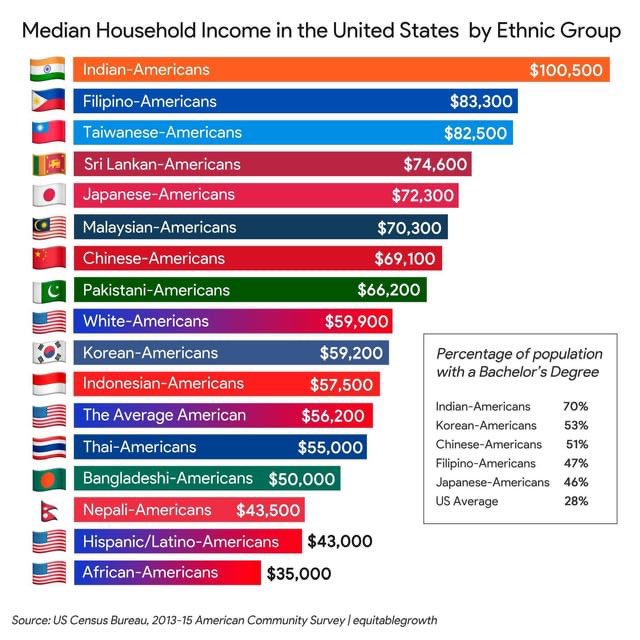
This Cato ‘immigrants pay more taxes’ flex + Indian chart is peak cherry-picking. Impressive numbers… until you actually look under the hood. 🧐”
1. It’s median household income, not individual or per-capita — and Indian households are structured differently
• The chart (and the “twice as much” claim) uses households, not people. Indian-American households are larger on average (~3.0–3.8 people vs. U.S. average ~2.5) and far more likely to have multiple full-time high earners (dual STEM/medical professionals is common). en.wikipedia.
• Indian Americans still have high personal earnings (median ~$85k for ages 16+, ~$106k for full-time workers per 2023 Pew), but the “almost twice” headline evaporates when you adjust for household size and number of workers. This is a classic statistical sleight-of-hand when comparing groups with different living arrangements.
2. Extreme positive selection bias … this is the cream of India’s elite, not “immigrants” in general
• Indian Americans aren’t a random sample of India’s 1.4 billion people. The vast majority arrived via H-1B, EB-2/3, or student visas …hyper-selective for advanced degrees and high-skill jobs. You’re comparing the top ~0.1–1% of India’s talent/IQ/education distribution to the broad U.S. average (which includes everyone from McDonald’s workers to retirees).
• India’s own per-capita income and education levels are far lower. This doesn’t prove broad immigration is economically magical; it proves cherry-picked high-skill immigration works for the selectees. Second-generation outcomes are strong but show some regression toward the mean, and chain migration/family sponsorship often dilutes the skill level over time.
3. Cato’s overall “immigrants pay more taxes” claim has well-documented methodological holes
• Cato (a libertarian think tank that favors more immigration) attributes welfare benefits received by U.S.-born children of immigrants to “natives,” not the immigrant parents. This understates immigrant fiscal costs. The Center for Immigration Studies (CIS) and others note this flips the picture: when you count the full household burden (including kids), immigrant-headed households use welfare at higher rates than native-headed ones.
• Cato aggregates all immigrants (high-skill Indians + low-skill groups + illegals). The net positive they find is heavily driven by the high earners. Other studies (National Academies of Sciences, Heritage, etc.) have found first-generation immigrants often impose net costs, especially low-skilled/illegal cohorts.
• Their data ends before the post-2021 border surge effects fully hit long-term budgets.
4. H-1B-specific issues (the main pipeline for Indian success)
• Many Indian immigrants in tech come via H-1B, which has documented problems: outsourcing/body shops (e.g., Infosys, TCS), wage suppression (foreign workers often paid less for similar roles), and ethnic nepotism once Indians reach management (preferring co-ethnics for hiring/promotions). This displaces U.S. workers and depresses wages in STEM.
• Fraud allegations are common (fake credentials, benching workers, etc.). Critics argue this isn’t “adding value” so much as arbitraging cheaper labor and networks.
5. Other drains and context
• Remittances: Indian Americans send massive sums back to India (India receives over $100B+ in remittances annually, a huge chunk from the U.S.). That’s money leaving the U.S. economy.
• Cost of living: Indians are heavily concentrated in high-cost metros (SF Bay, NYC, etc.), where nominal incomes are inflated anyway. Adjust for purchasing power and the gap shrinks.
• The post uses Indian success to defend a general “immigrants = net positive” narrative from Cato. But Indians are ~1.4% of the U.S. population and an outlier. Broad policy implications (more low-skill immigration, open borders, etc.) don’t follow from one high-performing subgroup.
At this point - the idea that we are going to have any kind of coherent government or social response to the impact of AI disruption seems laughable. The American led global order is collapsing, the federal government is increasingly approaching insolvency, all measures of social cohesion are collapsing, etc -there is no recognition from either political party that anything needs to change. How could the govnement possibly manage this transition in any kind of thoughtful way?
We need smart regulation to protect 3.5 million truck drivers & 2 million long haul drivers. AI should not be used for mass layoffs that drive up short term profits w/ no productivity gains.
Drivers are needed for safety, oversight, edge cases, & maintenance.
I stand with humans over machines, with @LorenaSGonzalez@TeamsterSOB over short term profits for corporate oligarchs.
@Noahpinion@romanhelmetguy The modern Western shifts (to NW Europe, then U.S.) follow the same logic: go where the next combination of resources + political conditions exists. Britain had coal near navigable water near iron. America had everything plus no hostile neighbors demanding standing armies.
@Noahpinion@romanhelmetguy Mediterranean agriculture also degraded its own foundations—deforestation, soil erosion, salinization in Mesopotamia. When your region is spent, you move. Rice paddy agriculture in China is sustainable indefinitely with proper management.