“We must pray, for prayer is neither more nor less than living with God. Shall I live today of myself and by myself, or shall I live it with God? Doubtless, whether or not I live it with God, God lives it with me—but that only makes it the more monstrous that I should not live it with him. Prayer is just living with God: looking at him, regarding his will, reaching out our hands for the blessings he is so eager to give, bringing our action into his.”
—Austin Farrer, “The Transforming Will”
Today I’d like to share with you a place on honor I give in my chapel to the saints of New York. Can you recognize them? I hope they’re taking care of me through the day and I hope one day through the mercy of Jesus to be united with them in the communion of saints. @thegnewsroom
#America250#Virginia250
The Virginia Declaration of Rights, adopted 250 years ago (June 12, 1776), succinctly expressed the American founding principles of inherent natural rights, republicanism, limited government, and due process of law. @LawLiberty https://t.co/cL882sga7C
You have noticed it. ChatGPT feels dumber than it used to. Your prompts that worked six months ago produce worse results now. The writing sounds flatter. The ideas sound safer. The internet itself feels like it is shrinking. Every article reads the same. Every email sounds the same. Every answer sounds like it was written by the same voice.
You thought it was you. It is not you.
Researchers at Oxford and Cambridge published a paper in Nature proving what is happening. They call it Model Collapse.
Here is the mechanism in one sentence. AI trained on AI-generated data gets dumber every generation until it forgets what real human data looked like.
The internet is filling with AI-generated content. Blog posts. Articles. Reviews. Comments. Social media. AI companies scrape the internet to train the next generation of models. Which means the next generation of AI is being trained on the output of the current generation.
Each cycle loses information. Not randomly. It loses the rarest, most unusual, most creative parts first. The researchers call these the "tails of the distribution." The weird ideas. The unexpected perspectives. The things that made the internet feel human. Those disappear first.
What remains is the average. The safe. The expected. The bland.
Then the next generation trains on that. And loses more. And the next generation trains on that. And loses more. The researchers proved this is not a slow decline. Major degradation happens within just a few iterations. Even when some of the original human data is preserved.
They tested it on large language models. On image generators. On statistical models. The pattern was the same every time. The output converges toward a narrow, flattened version of reality that looks nothing like the original data.
The lead researcher put it plainly. "Large language models are like fire. A useful tool. But one that pollutes the environment."
The pollution is invisible. You cannot see which sentence on the internet was written by a human and which was written by AI. Neither can the AI that is about to train on it. And once the tails are gone, they do not come back. The damage is irreversible.
This is not a prediction anymore. It is a diagnosis.
The internet you grew up on was built by humans writing things no algorithm would have written. Strange, personal, imperfect, alive. That internet is being diluted. One generation of AI at a time. And the models trained on what remains are learning a smaller and smaller version of the world.
Model Collapse is not a technical problem. It is a cultural one. The thing that made the internet worth reading is the thing that disappears first.
“The half-baked Rousseauism in which most of us have been brought up has given us a subconscious notion that the free act is the untrained act. But of course freedom has nothing to do with lack of training. We are not free to move until we have learned to walk; we are not free to express ourselves musically until we have learned music; we are not capable of free thought unless we can think. Similarly, free speech cannot have anything to do with the mumbling and grousing of the ego. Free speech is cultivated and precise speech, which means that there are far too many people who are neither capable of it nor would know if they lost it.
A group of individuals, who retain the power and desire of genuine communication, is a society. An aggregate of egos is a mob. A mob can only respond to reflex and cliché; it can only express itself, directly or through a spokesman, in reflex and cliché. A mob always implies some object of resentment, and political leaders who speak for the mob aspect of their society develop a special kind of tantrum style, a style constructed almost entirely out of unexamined clichés.”
—Northrop Frye, The Well-Tempered Critic
Catholics always have statues in our chapels and churches. I’m very fond of the wood carving of St. Paul that I’d like to share with you today on the feast of St. Barnabas, a disciple of Paul. We can’t live the kind of life Jesus wants for us by ourselves! We need Him and the help of others. @thegnewsroom
“In Magnifica Humanitas, Pope Leo singles out as ‘particularly insidious’ the ideology that ‘suggests that every person must earn or justify his or her own worth.’ This view—where the human person is born in debt, and eventually buys him or herself free—obviously puts the very young and the very old in danger. But now it imperils many others who fear they will not be able to justify their lives if their labor can be done more cheaply and speedily by AI.” @LeahLibresco
Pope Leo will carry Jesus in the Blessed Sacrament through the streets of Madrid in Spain during the Corpus Christi procession on Sunday
Image: Vatican Media
“I say the degree of vision that dwells in a man is a correct measure of the man. If called to define Shakespeare’s faculty, I should say superiority of Intellect, and think I had included all under that. What indeed are faculties? We talk of faculties as if they were distinct, things separable; as if a man had intellect, imagination, fancy, &c., as he has hands, feet and arms. That is a capital error. Then again, we hear of a man’s ‘intellectual nature,’ and of his ‘moral nature,’ as if these again were divisible, and existed apart. Necessities of language do perhaps prescribe such forms of utterance; we must speak, I am aware, in that way, if we are to speak at all. But words ought not to harden into things for us. It seems to me, our apprehension of this matter is, for most part, radically falsified thereby. We ought to know withal, and to keep forever in mind, that these divisions are at bottom but names; that man’s spiritual nature, the vital Force which dwells in him, is essentially one and indivisible; that what we call imagination, fancy, understanding, and so forth, are but different figures of the same Power of Insight, all indissolubly connected with each other, physiognomically related; that if we knew one of them, we might know all of them. Morality itself, what we call the moral quality of a man, what is this but another side of the one vital Force whereby he is and works? All that a man does is physiognomical of him. You may see how a man would fight, by the way in which he sings; his courage, or want of courage, is visible in the word he utters, in the opinion he has formed, no less than in the stroke he strikes. He is one; and preaches the same Self abroad in all these ways.”
—Thomas Carlyle, On Heroes, Hero-Worship, and the Heroic in History
"I am a man. See me as a human being—not a birth defect, not a syndrome. I don’t need to be eradicated."
Frank Stephens pleads for the humanization of people with Down syndrome, studies suggest 67-90% are aborted in the United States due to faulty prenatal screenings.
“What Shall We Say? Human Nature is intollerant when ever it has power. Trust Power then without a counterprize to no Man to no sect to no Party. Amen and Amen.” John Adams to François Adriaan Van der Kemp, 5 June 1812. #HumanNature#JohnAdams#AdamsPapers
You know that whenever we come to the First Friday, I’m going to talk to you about the beautiful tradition of the Church of Confession, Mass, and Holy Communion on the first Friday of every month! @thegnewsroom
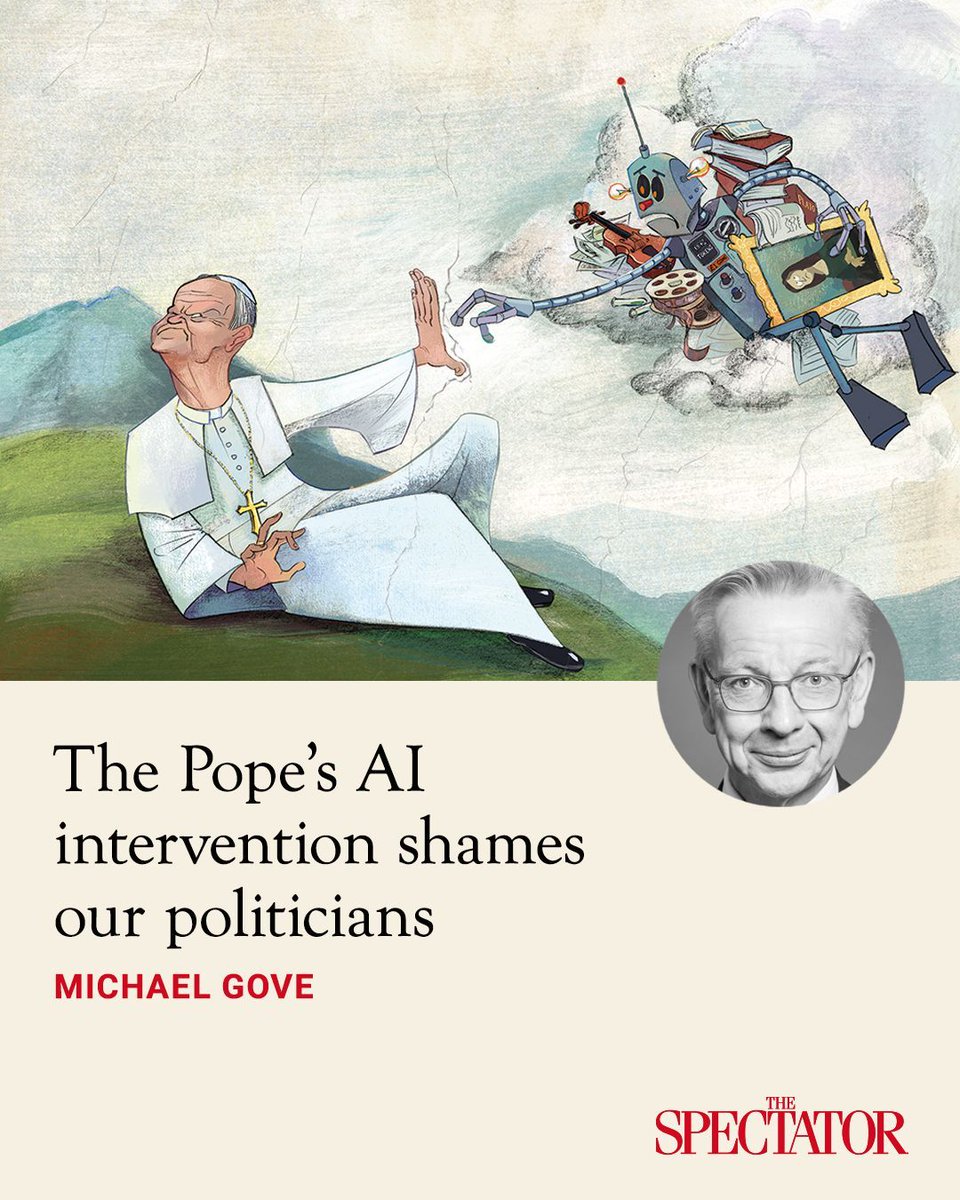
I was born into a sternly Presbyterian culture. Politically, I’m more Orange than Donald Trump’s skin tone. But today I am on my knees giving thanks to the Pope.
He has produced the most powerful political document of the year, taking on the greatest challenge of our times. His first encyclical, Magnifica Humanitas, deals with the changes which will be wrought to all our lives by artificial intelligence in the months and years ahead.
AI will transform our economies and societies massively and irrevocably; it will change what it means to be human; it may even mark the end of humanity itself. If it takes the Pope to alert us to this revolution then perhaps the Reformation wasn’t such a good idea after all.
✍️ Michael Gove
Article | https://t.co/ZZfyMFPFsX
I’d like to share with you a short prayer that’s perfect for Trinity Sunday. You know why I like it? It’s short, to the point, reminds us of the pivotal doctrine of our faith, and it doesn’t ask God for a darn thing! It simply praises Him. @thegnewsroom
Israel’s President Isaac Herzog warned that Israeli society is becoming desensitized to violence, saying it is “creeping into the mainstream,” and said, “We are exposed to disgraceful and ugly behavior by [Jewish] extremists against Christians and Muslims.”