When @astro_reid was a senior at Dulaney High School, the caption under his yearbook photo began with the words “FUTURE PLANS: Fly high.”
Tonight, he’s commanding NASA’s Artemis II—the first crewed mission to fly around the moon in over 50 years.
We’re so proud to be cheering him and his crew on from Baltimore County. We know @BaltCoPS is especially proud! 🚀🌓
The 2026 Medicaid Insights for Impact meeting was insightful, inspiring & moving! Grateful to my @urbaninstitute colleague @kenneygm, IU's @KosaliSimon & the entire planning committee for their work, to the presenters for their excellent remarks, & to @AcademyHealth for hosting!
Congratulations to my @urbaninstitute colleague @kenneygm for this well-deserved recognition as one of the most influential people shaping health care policy in Washington!
https://t.co/pNLqSiq7I5
There was strong consensus among health care policy experts that proposed Marketplace policy changes (restructuring enhanced subsidies, requiring the payment of small premiums, and ending automatic renewals with subsidy) could carry meaningful risks for affordability and coverage. | Forefront
@onceuponA, et al. | @HarvardChanSPH, @WeillCornell, @CornellBPP
https://t.co/B6SsNR3vaY
The pre-funding is $1,000 or $1,500, depending on age.
The average bronze plan deductible — and one must elect a bronze or catastrophic plan to use the HSA — exceeds $7,000
As millions await Congress’ upcoming vote on the future of the ACA Marketplace enhanced premium tax credits, this insightful blog from @urbaninstitute colleagues @jasonlevitis & Claire O’Brien discusses how to evaluate alternative proposals put forward: https://t.co/nlYiQ0T9cP
So proud of my @urbaninstitute colleague @jasonlevitis who is testifying before the Senate Finance Committee this morning on #healthcare affordability - you can tune in here! https://t.co/A6yI2wQbU1
Policy merits or demerits aside, it is logistically impossible to set up a brand new HSA scheme in the next six weeks. I suspect it could prove logistically impossible to execute in the next six months.
People are picking their plans for 2026 between now and January 15.
SNAP hot takes:
-the program helps 1 in 7 Americans purchase food
-nearly half of recipients are kids
-cheaper than other safety net programs
The kicker: SNAP has many positive benefits in terms of kids test scores, disciplinary actions, + theft/crime. Beneficial for everyone!
With 2026 ACA plans officially live, we can now see the impact of Congress' failure to extend enhanced premium tax credits. A 64 YO couple in Morgantown with household income of $85k will see their premiums for the same plan increase by over $4,000 *per month*
This AP story about the ACA Marketplace enhanced premium tax credits shares the difficult tradeoffs that enrollees are facing if the credits expire. My @urbaninstitute colleague @jasonlevitis is quoted discussing his important work on this issue.
https://t.co/IoSeZxjsMu
In honor of #Medicare Open Enrollment beginning today....this recent study by Urban Institute colleagues @LauraSkopec, Steve Zuckerman and Judy Feder takes a closer look at the Medicare Advantage sales industry and the role of agents and brokers: https://t.co/zlGXqeBPJ4
This morning’s @washingtonpost article on the ACA Marketplace enhanced premium tax credits (PTCs) features research done by my @urbaninstitute colleagues, estimating that if the PTCs are permitted to expire, 4.8 million people will lose coverage in 2026: https://t.co/oIrPw3QfBc
For the handful of you out there who are super interested in the problems with how physician fees are set in Medicare (spoiler, physicians and the American Medical Association play a big, problematic role!), a new journal article just for you: https://t.co/l67NhE5rMW
While 2026 rates are already set and consumers are starting to learn of premium increases, implementing #policy changes can still support future #healthcare coverage.
Urban's @jasonlevitis, Claire O’Brien, and Sabrina Corlette @McCourtSchool explore the shutdown's implications.
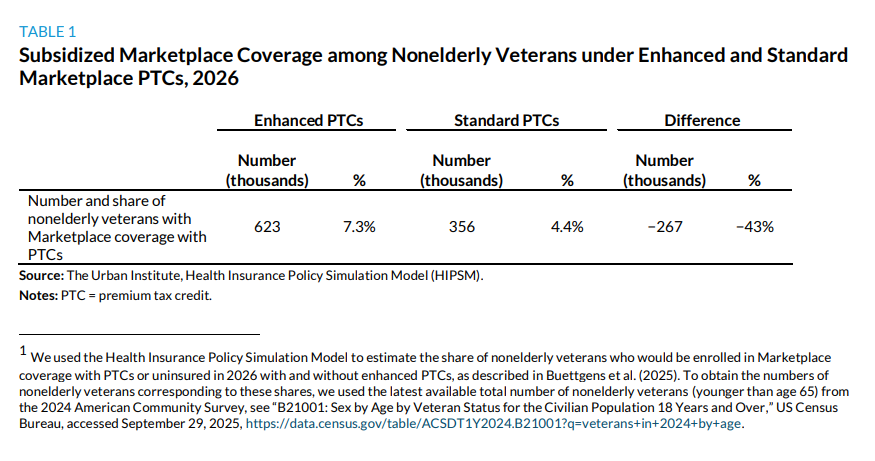
New analysis estimates that over 600K nonelderly #veterans would have subsidized Marketplace coverage in 2026 if enhanced premium #tax credits (PTCs) were extended. Urban Institute’s recent #research brief explores the impact on coverage if PTCs expire. https://t.co/3OxTt8d0VR
Looking forward to hearing about counties’ health policy and public health priorities at @NACoTweets Large Urban County Caucus Symposium, and participating in a conversation about homelessness and behavioral health.
One in eight working-age adults in #SNAP#families lost benefits in 2024 because of problems recertifying their eligibility on time. Urban research experts break down the #data in a new brief. https://t.co/HXVHkLH8DK
Note the striking variation across states: if the enhanced PTCs expire the largest increases in uncompensated care spending (and largest declines in provider revenues) will occur in the Southern US.
E.g. in SC uncompensated care spending projected to rise by 30% (!) in 2026.
Urban Institute #research experts estimate 4.8M people could lose coverage and #healthcare spending could drop by $32.1B in the US if enhanced premium #tax credits expire.
A new research brief breaks down the impact on spending and uncompensated care. https://t.co/PoUXmwzxFz