Even as we speak out against the criminalisation of transpersons under the recent #TransAmendment Act- rooted in the legacy of the casteist-colonial CTA, 1871; here is @IndianExpress reproducing the same casteist logic by stereotyping & stigmatizing another such DNT community~1
I also dislike the fatalism of the permanent underclass discourse, but am equally tired of people using euphemisms like “transition costs” instead of figuring out how to help the people we know will be impacted
What’s our plan for unemployed college grads and older clerical workers? Retraining programs have an awful track record, and anyway what do we retrain people to? What happens to colleges, healthcare, and the tax base in a world where white collar firm work is no longer the easy path to middle class stability? Plenty of urgent, unsolved, and politically salient questions that do not require a referendum on full automation
@carlbfrey: “Most economists will acknowledge that technological progress can cause some adjustment problems in the short run. What is rarely noted is that the short run can be a lifetime.”
From viral AI-generated content to subtle everyday interactions, online spaces can reproduce forms of exclusion that are easy to overlook but deeply consequential.
In this piece for @techpolicypress, @TithiNeogi from the @tqh_policy team examines how ableism manifests online and why it deserves more deliberate attention within platform governance and content moderation debates.
Rather than framing ableism only through extreme or explicit abuse, the article highlights how microaggressions, misclassification by moderation systems, and inaccessible design choices can cumulatively silence disabled voices. Drawing on recent developments in India, including a 2025 Supreme Court directive, it also reflects on the limits of speech-based regulatory responses and why they often fail to address harm that circulates organically and informally on platforms.
The piece argues for a more disability-responsive approach to online safety, one that recognises the complexity of harm, avoids overbroad restrictions on speech, and meaningfully involves persons with disabilities in the design of moderation tools and systems. Building inclusive digital spaces, it suggests, requires moving beyond blunt rules toward more context-aware and participatory solutions.
Read the article to learn more: https://t.co/FnmLo8s0If
#DigitalAccessibility #ContentModeration #DisabilityRights #InclusiveTech #TechPolicy #PlatformGovernance
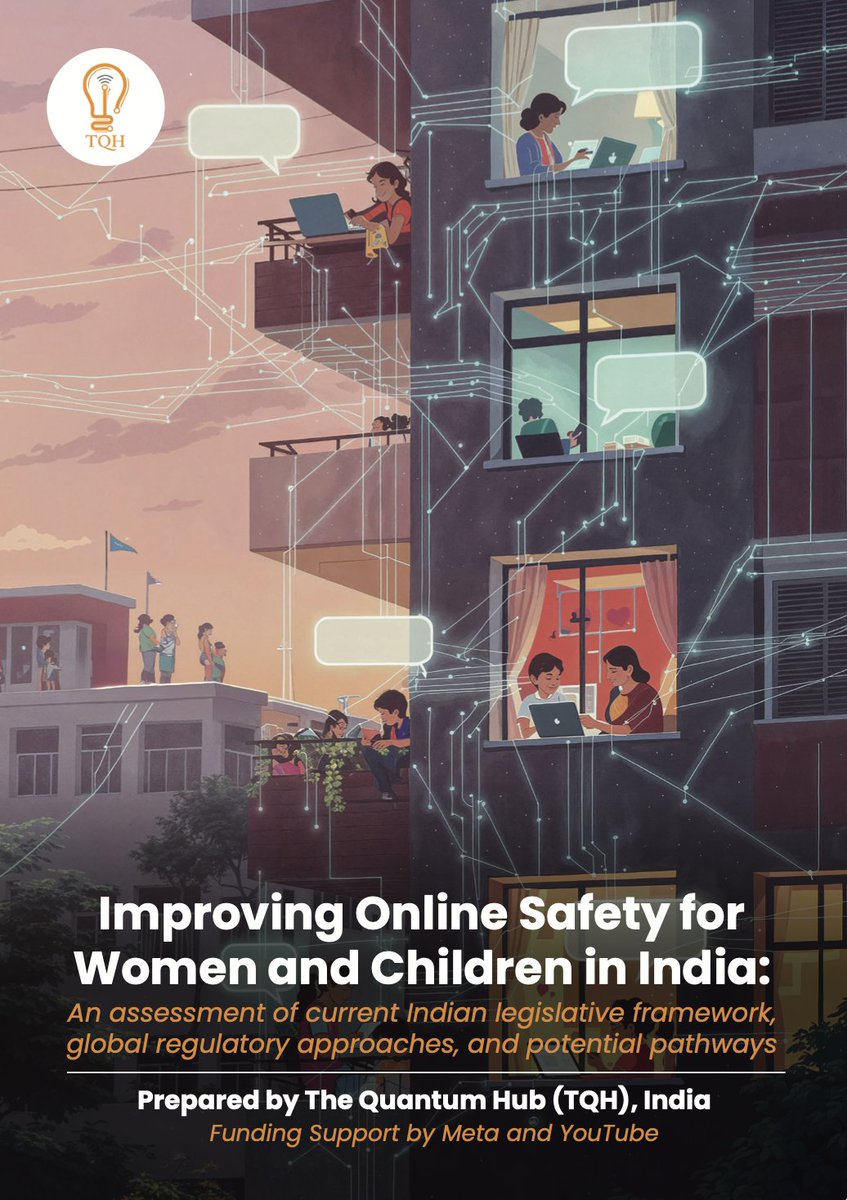
We are excited to announce the release of our flagship report Improving online safety for Women and Children in India at the inaugural Trust and Safety India Festival today. This study is a labour of love, that we have undertaken over the past year. It maps all existing legislation in India that addresses online harms against women and children directly or indirectly. It also maps global regulatory and legislative developments around tech facilitated gender based violence and children's wellbeing. Based on these regulatory experiences, we propose a pathway for India to deliver better outcomes on online safety of women and children.
This report has been authored by Senu Nizar (@NizarSenu), Rhydhi Gupta(@RhydhiG), Manan Katyal, Tithi Neogi (@TithiNeogi), Devika Oberai (@_devikaoberai), Akanksha Ghosh(@AkankshaGhosh5) and Nikhil Iyer.(@nikhiliyer23) The research has been led by Sidharth Deb (@DebSidharth) and Aparajita Bharti (@BhartiAparajita).
We thank the @YouTube and @Meta public policy teams for supporting this project. We are also very grateful to all the stakeholders who participated in our discussions for giving their thoughtful inputs and suggestions. We thank the Centre for Social Research (@CSR_India) and Trust and Safety India Festival for giving a perfect platform to bring this work to life.
We look forward to your feedback and we hope that this informs policy discussions about making the internet a safer place for women and children in India.
Read the report here: https://t.co/u3CsG7NVtO
#platformregulation #safetybydesign #digitalrights
✨ Blog post ✨
Taking into account the Indian DPDP Act, @TithiNeogi elaborates on whether and the extent to which consent is adequate to legitimise health data processing.
👉 https://t.co/1ScppFJTZD
I presented our research alongside @DashAngelinaaa at the #IGF2024 on Disability and Data Protection for Digital Inclusion. Special thanks to our moderator @Fawaz_Shaheen and speakers @OsamaManzar, Eleni Boursinou and Maitreya Shah for their insights. https://t.co/LFDYvgEm1W
I'm happy to have co-authored this paper with @DashAngelinaaa - we center persons with disabilities and their decisional autonomy within India's data protection law.
We are keen to continuing the conversation on Disability and Data Protection at #igf2024
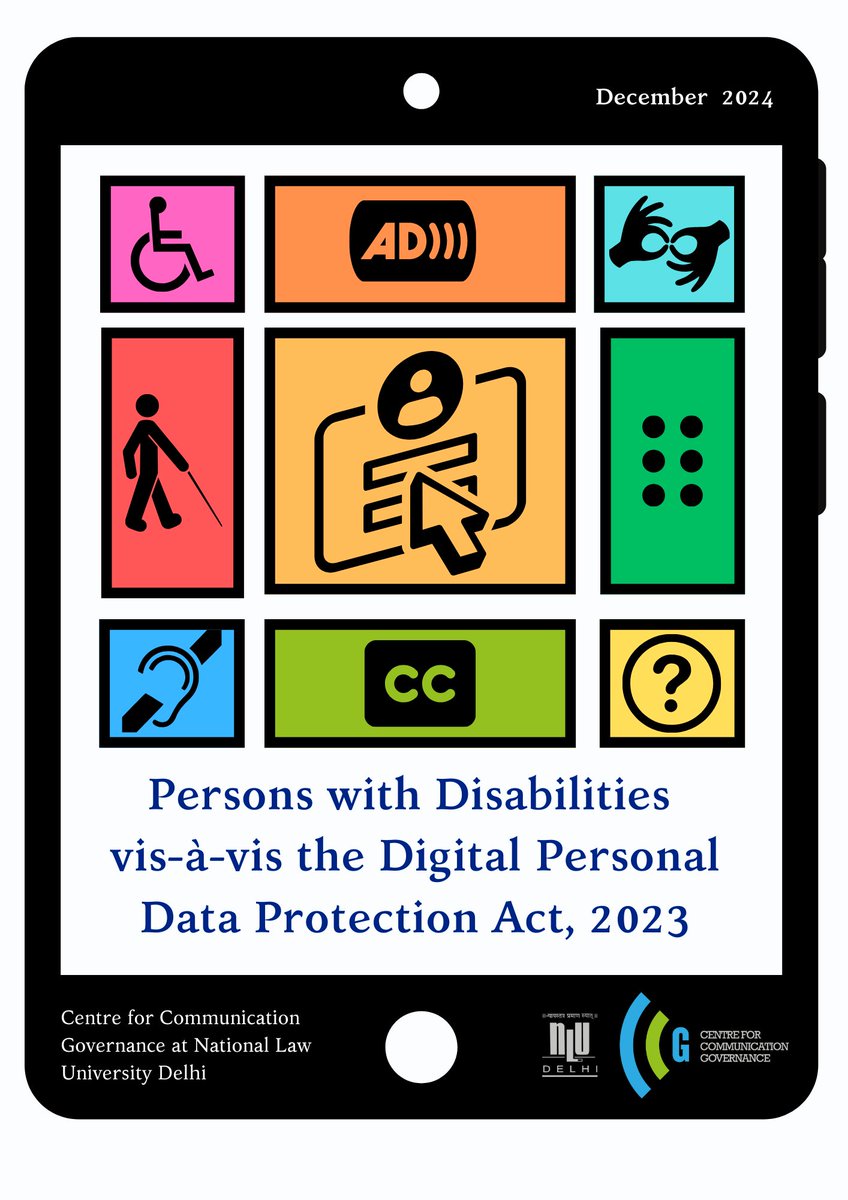
New Publication! We are happy to announce the release of our policy brief on Persons with Disabilities vis-à-vis the DPDP Act by @DashAngelinaaa@TithiNeogi. The brief examines the key problems of protecting personal data and autonomy for #PersonsWithDisabilities.
My colleague @DashAngelinaaa and I are organising a session at #IGF2024, based on our ongoing work on data protection for persons with disabilities. Join us as we discuss algorithmic discrimination and what data protection can do for persons with disabilities.
Join our workshop at @intgovforum on the interplay between digital accessibility & data protection; ADM tech & how data protection frameworks can address inequalities faced by persons with disabilities, on 18 Dec at 12PM IST to hear from a diverse panel.
https://t.co/HJC1FkfwFD
I write about how consent falls short of securing user rights over health data, and what can the Indian regulatory framework do more to check the power asymmetry between users and health data fiduciaries. An earlier version of this blog was published here: https://t.co/PDjiKfZGeT
We keep on with the data protection discussion with a blog post by @TithiNeogi where she discusses whether consent should be the cornerstone for processing health data from the Indian perspective
https://t.co/1ScppFJTZD
We kicked off our 3-day workshop on "AI and the Rule of Law" for judges & judicial officers from India, Bhutan, Maldives, Nepal & Sri Lanka organised in collaboration with @UNESCO today.
Day 1 had sessions on introducing AI, it's impact in the justice sector & the ethics of AI.
Congratulations to our colleague Tithi for being selected for the InSIG Fellowship! The fellowship offered an incredible platform to connect with leaders across academia, industry, and government, exploring critical topics in internet governance. #InSIG2024#InternetGovernance
#CCGBlogAlert@TithiNeogi discusses the limitations of using a consent-centric approach for processing health data, by explaining how the distinct sensitivity of health data necessitates safeguards beyond consent.
Read here: https://t.co/Nph2IBBzHw
#CCGBlogAlert@TithiNeogi explains the Election Commission’s takedown mechanism under the Voluntary Code of Ethics, and its implications on transparency in content moderation by platforms.
Read here: https://t.co/aKXWxRFBrn
@TithiNeogi highlights the absence of safeguards for the rights of persons with disabilities in the #DPDPAct. Read the blog here: https://t.co/woLITx66iT