I am grateful that @lipscomb published an article featuring my work with 3D re-creations of ancient artifacts at the Lanier Center for Archaeology and our collaboration with the Raymond B. Jones College of Engineering. I appreciate having it highlighted
https://t.co/CVgmbumnko
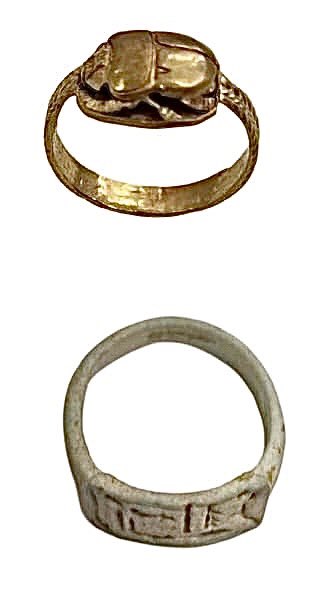
Saite Period Gold Artifacts Unearthed at Karnak Temples! Gold rings & amulets from 26th Dynasty discovered at Karnak. More info https://t.co/DF6zYzHLpZ Soon on display at Luxor Museum.
#Egypt#Archaeology#Karnak#Luxor@yukinegy@SilviaZago6@AlisonFisk
The EES, and many friends and colleagues around the world, mourn the death of Vice-President Prof Kenneth Kitchen, who sadly passed away on Thursday 6th February, aged 92.
Our full condolence message can be read here: https://t.co/lm7v5EqJRP
Haaretz and Christianity Today highlighted Tel Burna as one of the most important archaeological discoveries of 2024. The article links are:
Haaretz link: https://t.co/DGeu9lzh4g
Posted from our site director Itzick Shai at Tel Burna: Exciting News from the World of Biblical Archaeology!
Haaretz and Christianity Today highlighted Tel Burna as one of the most important archaeological discoveries of 2024. The article links are:
https://t.co/EvxfbcLHRk
Lanier Center for Archaelogy students uncovered 'historic discoveries' in Israel's Tel Burna excavation with monumental buildings and a rare Canaanite cult complex, offering a glimpse into religious practices over 3,000 years old.https://t.co/qyIGmVFE7e
The Arcane Texas Fact of the Day:
The Battleship Texas was intentionally flooded in support of D-Day operations. That's right.
As most Texans know, the USS Texas (BB-35) saw more combat action in her lifetime than most other US battleships, seeing service in both World War I and II, and combining military prowess with ingenuity to aid in the Allied success on D-Day. One outside-the-box idea by those aboard the vessel that day put the entire crew’s lives in jeopardy – thankfully, it paid off.
What happened was this.
n early June 1944, the USS Texas and the British cruiser HMS Glasgow (C21) arrived in Normandy. They joined the Omaha Beach western fire support lane near Pointe du Hoc. Among 702 ships in the US-British flotilla, the Texas was one of just seven battleships.
Texas fired 14-inch shells to support the 29th Infantry Division and the 2nd and 5th Ranger Battalions. In a remarkable 34-minute span, she launched 255 shell.. As the Allies advanced inland, Texas shifted her focus to bombard German positions from just 2,700 meters offshore.
Returning to Normandy on June 15 after a brief stint in England, Texas faced a challenge: Allied forces had moved beyond her firing range. To adapt, the crew flooded the torpedo blister on the starboard side, tilting the battleship two degrees into the water. This daring move allowed her guns to fire accurately and contribute to the operation’s success—a testament to the spirit of the Allied forces at Normandy. Most crews would NEVER think of intentionally flooding their own ship, but that's exactly what the Battleship Texas did.
Shown here: USS Texas (BB-35), HMS Glasgow (C21), USS Arkansas (BB-33), FFS George Leygues, and FFS Montcalm as “Force C” on D-Day off the coast of Normandy. USS Texas earned five battlestars in WWII including supporting the Torch, D-Day, and Dragoon landings then switching oceans to pound Japanese shore positions at Iwo Jima and Okinawa. (IWM – McNeill, M H A (Lt) Photographer)
It was 4 years ago today that Mark Janzen and I presented our findings on the Pharaoh Merneptah at the Ancient Egypt, New Technology Conference.
Earlier this month, those findings were published in a new volume of the Harvard Egyptological Studies.
https://t.co/f0GLNszb10
Jim Boeheim built Syracuse basketball with his bare hands from scratch, making Central New York a destination. He was a consistent and dominant winner, an icon and Hall of Famer for 47 years while bleeding Orange and doing so much amazing charitable work in Syracuse. 🐐🍊