New article in @JDevStudies! Thread below ⬇️
https://t.co/CZhs4KLgXT
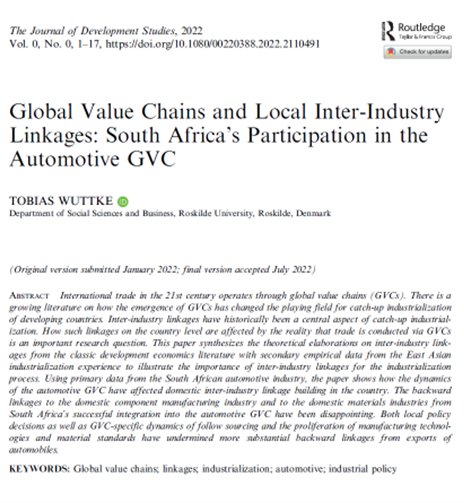
I weigh in on the debate about global value chains and their impact on catch-up industrialization, with a focus on the issue of backward linkages from manufacturing exports into GVCs. 1/8
Lindsay Whitfield & @TobWuttke on Opps for Latecomer Technological Catch-up with renewables
https://t.co/4TXZFZCkVQ
@professor_sud on Asian Coal Economies
https://t.co/UXwL7KwBoH
Dic Lo, Niangjijia Nyangchak & @lfqirrrrr on China in the Green Transition
https://t.co/cDuF1PTxLJ
@haugejostein Impressive indeed. Although China‘s car production has been this high for some time now, see screenshot. The even more dramatic point is the increase of Chinese brands as a share of total production, driven by EV leapfrogging. See our new paper: https://t.co/ciazfqopmU
Happy to share a new article published in the @JDevStudies, co-authored with Tobias Wuttke and Kriengkrai Techakanont:
"Competition and Development in Automotive Global Value Chains: Insights from Thailand, South Africa and Argentina"
https://t.co/RQgHL90S6A
The window of opportunity for battery manufacturing and electric vehicles has already closed, as the economies of scale will be hard to replicate for latecomer firms and countries, says @TobWuttke at #RSAwinter
How did the US invent solar power and dominate it for 60 years, before giving it up to China over the past decade?
The answer is, IMO, quite different to the stories we have told ourselves in recent years. And it has important lessons for the future.🧵
https://t.co/uj1bwFgYZA
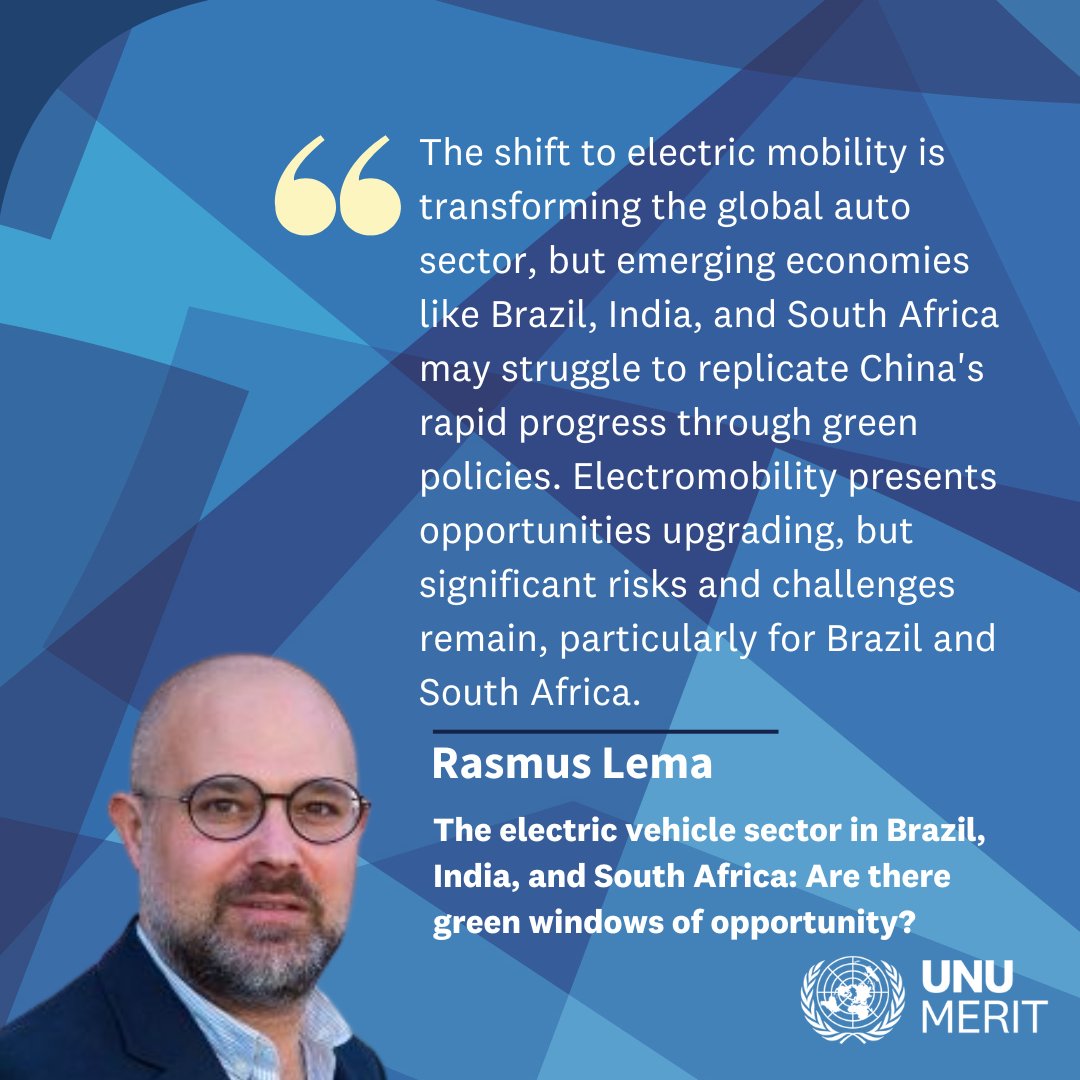
Can Brazil, India, and South Africa replicate China's success in electric mobility? Prof @RasmusLema and co-authors compares green industrial policies, domestic conditions, and outcomes, highlighting unique opportunities and challenges.
https://t.co/hirDwCN75n
#Sustainability
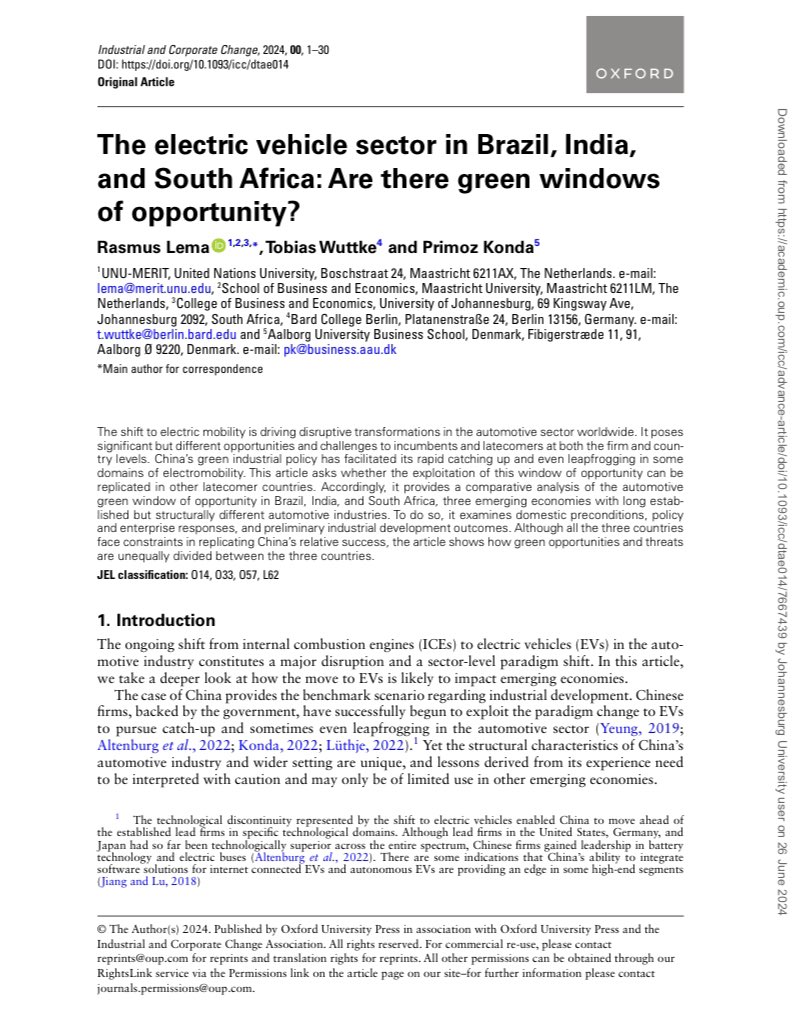
How will the shift to electric vehicles affect the automotive sectors in emerging economies?
Check out this new paper with @KondaPrimoz and @TobWuttke@UNUMERIT@UJ_TRCTI
https://t.co/Z2UTcWl7Iq
So to return to the original FT piece (https://t.co/TObZ7eTCXc), while I agree with many of its points, I think it's important to be clear that globally successful South Korean firms like Hyundai benefited from both export-promoting policies and protectionist measures. 5/
@yinshaoloong@kyleichan Yes, and Hyundai‘s great achievement was to develop its own tech (engine) which freed it from being dependent on licenses and thus license owners. Much to learn from the industrial policies which helped with tech indigenization, rather than simple ISI/EOI dichotomies.
While some tools of industrial policy demand significant fiscal resources, this is certainly not true for all of them, notes Keun Lee. Entry controls are a case in point. https://t.co/XLe0d7BCij
The end of globalized production? Our colleague @flobut criticizes together with Cornelia Staritz and Tobias Wuttke predictions of deglobalization and reshoring. Out as early access in @CritSoc:
https://t.co/YyZ1cnD6SH
TSMC raised its US investment to US$65 billion for 3 fabs in Arizona, with the 2nd fab using 2nm process technology instead of 3nm and the 3rd fab at 2nm or better, it said. The US proposed direct funding of $6.6 billion and up to $5 billion in loans for the investments. Each of the 3 fabs “…will have cleanroom area approximately double the size of an industry standard logic fab,” TSMC said. $TSM #CHIPSAct #semiconductors https://t.co/WK6bL36yAy
Just published, this is a really important paper providing some much-needed evidence on the topic of deglobalization and reshoring.
"(...) we do not observe deglobalization in the sense of a comprehensive retreat from globalized production."
https://t.co/1aqUYH38Hi