I have a position in SOL again for the first time since selling early last year. First entry is ~71.
It's not the biggest position, but it felt like reasonable value when looking ahead 12-18 months, which is my time horizon for most spot positions here.
I felt there was a loss of focus following the memecoin szn blow off, but Solana seems to be back on track when looking at tech improvements (alpenglow), tokenomics (inflation reduction), metrics (ATH in transaction activity) and a focus on spot and RWA trading.
I know there is the comparison with ETH last cycle, but I don't think any of the same issues Ethereum was facing (scaling, foundation complacency, outsourcing of execution to L2s etc.) apply to Solana, so it feels like a lazy analogy. Devils advocate is the BTC pair, which does resemble ETH/BTC.
I will keep adding over the coming months and hopefully end up with a decent bear market average.
I still think there is another low to come for BTC in the coming months, but possible that SOL rallies first and then doesn't make a lower low when it gets pegged back before we exit the bear.
I don't know if it makes a new ATH, as that will depend on a lot more adoption and breakout apps, but I certainly think it can go back up a fair bit.
The biggest inflection point in markets this year is NOT the SpaceX IPO
Arthur Hayes believes Trump will pop the AI bubble to win the midterm elections
"He can't fix inflation, he can't end the war... the only option he has left is to flip on the AI bros."
He predicts H2 will be risk off across crypto and equities as Trump
Watch the full interview now
00:00 Welcome Arthur Hayes + The HYPE Trade
02:00 Arthur’s Trading System and Narrative Shifts
04:15 Why HYPE Became Attractive Again
06:11 Why HYPE Stayed Strong vs Competitors
08:20 H2 Macro Outlook and the Iran/Oil Risk
11:21 Why Higher Energy Prices Threaten the AI Story
14:13 Why Arthur Dumped Risk Assets
15:48 Balancing Macro Signals with Momentum
17:20 Liquidity, Treasury Issuance, and the AI Bubble
18:21 Has Crypto Delivered on Its Original Promise?
20:21 Bitcoin to $1M and the Money Printing Thesis
21:34 Bitcoin vs Gold and Long-Term Store of Value
22:34 Can You Still “Make It” in Crypto?
24:52 Trading vs HODLing: What Actually Works Now
25:49 Lifestyle, Money, and What Actually Buys Happiness
27:48 Arthur’s Big Contrarian Prediction on AI
30:17 Trump, Politics, and the Power Game
32:21 Attention, Entertainment, and Financial Commentary
34:31 Why Being Entertaining Matters More Than Being Right
36:20 Arthur’s Bitcoin Bottom Prediction
36:58 House Music, Ibiza Picks, and Final Thoughts
We are currently witnessing record Institutional selling of Bitcoin. The most selling in history, led by ETFs, nuking over 460% of the daily mined supply, every day.
Saylor x BTC Drama
Fwiw I sat down for more than 2 hours with Saylor about 2 weeks ago
This usually enables me to “feel” what kind of person is in front me , something that you can’t if you arent in the room with us. I’ve done 173 of those interviews over the last 3 years and this has enabled me to develop a good intuition, although there are no certainties ever (especially in this industry)
My intuition tells me that Saylor is a genius and is always a few chess plays ahead of everyone else. This is not new to his Bitcoin journey, it’s been true for 35 years at least. Watch the podcast below and you’ll understand what I mean
Imho, we have a bunch of monkeys on this app who havent done the work properly and are shouting for engagement and maybe because they are angry because they are losing money while their non crypto pals are outperforming them (enormously) by buying AI stocks or simply DCAing the Nasdaq for years
And then we have Saylor who is an engineer and understands financial engineering way better than the little monkey “traders” or “KOLs” on this app
$BTC isn’t going down because of Saylor, although it’s always helpful to have a scapegoat for one’s poor investment/ trading / financial decisions and lack of long term thinking- every cycle needs a scapegoat.
BTC is going down because it’s in a bear market.
I’ve been wrong in the past and am not a financial engineer by any means but I have developed a pretty good gut feeling after interviewing the biggest people in the industry - in a room - for more than 3 years. Saylor is truly built different and on another level of both intelligence and humility - that most could only dream of (myself included)
I truly believe (and know for a fact) that the majority of the people on this app have no idea what they are talking about and on top will say they bought the dip or the crash (whatever comes next) once the sentiment turns in the next few weeks or months
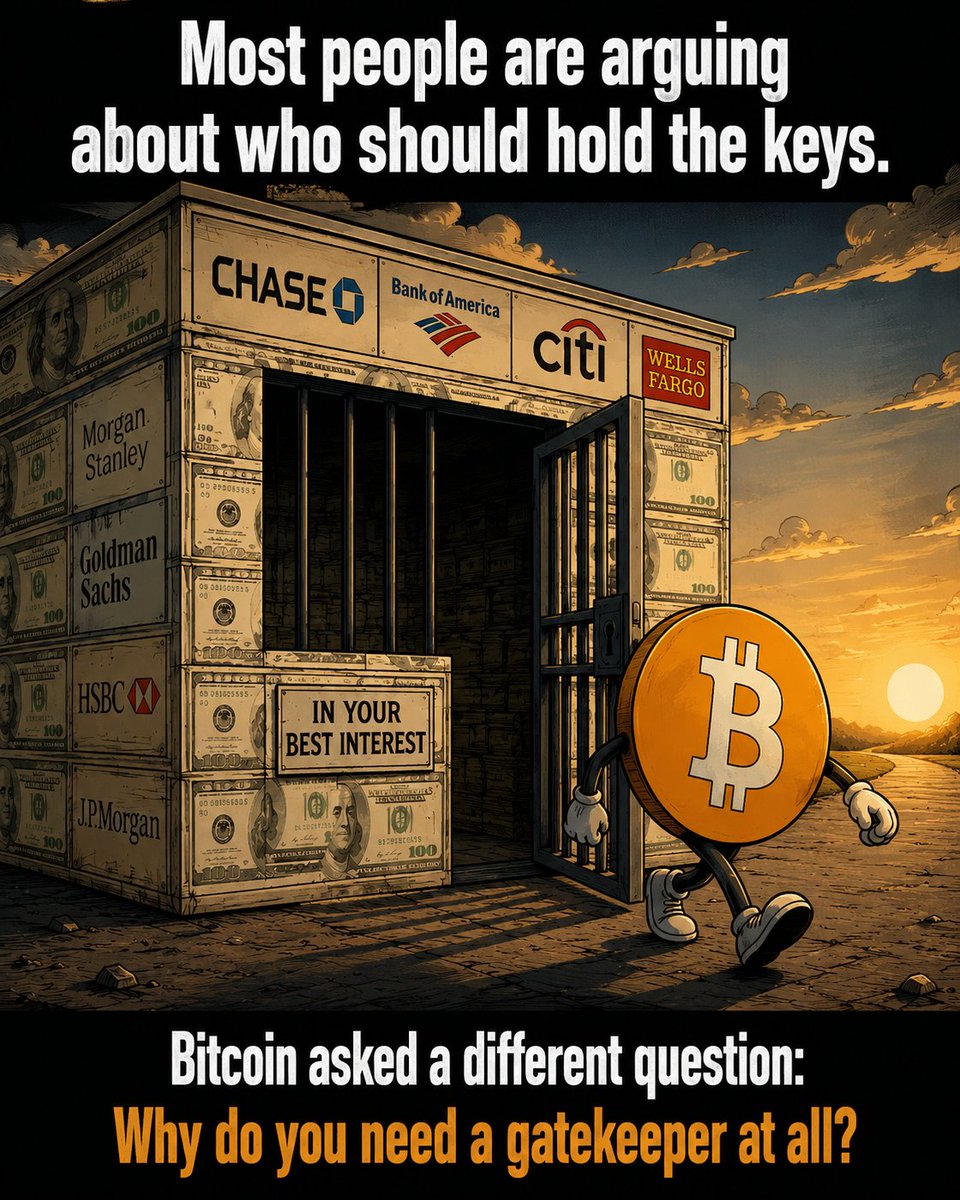
Bitcoin isn't a better investment product. It's an escape hatch.
I don't care about permission from governments, approval from banks, or validation from Wall Street.
I care about property rights, voluntary exchange, and a monetary protocol no politician can print, censor, confiscate, or corrupt.
Bitcoin isn't here to fix the state.
It's here to give you a way around it.
I am sure I am a mix of the four in this article.
If allowed a blend, my guess would be roughly:
55% Fundamentalist
30% Maximalist
15% Technologist
0% Capitalist (in the sense of celebrating Wall Street, ETFs, custodians, banks, or financial engineering).
How about yourself, where do you fall?
While I’m no fan of socialism or arbitrary confiscations of wealth, I can see why Bernie Sanders’ proposal (for the government to take a 50% stake in AI companies) resonates, including with many on the right.
The CEOs of the leading AI labs have told us repeatedly that they will cause massive job loss. This is not a story that I believe, nor does the data bear it out, but this is what they have told us. Similarly, they have hyped the risks of AI without putting an equal or greater emphasis on the benefits or readily available mitigations.
Conservatives have another fear. The employees of the leading labs claim to be philanthropic, but what we’ve seen is massive enrichment of NGOs advancing an agenda at odds with traditional values, fueling a revolution against our cities and communities. Soros-maxxing is not charity in our book.
Anthropic and OpenAI have established themselves as Public Benefit Corporations. What could be more in the public benefit than using half the wealth generated by these companies (which trained for free on the collective knowledge of humanity) to pay down the national debt? There is no ideological bias in that philanthropy.
Dario and Sam have begun to walk back their claims of massive job loss, but the damage to public trust is done, and now the chickens are coming home to roost. I could almost support the Sanders proposal as a stupidity tax.
There’s just one problem. Nationalization of AI will accelerate the corporate-government fusion we’re already sliding toward. Conservatives rightly fear a Central Bank Digital Currency. They ought to be even more concerned about Central Government AI — a system with even more totalistic power over information, decision-making, and human behavior.
We saw how social media was weaponized to censor conservatives (including President Trump) in the last Democrat administration. The definition of “trust & safety” expanded to mean protecting the public from supposed psychological harms, micro-aggressions, and disinformation (you know, like hearing conservative ideas or true facts about Covid).
That “safety” agenda as applied to AI will be vastly more powerful and Orwellian. AI won’t just moderate posts; it will curate reality — with the ability to rewrite history, enforce ideological conformity, influence policy at scale, mass surveil Americans, and condition the benefits of the many systems it controls on approved behavior.
America won’t win the AI race if we beat China but end up with a CCP-style social credit system in the U.S. — and that is the danger as the government becomes more deeply involved in AI development and assumes direct ownership and control.
Conservatives are right to fear where this is all headed but ought to think more carefully about how regulations they are flirting with now (that are widely celebrated among those with a long history of lust for Big Government) will be used against them the next time a Democrat administration is in power.
If someone is willing to homeschool their kids because they don’t trust the system to shape their mind, but still leaves BTC on an exchange or buys shitty institutionally run ETFs (trusting that same system with their money) they don’t have a philosophy. They have a contradiction.
BREAKING: Donald Trump Jr's investment firm, 1789 Capital, has seen its assets under management surge by +1,650% over the last year, to $3.5 billion, per FT.
Details include:
1. The firm is building an investment empire around "patriotic capitalism" and targets $10 billion in AUM
2. In recent pitches, the firm is being described as the "new Carlyle Group"
3. Over the past year, 1789 Capital has bought stakes in some of the most sought-after private companies including Ramp, Deel, Crusoe, Groq, and Reflection AI
4. Recent successful investments include investments in Cerebras, SpaceX, Anduril, and xAI under @DonaldJTrumpJr's guidance
1789 Capital is now one of America's fastest growing investment funds.
AI & INFLATION: Fun facts about AI:
1) The sell-side currently* estimates AI capex at ~$800bn in 2026 and $1.2tn in 2027. Emphasis on “currently” because these figures experience a jump condition higher in each successive earnings season.
2) $800bn is 2.5% of 2025 U.S. nominal GDP and $1.2tn is 3.8% of 2025 nominal GDP.
3) 2.5% is 46% of 2025 nominal GDP growth and 3.8% is 70% of 2025 nominal GDP growth.
4) Obviously, not all AI capex is spent domestically, with significant portions allocated to capital and commodity imports from places such as Taiwan, Korea, the Netherlands, Japan, Australia, Canada, etc.
5) A significant portion of AI capex is spent domestically, however, which is why each of the ~two dozen core and underlying inflation measures that we track are exhibiting positive impulses at levels that are radically inconsistent with the Fed’s 2% inflation target.
We’ve all been gaslit by Silicon Valley, Wall Street, D.C., and Mar-a-Lago to support the rapid development and adoption of a technology that is all but guaranteed to replace tens of millions of jobs and consolidate wealth—and political power via campaign finance—to a degree not seen since the era of the ancient Egyptians.
Now we’re being gaslit into assuming that a positive demand shock of this magnitude isn’t inflationary and isn’t contributing to the nationwide affordability crisis. There are 100+ million American families that have been struggling to make ends meet for roughly half a decade because of inflation, and many of them are about to be incrementally squeezed by perpetually soft demand for labor.
This is bad. You’re drunk and high if you don’t think this historic display of greed and equally historic consolidation of power will have massive political consequences. Investors will look back on the advent of nationwide wealth taxes and trust-busting regulation with nostalgia by the time this Fourth Turning climax is over. Pray for every high-school-aged child in this country because every Fourth Turning since at least the 15th century has ended in total war.
I love you and Jesus Christ loves you.
—Skipper 💜
Very enjoyable watch. Lots of gold in here from one of the greats, both timeless advice and thoughts on where we are today.
Here are some notes I took:
Trading vs Investing
• PTJ sees trading and investing as totally different games. A trader's job is just constant risk management and patience, waiting for the rare setups where you can take a really big swing
• He compares trading to boxing. You're getting punched the whole time and the goal is just to stay standing until your real opportunity shows up (lesson from his mentor Eli Tullis)
• Emphasizes having a plan before you even enter a trade and making sure that plan is self-executing so you don't freeze up when things get volatile.
• Still wakes up in the middle of the night to watch global markets. Reckons passion and obsession are non-negotiable if you want to keep an edge over decades
Liquidity is king
• Never trust an asset you can't get out of quickly. Learned this early on seeing silver crash in the 80s. You're only worth what you can write a check for tomorrow.
Riding the trend/big swings
• The job isn't being right all the time. It's being massively positioned when conviction, technicals and macro all line up.
• Most of his P&L comes from a handful of knockout trades. Everything else is just preservation.
• He pointed to Bitcoin's 2020 surge as a textbook example of a rare knockout macro trade driven by a policy shift.
Bitcoin as the best inflation hedge
• Calls BTC unequivocally the best inflation hedge, better than gold, because the supply is finite while gold keeps expanding through new mining every year.
• Inflation trades took off after central banks intervened in 2020 and he thinks the same setup repeats whenever you get heavy monetary or fiscal stimulus.
• Did flag real long term risks for BTC: AI and quantum computing + cyber warfare.
Equities are a bad setup
• Buying the S&P at current valuations basically implies negative 10 year forward returns. He thinks it's going to be really hard to make money from here.
• We're in a sovereign debt bubble and historically over-equitized. When the stock market cap to GDP ratio hits 250% (where it is now), history suggests 10-year returns could be negative.
• A potential rolling top in the market could be triggered by a massive wave of new IPOs and subsequent unlock periods which will flood the market with equity supply while corporate buybacks are slowing down.
The macro feedback loop risk
• A proper equity correction could kick off a nasty self reinforcing problem.
• Around 10% of US tax revenue is capital gains. In a crash, that goes to zero.
• Then the deficit blows out, the bond market gets smoked, and the negative reflexivity feeds on itself.
Bubble right now?
• Stops short of calling this an outright bubble but reckons the structural conditions (valuations, leverage, supply pressure) rhyme pretty uncomfortably with prior tops.
Yen bull case
Talked through a long yen thesis. Thinks it is undervalued and the catalyst is the leadership change (new PM) that will drive the economy in a different way going forward (Japan first etc).
AI Risk (Investment Lens)
• Thinks AI is one of the biggest risks out there for markets and society
• Reckons the industry has no proper risk management and is openly calling for regulation, not just as an ethics thing but as a structural market concern
• He went to a conference with the top AI modelers, and the vibe was basically: "We probably won't do anything about safety until 50 or 100 million people die in an accident."
On Kindness
• Everyone should start their day with the goal of one simple act of kindness. It doesn't have to be a big deal or cost money. It’s about building the reps until being a kind person is just instinctive and organic.
• His mom’s old advice was to kill them with kindness. He thinks that’s exactly what the country needs right now to fix the vitriolic, attack mode culture that’s taken over since the early 2000s.
Highly recommend watching the whole thing. PTJ is a great role model for young people.
The highest-value human work in the AI era will be in domains with sparse reward signals. Internalize this, or watch your value erode over the next decade.
Math, programming, rote memorization, data science, all fucked. The classic “smart nerd” jobs are exactly where AI is strongest, because the feedback loops are dense. You can check the answer. You can run the test. That means AI can improve quickly, and humans will rapidly fall behind.
Your advantage as a human is in messy domains.
Taste. Judgment. Negotiation. Risk-taking. Politics. Sales. Science at the frontier. Anything you can only really learn by doing. Cross-disciplinary stuff.
The valuable domains will be the ones guarded by secrets, tacit knowledge, weak labels, long feedback cycles, and ambiguous outcomes. Places where the training data is scarce, the ground truth is disputed, and it's impossible to explain why something is good.
AI will still enter these domains. But we will be slower to trust it unsupervised there, because it will be harder to tell when it is right, harder to prove when it is wrong, and difficult to construct secure sandboxes. The stakes will be too high to YOLO it.
I find myself saying this over and over again to young people today: the future does not belong to people who are able to get good grades on tests. It belongs to people who can operate under uncertainty, in domains where correctness is hard to define.
Those domains will become the thin waist of the economy: as productivity everywhere else accelerates, the humans who excel there will become our economic Strait of Hormuz. The best humans in these domains will demand an enormous cut of the growing economic pie.
Your imperative going forward is to make sure you're one of these people.
(Or become an electrician. That probably works too.)