Launching a memecoin can feel like climbing Everest. 🏔️ But what if you had the right gear? 🤔
Introducing @ApeExpress_ 🐵: the all-in-one toolkit making token creation, liquidity management, & community building effortless on #ApeChain. Here's the scoop:🧵👇
@ThankApe@apecoin
Every DeFi hack story has the same plot twist: someone clicked "Sign" without reading what they were actually signing.
Day 18 of my AI & Web3 tool sprint dives into the tech behind that one click. 🔏⚠️
First, the concept most people never learn:
A signature and a transaction aren't the same thing. Signing costs no gas and doesn't move funds by itself, but it can authorize something that does, later, without you seeing it happen.
That gap is exactly what wallet drainers exploit: trick you into signing an approval or a permit, and the attacker moves your tokens whenever they want, no need to ever touch your private key.
Older signing methods (like raw eth_sign) show you meaningless hex data, basically asking you to trust blindly.
EIP-712 fixed part of this by making signatures human-readable, structured data instead of gibberish. But readable isn't the same as understood, most people still don't know what they're approving.
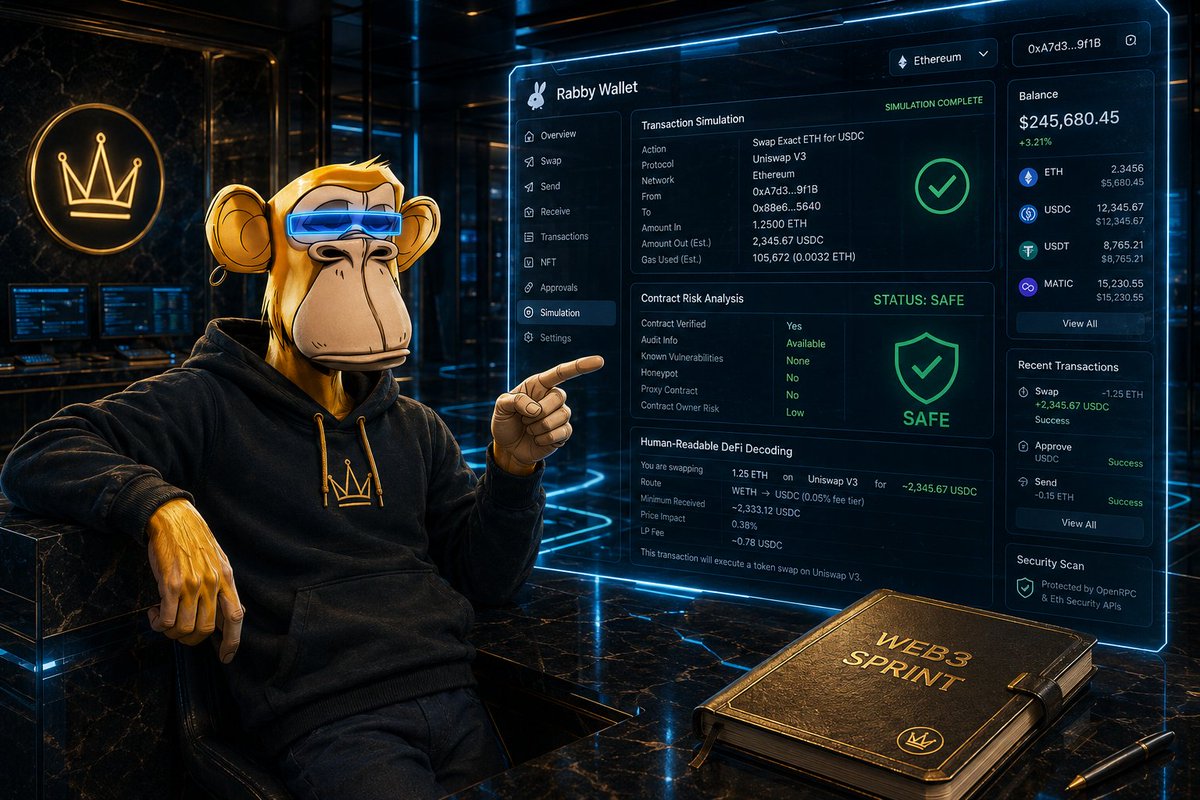
Tool: Rabby Wallet @Rabby_io – an EVM wallet built by the DeBank team that decodes what you're about to sign before you sign it. Instead of raw contract calls, it shows you plain language: "Swapped 100 USDC for 0.08 ETH," or a clear warning if your balance is about to drop with nothing coming back.
What it actually does:
1️⃣ Transaction simulation: Previews exactly what will happen before you approve, catching malicious contracts before they execute.
2️⃣ Risk scanning: Flags known phishing sites and suspicious contracts using a maintained threat database
3️⃣ Approval management: Shows and lets you revoke old, unlimited token approvals, the single most common vector behind DeFi exploits
My Honest Review 🔍
With over $2.3 billion lost to crypto exploits in 2025 alone, most of it from consent mistakes rather than actual protocol breaks, a wallet that forces you to slow down at the exact moment of risk isn't a luxury feature. It's the difference between losing your funds and not.
My Take 🧠
The real vulnerability was never the blockchain, it's the human clicking "Sign" without understanding what that means. Tools like Rabby don't remove that risk entirely, but they finally make the moment of signing something you can actually see through instead of trust blindly.
The safest habit to adopt in DeFi, isn't depending on a particular tool.
It's slowing down before you click "Sign." ✍️
Imagine two AI agents, built by two companies that have never met, trying to do business together. No handshake, no contract, no LinkedIn to check credentials. One agent has money to spend, the other has a service to sell.
How does either one know the other isn't a scam? 🤔
That's the exact problem @ethereum just shipped a fix for.
Day 17 of my AI & Web3 tool sprint. 🪪🤖
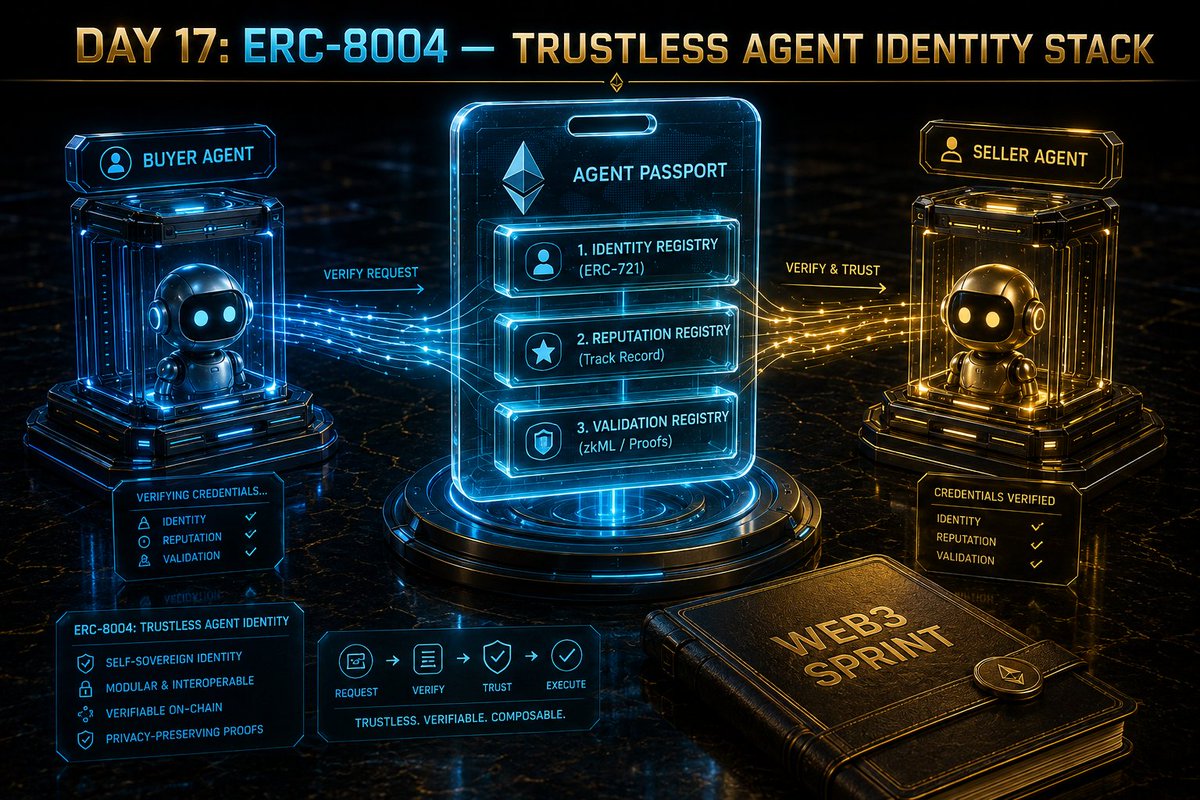
Tool: ERC-8004 ("Trustless Agents") – an Ethereum standard that gives AI agents a persistent on-chain identity and portable reputation.
Think of LinkedIn + Yelp + Notary Public, but fully on-chain and permissionless.
Built on the foundation @VitalikButerin and the Ethereum community spent a decade laying, and shipped by Marco De Rossi, Davide Crapis, Jordan Ellis, and Erik Reppel, with the Ethereum Foundation, MetaMask, Google, and Coinbase all contributing to the spec.
How it works, three registries:
1️⃣ Identity Registry: Mints each agent as an ERC-721 token, giving it a globally unique, portable ID that describes what it does and how to reach it.
2️⃣ Reputation Registry: Stores verified feedback after every interaction, building a public track record any other agent (or human) can check.
3️⃣ Validation Registry: Records independent, cryptographic proof that a task was actually completed correctly, from lightweight re-checks up to full zkML verification for high-stakes work.
Trust is tiered by what's at stake: reputation alone covers low-value tasks, crypto-economic validation kicks in for bigger ones, and full zkML proofs (the EZKL territory we covered on Day 12) come in when it really matters.
The scale, fast: went live on Ethereum mainnet January 29, 2026. Over 45,000 agents registered within the first month. Already chain-agnostic, live on Base, Avalanche, and other EVM chains too. Some agents already support x402-compatible payments, connecting straight back to Day 16.
My Honest Review 🔍
This is the missing connective tissue for everything I've covered so far. Payments without identity means anyone can spin up a fake agent and get paid.
Verifiable AI without discoverability means nobody knows the proof even exists. ERC-8004 is the layer that lets all these pieces actually work together as one economy, not isolated experiments.
My Take 🧠
45,000 agents registering in a single month isn't hype, it's infrastructure adoption. When identity, reputation, and payments all become standardized and interoperable, "AI agent" stops being a marketing term and starts being an actual economic role.
Two strangers, one deal, zero trust required. That's the internet Ethereum is quietly building. 🏗
Welcome to August, my Amazing Builders and Consumers.
I hope you have a productive month. ✨️
Let's go straight into Day 16 of my AI & Web3 tool sprint. 💸🤖
Back on Day 14, we talked about AI agents needing bank accounts, not just brains. Today's protocol is the biggest reason that's now actually happening at scale.
Tool: x402 by @coinbase – an open-source, web-native payment standard for stablecoins, revived from an old, mostly forgotten piece of the internet: the HTTP "402 Payment Required" status code, sitting unused in the web's core spec since the 1990s, until now.
How it actually works:
1️⃣ A client (human or AI agent) requests a resource; an API, a dataset, a compute call
2️⃣ The server responds with a 402 status and a payment requirement
3️⃣ The client pays instantly in stablecoins; no accounts, no sessions, no manual invoicing
4️⃣ A "Facilitator" verifies and settles the payment on-chain, so sellers don't need their own blockchain infrastructure
Real use cases already live:
• Self-funding agents paying per-inference for their own compute.
• Pay-per-call API access for live data feeds (prices, supply chain metrics).
• Agents paying for web services (software, datasets, even private groups).
• Machine-to-machine payments between two AI agents, no humans involved.
The MCP connection matters here too: developers are already building MCP servers with x402 paywalls, letting AI models pay autonomously for tool access and data retrieval.
The payment layer MCP was always missing.
The scale: since launching in May 2025, x402 has processed hundreds of millions of transactions. The backing coalition includes Cloudflare, Circle, Stripe, and AWS; not a niche crypto experiment, but infrastructure Web2 giants are actively building into their own payment flows.
My Honest Review 🔍
What stands out is how quiet this shift has been. No hype cycle, no token pump, just an old, forgotten status code repurposed to let machines transact with machines, and it's already processing serious volume in production, not a whitepaper promise.
My Take 🧠
Agent-to-agent payments used to be the missing piece of "autonomous AI." x402 shows that piece is no longer missing, it's already live, and Web2's biggest infrastructure players are betting on it too. The agent economy isn't a future narrative anymore, it's a running transaction log.
If your team is building on x402, or something like it, feel free to drop it below, I want to hear how you go about that.
Stay tuned for more. ✅️
On June 12, 2025, a Google Cloud configuration error triggered a multi-hour outage that took down services across the internet, including AI tools like Gemini and Character AI, alongside Spotify, Discord, and Gmail. Millions of users were locked out, with zero visibility into when things would recover.
That incident exposed a massive vulnerability in modern tech: when you rely on a centralized AI monopoly, their single point of failure becomes your operational risk.
Day 15 of my AI & Web3 tool sprint breaks down the protocol building the permissionless alternative. 🧠⛓️
Tool: Bittensor @opentensor – an open-source decentralized network that commoditizes machine intelligence through global subnets and crypto incentives.
Instead of relying on a single corporate server stack, Bittensor spreads compute, model training, and inference across thousands of independent nodes:
1️⃣ Subnet Architecture: specialized subnets dedicated to distinct tasks, from serverless inference (Chutes) and LLM pre-training (Templar) to P2P GPU clusters (Lium)
2️⃣ Incentive Mechanism: miners provide model intelligence, while validators programmatically evaluate outputs and benchmark uptime in real time
3️⃣ Yuma Consensus: the on-chain algorithm that distributes TAO emissions based strictly on performance, eliminating single-point vulnerabilities
My Honest Review 🔍
Bittensor isn't just an ideological play, it's an economic one. Watching open-market subnets serve enterprise-grade AI requests at a fraction of cloud costs, while remaining completely permissionless, proves decentralized compute can genuinely compete on reliability and price.
My Take 🧠
The winning argument for DeAI comes down to resilience. When machine intelligence operates across a global, incentivized network, you remove single corporate choke points, centralized downtime, and systemic security risk.
15 days in, and my simple message to you is this: build secure or don't build at all. 🔒
Day 13 of my AI & Web3 tool sprint (Phase 2: Workflow & Execution Stack). 🖼️📊
Today's problem: Floor price is a flawed metric.
Most NFT traders rely on static floor prices or manual trait checks. But when sweeps happen fast, pricing misalignments occur in seconds.
Manually calculating trait scarcity vs. historical sales takes too long.
Tool: Nansen AI @nansen_ai machine-learning valuation and smart money tracking engines.
How it works:
1️⃣ Trains ML models on historical sales data, trait combinations, wash trading filters, and wallet reputation.
2️⃣ Calculates a real-time Fair Value price target for tokens across a collection.
3️⃣ Automatically flags underpriced listings where trait scarcity isn't reflected in the current listing price.
My Honest Review 🔍
Floor price only tells you what the cheapest item costs, it tells you nothing about trait-weighted value or liquidity depth. Predictive ML models factor in trait clustering and wallet accumulation to give a much clearer picture of true market value in real-time.
My Take 🧠
NFT trading evolved past simple floor-pumping a long time ago. The edge belongs to operators using real-time predictive data to spot mispriced traits before the rest of the timeline catches on. AI valuation turns static JPEG trading into a quantitative asset market.
Day 13 complete. Onto the next block. ⛓️
Day 12 of my AI & Web3 tool sprint. 🧠🔐
Back on Day 8, we asked: if an AI agent makes an execution decision with real capital on the line, how do you actually prove it didn't lie or hallucinate its reasoning?
Today's tool tackles that exact problem, and it's actively shipping right now.
Tool: EZKL @ezklxyz – an open-source engine that turns machine learning inference into a zero-knowledge proof. Define a model in PyTorch or TensorFlow, export it, and EZKL compiles it into a verifiable ZK-SNARK; usable from Python, JavaScript, or the command line.
The workflow, per their docs:
1️⃣ define your model in PyTorch/TensorFlow
2️⃣ export it as an .onnx file, plus a sample input as .json
3️⃣ run it through EZKL's CLI to generate a ZK circuit
4️⃣ get a cryptographic proof that a specific input produced a specific output, verifiable on-chain, without exposing the model itself
This isn't just theory.
@Balancer is already integrating EZKL to pioneer dynamic swap fees that adapt to market volatility in real time, trustlessly, solving the "static parameters lag the market" problem DeFi has had for years.
My Honest Review 🔍
Worth noting: EZKL's own docs are upfront that the project hasn't been audited yet, and zkML as a field is still nascent.
That honesty is refreshing, this is real, promising infrastructure being built in the open, not hype dressed up as a finished product.
My Take 🧠
Most "AI agent" projects skip this layer entirely. EZKL is one of the few teams actually shipping the tool that makes "trust me bro" AI provably unnecessary, and a live protocol (Balancer) is already building on it. If you're working on an agent that touches real money, this is the kind of infrastructure that should be on your radar.
This is just another piece of the stack, still mapping the rest.
Watch out for the next one. 👀
Day 11 of my AI & Web3 tool sprint. 🛡️🔍
Today's tool solves a problem every single person who's ever aped into a new token has felt: "Is this about to rug me?"
Tool: https://t.co/DGnfyicvVO by @Rugcheckxyz paste any Solana token's contract address and get an instant risk score. It checks liquidity locks, mint authority, holder concentration, and creator balances.
Ran it on a trending https://t.co/lRzNKTNO5j token: eeepydog.
📊 Score: 1 ("GOOD" / Ultra Low Risk)
⚠️ Risks: No critical risks found
🔒 Key Data: LP locked 100%, mint authority renounced, creator balance: SOLD, 1,569 holders, $43K MC.
My Honest Review 🔍
Genuinely one of the smoothest, most accessible tools tested in this sprint. No wallet connection or sign-up required, just paste the contract address and get a clean verdict in seconds. The UI tells a full narrative at a glance: score, active risk flags, holder distribution, and LP status all on one screen.
My Take 🧠
"Creator balance: SOLD" is the line most people glaze over, but it’s critical nuance. A dev who has already dumped their supply isn't an automatic green light just because the top-level score reads "GOOD." A clean code audit doesn't guarantee price momentum if creator alignment is gone. Read past the score, the narrative always matters.
11 days down. 🤝
I know you're wondering what tool is next. 👀
Well, you'll find out. 😎
Day 10 of my AI & Web3 tool sprint. 🔍🤖
Today's test tackles something everyone on this timeline has asked at least once: "Is this account even real, or am I trusting a bot-farmed KOL?"
Tool: https://t.co/HvlyBhlRBm (formerly TweetScout) scores accounts by real influence and estimates bot-follower percentage.
Ran it on two accounts everyone here already knows:
@whale_alert — score 2548, Tier 5 "Supreme," 2.86M followers, joined 2018
@WatcherGuru — score 3332, Tier 5 "Supreme," 4.48M followers, joined 2021
Both landed in the top influence tier, which tracks, these are two of the most cited accounts on CT for a reason.
My Honest Review 🔍
Here's the catch: the actual bot-follower % (the number people probably want most), is locked behind a paywall.
The free tier gives you the influence score, but the exact thing that answers "are these followers real" needs an upgrade.
Useful tool, but the free version doesn't fully solve the problem it's marketed for.
My Take 🧠
Influence scoring is a good proxy, but "who follows you" only tells half the story.
Until bot-detection is actually free to see, most people will still be guessing on the thing that matters most.
10 days down. 🤝
Who's next? 👀
We’re letting AI agents run entire token treasuries, but almost nobody is verifying who actually holds the keys. 🤖🔑
The "autonomous AI agent" narrative is flying right now. But here is the brutal on-chain truth:
A flashy UI showing an AI agent "managing" things is completely useless if the underlying infrastructure is run out of a developer's browser extension.
For Day 8 of my AI & Web3 tool sprint, I audited a trending AI-agent collab protocol ($GITLAWB) by @gitlawb to see if its execution layer is actually decentralized.
Here is my 3-step on-chain audit framework (with quick definitions for beginners):
1️⃣ EOA vs. Contract (The Illusion of Control)
Paste the token CA (Contract Address) into BaseScan:
0x5F980Dcfc4c0fa3911554cf5ab288ed0eb13DBa3
Go to "Read Contract" and look for the owner.
If it’s a standard EOA (Externally Owned Address; essentially a standard personal wallet like MetaMask run by a human), the developer holds the recovery phrase, and the "agent" is just a script on a private server.
For $GITLAWB , the owner is 0x660e...8D12; the programmatic @dopplerprotocol Doppler Airlock contract (a smart contract designed to automatically manage launches with strict, unchangeable rules).
Massive green flag; no individual dev has a backdoor key to unilaterally mint or alter parameters.
2️⃣ Programmatic Guardrails
Under "Read Contract", check for programmatically enforced parameters (like yearlyMintRate or vestingDuration).
If an agent has no on-chain threshold limiting its daily outflow, there is zero risk management. One bad prompt-injection (tricking an AI's brain using manipulative chat inputs) could exploit the LLM into signing a transaction that empties the pool.
3️⃣ The "Kill Switch" Owner
Programmatic execution means nothing if a single admin key can trigger an emergency freeze and withdraw funds unilaterally.
True autonomy requires the override keys to be secured by a multi-sig (a wallet that requires multiple independent approvals to sign a transaction) or a timelocked contract.
The Bottom Line:
Stop trading the narrative blindly. Paste the address, audit the contract, and follow the signatures.
The ledger doesn't lie. 🤝
GM to everyone except the devs trying to hide their insider distribution loops. 🕵️♂️
The blockchain always keeps the receipts, and the tools to expose them are getting sharper every single day.
Focus, execute, and trust the data.
Let’s have a productive day. 🤝
Everyone on this timeline is chasing the next explosive narrative, but almost nobody is verifying the actual supply architecture behind it. 🕵️♂️📊
For Day 7 of my AI & Web3 tool sprint, I wanted to move away from text entirely and look at raw behavioral data visualization using @bubblemaps
The harsh reality of crypto? A project can have beautiful branding, an active community, and an ironic meme narrative, but if the supply is held hostage by clusters of interconnected wallets, you aren't trading, you’re exit liquidity.
But here’s the kicker: mastering these tools pays off in more ways than one.
Lest we forget, Bubblemaps dropped a massive airdrop for their early V2 users, allocating an insane 22.17% of their total $BMT token supply directly to the community. Doing your on-chain homework literally pays. 🪂💰
The Stress Test 🛠️
Instead of auditing a safe, tier-1 asset, I threw a raw, trending token directly into the bubble terminal:
Robbinghood on @solana chain 🔗
(6fkhFEPL1KjipJkAuJg6gCQmHsnvwfhJXUyjV2Tspump)
Most platforms give you a boring list of top holder percentages that can easily be spoofed by splitting tokens across multiple clean addresses. Bubblemaps visualizes the actual relationships between wallets. If one wallet transfers funds or distributes supply to others, they light up as an interconnected network.
What it exposed:
The ledger never lies. While the individual top holder percentages looked fragmented on paper, the cluster map exposed multiple independent networks acting in sync:
• A hot pink spiderweb pulling strings at the top.
Isolated orange and cyan execution loops holding distinct chunks of supply on the flanks.
• It completely visualizes the insider distribution web before they even think about hitting the market.
My Honest Take 🔍
Real alpha isn't found in a project's marketing pitch or the hype in the comment section. It’s found in the unalterable signal of the blockchain ledger.
Bubblemaps proves that data transparency is our sharpest weapon. If you aren't running contract addresses through a behavioral cluster map before allocating capital, you are trading completely blind. Look at the architecture, not the hype.
One full week officially down. 7 days of non-stop daily execution.
GRWM as we dive deeper into this. ✨️