"The problem is in essence very simple. Decentralized Western capitalists have been able to squeeze domestic labor for forty years and run outsized profits. But now they are faced by a centralized capitalist (which is in effect the Chinese state) who is even more efficient in squeezing wages and increasing productivity. That centralized capitalist is now driving out of business Western decentralized capitalists. This is why the latter have to move the heaven and the earth in order to stop the centralized capitalist from winning. But they have to do all of that while never mentioning the role their own profits play in it."
https://t.co/BihdkikaDf
Food for thought!
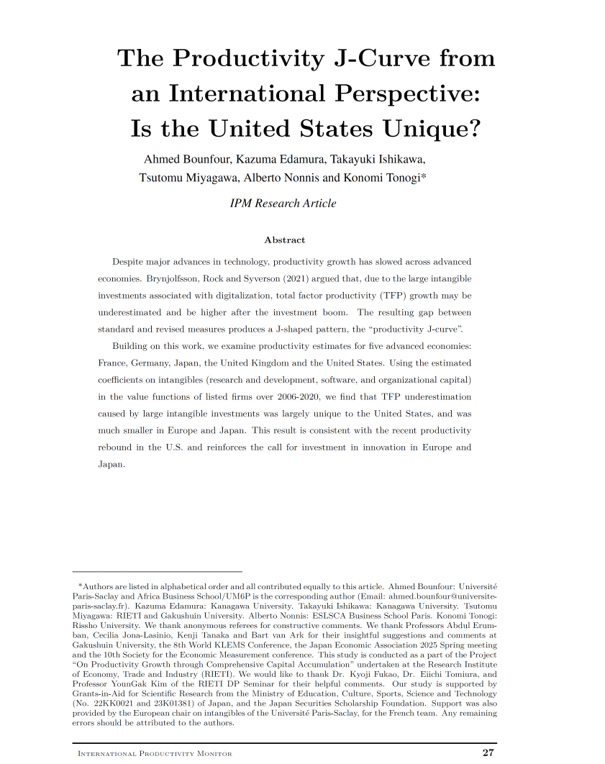
"The Productivity J-Curve from an International Perspective: Is the United States Unique?" by Ahmed Bounfour, Kazuma Edamura, Takayuki Ishikawa, Tsutomu Miyagawa, Alberto Nonnis, and Konomi Tonogi.
"This article examines productivity estimates for five advanced economies: France, Germany, Japan, the United Kingdom and the United States. Using the estimated coefficients on intangibles (research and development, software, and organizational capital) in the value functions of listed firms over 2006-2020, the authors find that TFP underestimation caused by large intangible investments was largely unique to the United States, and was much smaller in Europe and Japan."
https://t.co/o2fG0YkqEC
Super interesting!
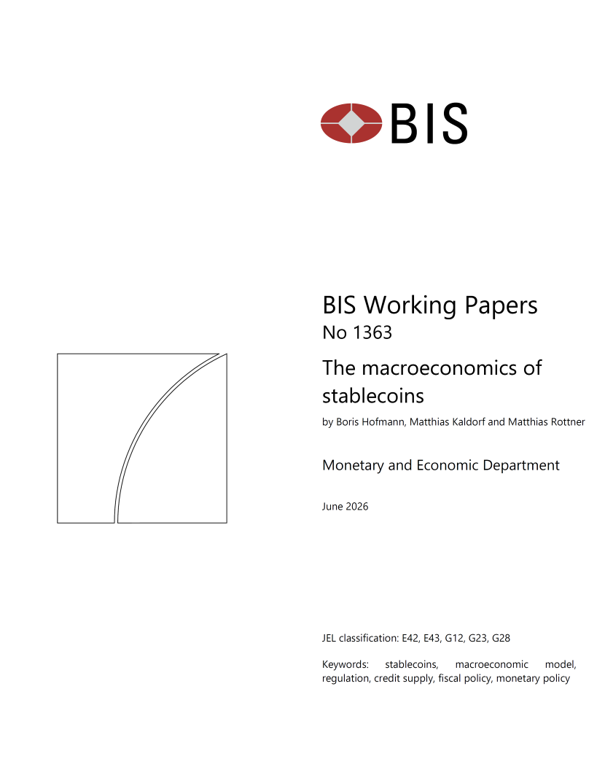
"The macroeconomics of stablecoins" by Boris Hofmann, Matthias Kaldorf, and Matthias Rottner.
"Our analysis suggests that stablecoin adoption affects the economy through two main channels: a bank lending channel and a fiscal space channel. The bank lending channel operates through banks' deposit funding and credit supply, while the fiscal space channel operates through stablecoin issuers' demand for Treasury bills and the government budget constraint. These channels have opposing effects on output. Calibrated to the United States, the model predicts that, in the long run under our baseline specification, the contractionary effect of the bank lending channel dominates slightly. The net effect, however, depends on stablecoin regulatory design, the strength of foreign demand for stablecoins and fiscal conditions. The model also implies that the fiscal space channel acts more quickly during the transition and that stablecoins can amplify monetary policy transmission through bank lending."
https://t.co/Up1UNIXBiw
Highly recommended!
"Messy Jobs: The Work That AI Cannot Reach" by Luis Garicano, Jin Li, and Yanhui Wu.
"Economists Luis Garicano, Jin Li, and Yanhui Wu offer a new framework for thinking about AI and work. They show why some roles will disappear, why others will be reshaped, and why many of the most valuable forms of human work will endure. Along the way, they explain how AI changes careers, firms, and the wider economy. AI will automate many tasks, the authors say, but jobs are more than tasks. Jobs are bundles of judgment, coordination, accountability, tacit knowledge, and human relationships. When tasks are tightly bundled within a job, AI will be less able to eliminate it."
https://t.co/2z3V00M8bW
Highly relevant!
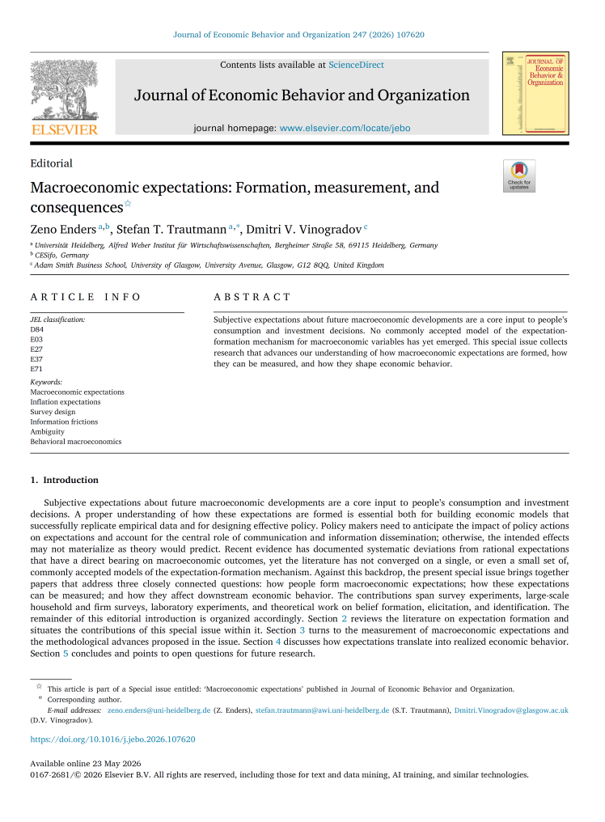
"Macroeconomic expectations: Formation, measurement, and consequences" by Zeno Enders, Stefan T. Trautmann, and Dmitri V. Vinogradov. An editorial for the "Macroeconomic expectations" special issue in the Journal of Economic Behavior and Organization.
"The contributions assembled in this special issue cut across the three thematic strands of formation, measurement, and consequences of expectations, but they speak to one another in ways that suggest a more integrated agenda. On the formation side, the new evidence reinforces the picture of expectations as the joint product of information frictions, cognitive limitations, social influences, and salient personal experiences, rather than the output of a single canonical mechanism. On the measurement side, the papers in the issue show that the apparent properties of expectations – their level, dispersion, and uncertainty – depend systematically on how questions are framed, on which response format is used, and on how the elicited distributions are summarized; methodological choices are not innocuous, and the comparability of results across surveys and over time hinges on them. On the consequences side, the evidence confirms that expectations influence behavior across households, firms, and asset markets, but also that detecting these effects depends on careful identification strategies, structural model integration, randomized information experiments, and laboratory designs, each with its own strengths and limitations."
https://t.co/G6L3vQKBP9
Highly relevant!
"The short‑ and medium‑term effects of structural reforms: a reassesment" by Joana Duran-Franch, Alvaro Leandro, Sébastien Turban, Nicolas Ruiz, Elisa Mitteldorf, and Iris Smiderle.
"This paper considers the short- and medium-term macroeconomic effects of a broad set of structural policy changes (corporate tax measures, marginal tax wedges, ALMP spending, employment protection legislation, rental market regulations, rail infrastructure investment, and basic research expenditure), building up on the baseline results presented previously in the overview of Foundations for Growth and Competitiveness (F4GC). Using recent econometric methods, it analyzes the robustness of these results and the potential heterogeneities in reforms impacts. The evidence suggests that many reforms deliver measurable short and medium run gains when assessed on the components of growth in GDP per capita."
https://t.co/EzMcsesH68
This looks like a must-read!
"Macro: The Economic Models That Shape Our World" by Greg Kaplan (available in November).
"In clear and engaging prose, Chicago economist Greg Kaplan demystifies how our everyday behavior, including how we spend and save, connects to the biggest questions in fiscal and monetary policy. Tracing the evolution of modern macroeconomics from Keynes to today, he guides readers through the models that are often used to explain our economy, uncovers their flaws, and reveals what cutting-edge research tells us about managing the economy in good times and bad. The journey culminates in HANK, a macroeconomic model co-created by Kaplan that is more consistent with reality. Macro offers a timely, new framework for understanding and shaping economics in the real world."
https://t.co/IxOWTajiak
Delighted to tell you that Messy Jobs is coming out on June 21st. The kindle preorder link is available!
Here are advance reviews/blurbs for you to ponder by @raffasadun@davidautor@patrickc@alexolegimas@bengtmit and Evan Guo.
"Messy Jobs is a brilliant application of price theory. AI changes what is scarce in the economy and therefore what is valuable. When intelligence becomes cheap, judgment, coordination, trust, and responsibility become more valuable. The authors use this simple, powerful logic to illuminate how AI will reshape work and organizations." Bengt Holmström, Paul A. Samuelson Professor of Economics at MIT and recipient of the 2016 Nobel Memorial Prize in Economic Sciences
"In Messy Jobs, Garicano, Li, and Wu bring the discipline of organizational economics to a question too often left to speculation: How will AI actually reshape work? They move past the usual debates about what AI can or cannot do and ask the harder questions. What shapes the incentives to adopt it? How does adoption reshape the incentives to learn? What new configuration of skills will emerge as AI advances? A rigorous, original, and engaging account of how AI will reshape organizations and labor markets, and what it will take to thrive in them." - Raffaella Sadun, Charles Edward Wilson Professor of Business Administration, Harvard Business School
"This is the first book in the AI era that recognizes that most of what organizations struggle with does not involve computational problems. People in messy jobs must hold coalitions together, adjudicate between competing interests, and make change stick. These are political, diplomatic, and interpersonal challenges. As a result, these types of messy jobs will persist well into our AI future. Garicano, Li, and Wu, are neither techno-utopian nor techno-dystopian. They take seriously what machines can do, what humans will do, and how jobs will be rebundled. The economics analysis is lucid and penetrating, and the book pinpoints where human agency will remain paramount. The book is hopeful and practical for anyone charting a career in the coming decade." - David Autor, Daniel (1972) and Gail Rubinfeld Professor, Google Technology and Society Visiting Fellow, Margaret MacVicar Faculty Fellow, MIT Department of Economics
"This is simply a must-read book if you are interested in the future of work in the age of AI. For decades, Luis Garicano has been a leading voice in how organizations morph and change with new technology and innovation. Together with Jin Li and Yanhui Wu, they have written the definitive text on how AI will affect the labor market. The book is an impressive feat of combining academic rigor with clear explanations and concrete examples. I would recommend this book to anyone interested in learning about what comes next. "- Alex Imas, director of AGI Economics, Google DeepMind, and the Roger L. and Rachel M. Goetz Professor of Behavioral Science, Economics, and Applied AI, and Vasilou Faculty Scholar at the University of Chicago Booth School of Business
"There is a lot of woolly thinking on the topic of AI and jobs. This excellent book contains by far the most thoughtful and economically literate account that has yet been written." - Patrick Collison, CEO, Stripe
"AI is not going to lead to mass unemployment, and this is the best book to explain why not. It also illuminates how labor markets are likely to evolve. It is short, to the point, eminently readable, and of extreme relevance. ""- Tyler Cowen, professor of economics at George Mason University
"This book isn't just some economist's armchair theorizing; it's a practical guide. I hope you get as much out of it as I did. "-- Evan Guo, CEO of Zhaopin Group, the largest career development platform in China
https://t.co/L7UM3bHHYO
Highly relevant!
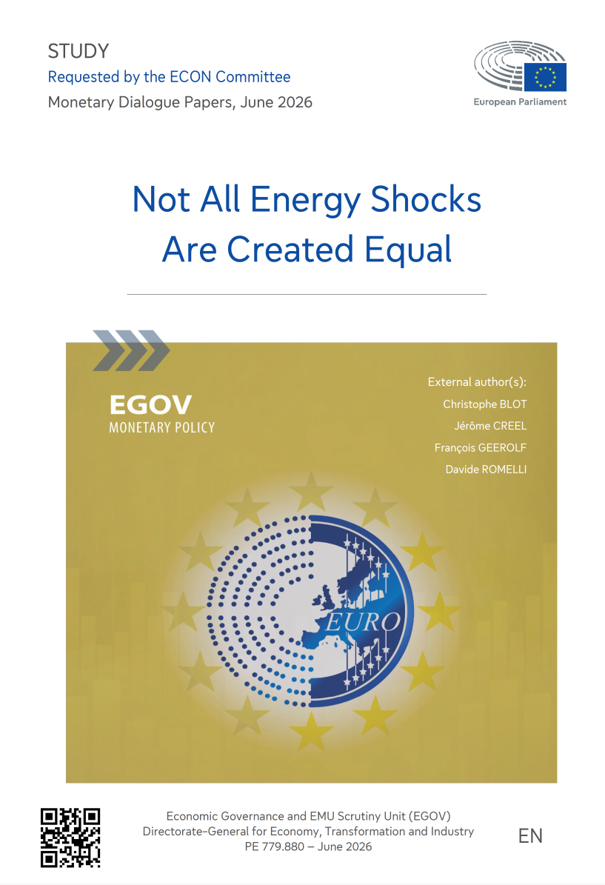
"Not All Energy Shocks Are Created Equal" by Christophe Blot Jérôme Creel, François Geerolf, and Davide Romelli.
"The inflation surge of 2022–2023, and the risk of recurrence following the outbreak of conflict in the Middle East in early 2026, raises fundamental questions about the appropriate monetary policy response to supply-driven inflation. We examine the anatomy of both inflationary episodes, the challenges in distinguishing between supply and demand shocks in real time, the adequacy of the ECB's response to the 2022–2023 energy crisis, and the lessons that can be drawn for responding to the current inflationary pressures."
https://t.co/ctqQMEtghW
Glad to meet in Sofia the new Deputy Prime Minister, an old great friend, @atanaspekanov, at the Green Transition Forum, with Monica Stanisheva. Great opportunity to share support to the “One Europe One Market” Plan. @DelorsInstitute@IEUniversity@iespega
New paper: We assess ageing costs in the reformed EU fiscal rules. We show that the treatment of ageing costs under the Debt Sustainability Analysis (DSA) that underpins the new rules constrains elected governments based on uncertain and arbitrary ageing-related assumptions.
Our paper on EU countries' development models in the race for the best location is out in "Review of Evolutionary Political Economy". Cluster countries by macro and institutional characteristics. Four models: core, periphery, workbench, finance hubs. Hubs importance has increased
The European Commission allows additional government spending of up to 0.6% of GDP until 2028 to reduce dependence on fossil fuels by broadening the scope of the current National Escape Clause for defence spending. Such extra spending would be exempt from fiscal rules constraints
Thought-provoking!
"Automation and Repression" by Daron Acemoglu, A. Arda Gitmez, and Mehdi Shadmehr.
"We consider a model of automation embedded in a political environment where workers can undertake a revolt (modeled as a global game), and greater inequality between capital and labor increases the likelihood of a revolt. Decentralized automation decisions raise the share of capital in national income and increase the likelihood of a successful revolt. A capitalist state (representing capital-owners) prefers to regulate the level of automation to lessen the threat of a successful revolt. The capitalist state can also redistribute to workers via the tax system or repress political action, thus creating greater room for further automation. We characterize the trade-off between the regulation of automation, redistribution and repression. Our main result is a complementarity between automation and repression. Unless the threat of revolt is quite weak or the capital stock is very low, the capitalist state prefers repression. A higher capital stock in turn encourages more automation and thus more repression. In our full dynamic model with capital accumulation, in the long run the economy tends to repression (again unless the threat of revolt is very weak). We also prove that the same conclusions apply when firms can additionally invest in new labor-intensive tasks. Finally, we show that, starting in a democracy, capital accumulation and thus greater automation encourages the capitalists to support a coup against democracy and set up a repressive system."
https://t.co/rayjIFPcWY
I had the honour to give the keynote at the #BankofKoreaInternationalConference, hosted by Governor @HyunSongShin. I spoke about how stablecoins affect the financial landscape and what this implies for central banks, taking lessons from the evolution of money market funds. 1/18
Short post on the two traditions in the history of economic ideas. The central divide is between classical political economy, reproduction, surplus, accumulation, and the Benthamite/marginalist tradition of utility, exchange, scarcity, and individual choice /1
On the Krugman/DeLong/Aghion/Garicano/Bergeaud/et al debate on the central issue of pty US/EU.
Let me admit my total confusion (am I the only one?). There seems to be at least three relevant measurement dimensions: PPP prices versus national prices. Quality adjustments for each. Current versus constant prices. The discussions seem to mix them in various ways. And different concepts: productivity growth, standard of living, consumer surplus.
My plan is to sit down and understand it all. But I am not there.
Super interesting!
"A Demand Theory of the Price Level" by Marcus Hagedorn (The paper was submitted to the International Economic Review posthumously. Sadly, Marcus Hagedorn passed away too soon.).
"Heterogeneous agent incomplete markets models offer a new perspective on price and inflation determination. In contrast to complete markets, the price level is determined from the asset-market clearing condition. Fiscal and monetary policy then jointly and uniquely determine the finite steady-state price level and the inflation rate, including in a steady state in which the nominal interest rate is constant. Fiscal policy can determine the long-run inflation rate for a fiscal rule which sets the growth rate of nominal government debt, whereas both fiscal and monetary policy determine the long-run inflation rate under different tax rules."
https://t.co/xQyfA1rJEa
1/ Last week I attended the 2026 GRN Dev. Banking Research Conference, organized by @AFD_France & @FinanceinCommon with FERDI and CERDI. A recurring theme, implicit rather than explicit, was the knowledge role of national development banks. A thread on why this matters. 🧵