opportunities don't fail the market.
They fail the mirror.
The opportunity is usually visible. The uncomfortable part is admitting we ignored it.
That was my reaction when I started looking deeper into @RallyOnChain.
Creators are already earning money every single day, yet most of us still treat posting as something that only platforms monetize.
The current campaign has a $5,000 prize pool, and the top 10 winners take a meaningful share of it, almost $500 each.
What stood out wasn't the payout.
It was the realization that the same research, opinions, and analysis I was already posting could actually be evaluated and rewarded instead of disappearing into a timeline.
Maybe being early is less about finding hidden opportunities and more about recognizing obvious ones before the crowd does.
https://t.co/CgjihDVXAO
What changes when contribution becomes more valuable than attention alone?
opportunities don't fail the market.
They fail the mirror.
The opportunity is usually visible. The uncomfortable part is admitting we ignored it.
That was my reaction when I started looking deeper into @RallyOnChain.
Creators are already earning money every single day, yet most of us still treat posting as something that only platforms monetize.
The current campaign has a $5,000 prize pool, and the top 10 winners take a meaningful share of it, almost $500 each.
What stood out wasn't the payout.
It was the realization that the same research, opinions, and analysis I was already posting could actually be evaluated and rewarded instead of disappearing into a timeline.
Maybe being early is less about finding hidden opportunities and more about recognizing obvious ones before the crowd does.
https://t.co/CgjihDVXAO
What changes when contribution becomes more valuable than attention alone?
@UFOLORD@RallyOnChain That's exactly what clicked for me. Visibility comes and goes, but useful contributions can keep creating value long after they're posted.
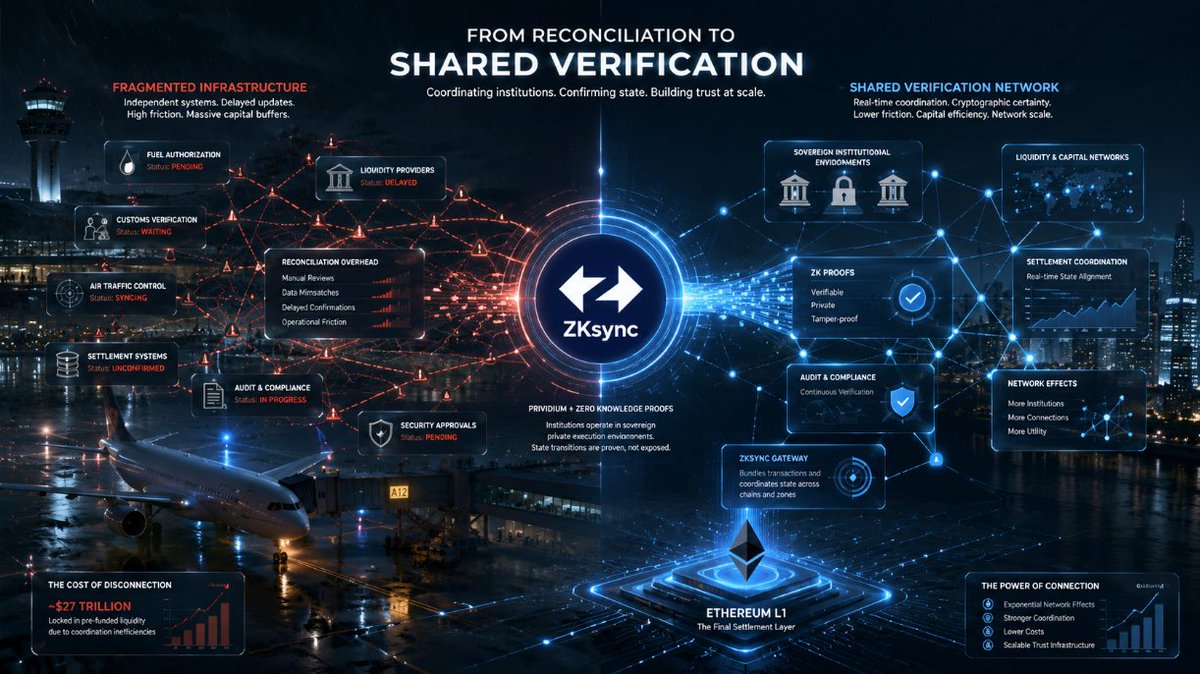
An international flight can be fully cleared for departure and still remain stuck at the gate because one fuel authorization update has not synchronized across airport systems yet.
Passengers see a delay.
What operators see is a coordination problem between independent infrastructure layers trying to confirm the same operational state before movement is approved.
Global finance works in remarkably similar ways.
More than $3.7 quadrillion in annual transaction volume moves through institutions constantly synchronizing settlement conditions, exposure calculations, liquidity obligations, and audit records across fragmented systems.
To reduce uncertainty, the system relies on buffers.
Correspondent banking alone still requires roughly $27 trillion in pre-funded liquidity because institutions cannot always coordinate around shared settlement verification in real time.
That is why institutional infrastructure choices matter.
When networks connected through SWIFT expanded from hundreds of banks to more than 11,000 institutions, the value of participation compounded because every new participant increased the number of possible coordination pathways across the system.
What stands out with @zksync is that the network architecture is designed around that same coordination principle.
Prividium allows institutions to operate inside sovereign private execution environments.
The resulting state transitions generate zero-knowledge proofs finalized through Ethereum L1.
So institutions coordinate around cryptographically verified outcomes without exposing sensitive operational data publicly.
That changes how institutional systems scale.
In fragmented infrastructure, every new participant increases reconciliation overhead.
In shared verification networks, every new institution increases the utility of the network itself.
That is where $ZK fits structurally.
$ZK is the only native asset of the ZKsync network.
Today it serves as:
• the governance token for protocol-level decisions
• the native gas token for ZKsync Gateway
• the native asset used within coordination and settlement flows across ZKsync chains and Prividium zones before finalization on Ethereum.
The deeper implication may be that financial infrastructure stops growing through larger trust buffers and starts compounding through continuously shared verification instead.
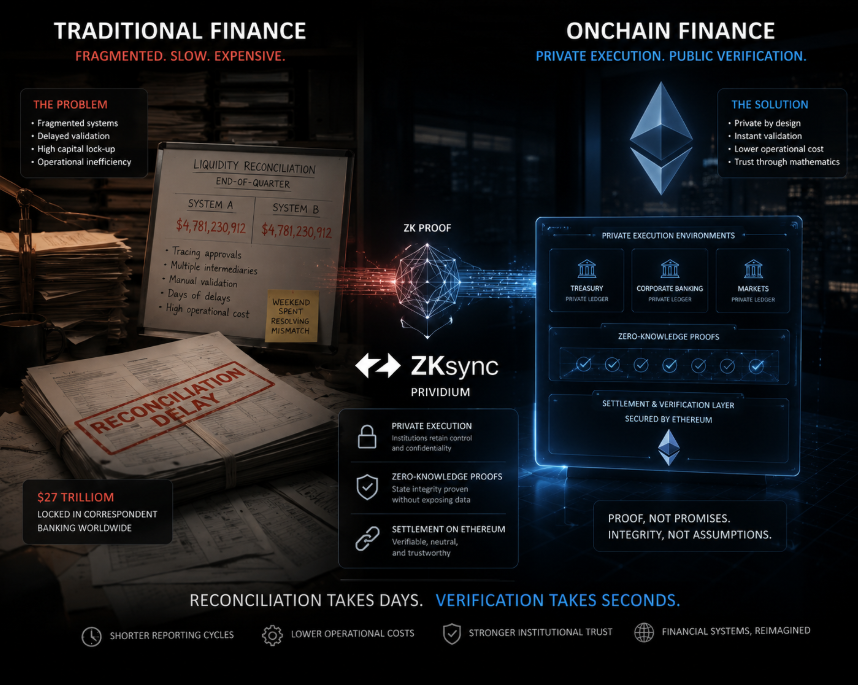
A bank compliance team once spent an entire weekend resolving why two internal systems showed different end-of-quarter liquidity numbers.
Not because funds were missing.
Because proving which ledger version was final required tracing approvals across multiple intermediaries.
That coordination problem exists across much of traditional finance.
Correspondent banking alone still locks around $27 trillion in pre-funded capital globally.
A large part of that friction comes from delayed validation between fragmented systems.
Public chains solve verification well.
But most institutions cannot expose treasury activity, client flows, or internal positions in fully transparent environments.
Private infrastructure solves confidentiality.
But external oversight still requires provable integrity.
What stands out with @zksync Prividium is that it separates privacy from validation.
Execution stays inside permissioned institutional environments.
But finalized state transitions generate zero-knowledge proofs anchored to Ethereum.
So oversight no longer depends entirely on trusting internal records.
Auditors can confirm state integrity mathematically without accessing sensitive operational data.
That reduces reconciliation overhead, shortens reporting cycles, and lowers the operational cost of institutional trust.
Feels less like digitizing finance.
More like redesigning how financial systems coordinate in the first place.