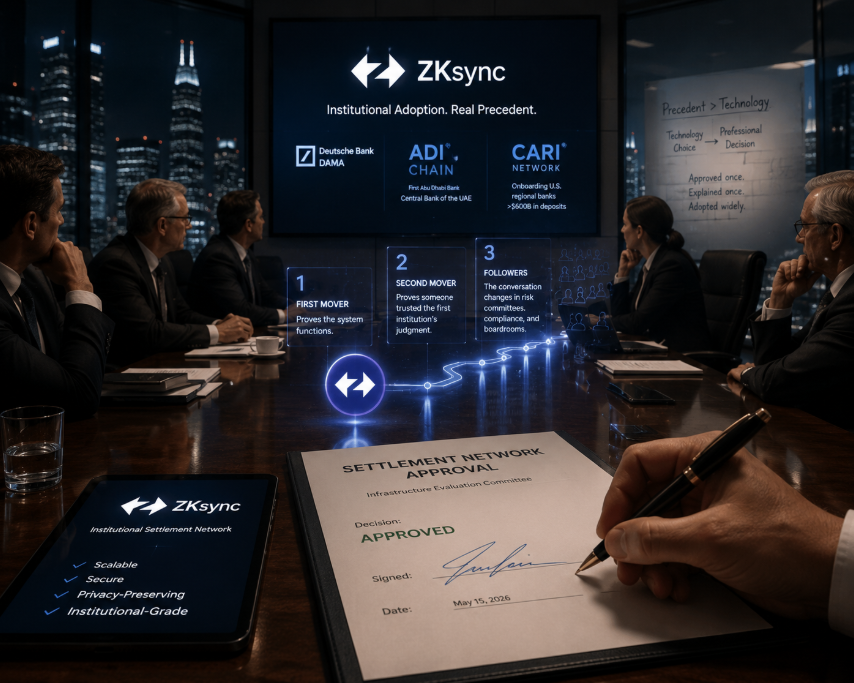
What convinced me wasn't one institution.
It was four different institutions reaching the same conclusion independently.
Deutsche Bank's Memento is already the production deployment of DAMA 2.0.
ADI Chain is live with First Abu Dhabi Bank, the Central Bank of the UAE, BlackRock, Mastercard, and Franklin Templeton.
BitGo has integrated institutional custody and wallet services through Prividium.
Cari Network is currently onboarding five U.S. regional banks representing $600B+ in combined deposits, with production rollout planned for later in 2026.
These organizations don't share regulators.
They don't share risk committees.
They don't share compliance frameworks.
Yet they arrived at similar architectural requirements despite independent approval processes.
Institutions cannot expose trading activity to counterparties, which makes privacy an operational requirement rather than an optional feature. They need institutional control over execution, deterministic settlement without challenge-window uncertainty, and custody workflows that fit existing operating models.
Missing any one of those can stop deployment long before launch.
That's what stands out to me about @zksync.
The signal isn't that institutions are experimenting with blockchain.
The signal is that independent review processes across banking, asset management, custody, and payments are increasingly validating the same settlement architecture.
When independent approvals, regulatory trust, and operational requirements begin converging on the same rails, at what point does validation become infrastructure consensus?
I was helping an older family member recover access to years of online accounts and realized something strange.
We spend decades building digital lives, but almost nobody is responsible for organizing what happens to them afterward.
By 2030, I think we'll see a profession called Legacy Network Planner.
Their job would be to manage a person's digital assets, AI assistants, online identities, subscriptions, and data permissions across multiple platforms. Part estate planner, part technology strategist.
The more our lives exist online, the more important it becomes to decide what should continue, what should be archived, and what should disappear.
Future inheritance may involve far more than money. @RallyOnChain
Being available to everyone is not kindness, it is usually a lack of boundaries and people get surprisingly upset when you say that out loud @RallyOnChain
@chyamk3rd That stood out to me too. It changes the relationship between creator and platform because participation becomes part of the product, not just the marketing funnel.
I usually spend more time researching a project than participating in it.
This was one of the rare cases where the order flipped.
I started paying attention to the activity around Rally campaigns before I looked closely at what people were actually competing for. The surprising part wasn't the competition itself. It was how many creators seemed willing to earn access rather than simply wait for it.
That led me to read more about Wingston, @RallyOnChain's new NFT collection.
The free mint stood out for a different reason than most free mints. The whitelist isn't based on being early or getting lucky. It's tied to participation. Join 3 Rally campaigns, reach the top 425 on the weekly leaderboard, and follow Rally on X.
The more I looked into it, the more the design made sense. Ownership comes after contribution. The NFT itself also carries utility through staking rewards, VIP community access, and Rally Score benefits.
For creators, that changes the incentive structure. Access becomes something earned through activity instead of simply claimed.
https://t.co/pmAMdGOByN
I wonder which creates stronger long-term communities: lowering the cost of entry or making participation part of the entry process?
@habib_atif36158 That’s the tradeoff I keep thinking about. Activity is measurable, but quality is harder to track. The leaderboard creates momentum, but long term the real test is whether contributors stay once the reward is gone.
My prediction is that in ten years, being verified will matter more than being famous.
Right now, the internet rewards whoever gets attention first. We treat visibility as proof of credibility.
I don't think that lasts.
AI is making content cheaper, faster, and harder to trust. When anyone can generate something convincing, the real scarcity becomes knowing who consistently contributed value and who merely captured attention.
That's why systems focused on reputation, contribution, and signal quality interest me more than follower counts. It's one reason @RallyOnChain feels directionally right.
What do you think people will trust when content itself becomes impossible to verify?
@JensonMed Many assumed transparency was always beneficial. Trading desks often view information leakage as a direct operational risk rather than a technical preference.
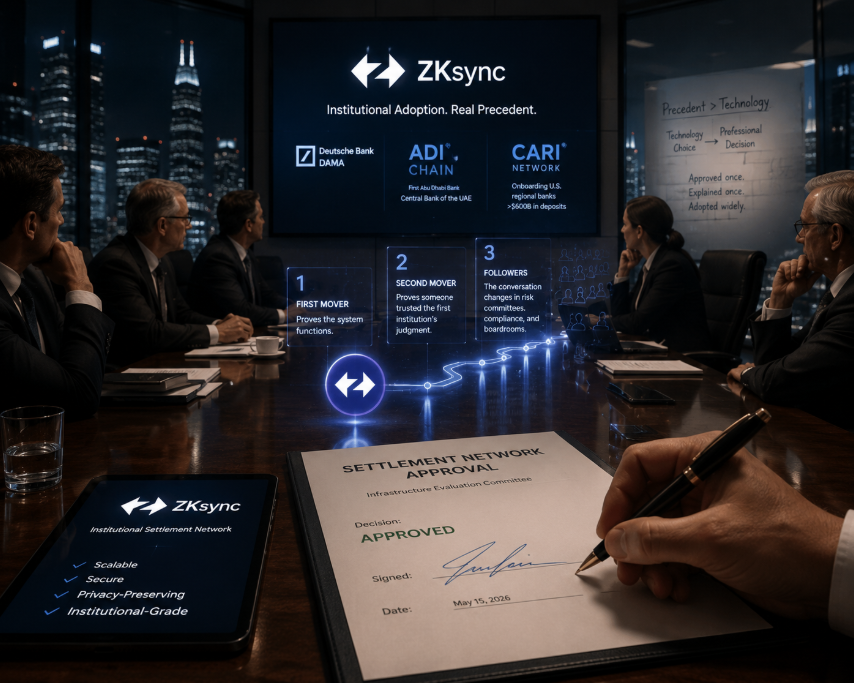
What convinced me wasn't one institution.
It was four different institutions reaching the same conclusion independently.
Deutsche Bank's Memento is already the production deployment of DAMA 2.0.
ADI Chain is live with First Abu Dhabi Bank, the Central Bank of the UAE, BlackRock, Mastercard, and Franklin Templeton.
BitGo has integrated institutional custody and wallet services through Prividium.
Cari Network is currently onboarding five U.S. regional banks representing $600B+ in combined deposits, with production rollout planned for later in 2026.
These organizations don't share regulators.
They don't share risk committees.
They don't share compliance frameworks.
Yet they arrived at similar architectural requirements despite independent approval processes.
Institutions cannot expose trading activity to counterparties, which makes privacy an operational requirement rather than an optional feature. They need institutional control over execution, deterministic settlement without challenge-window uncertainty, and custody workflows that fit existing operating models.
Missing any one of those can stop deployment long before launch.
That's what stands out to me about @zksync.
The signal isn't that institutions are experimenting with blockchain.
The signal is that independent review processes across banking, asset management, custody, and payments are increasingly validating the same settlement architecture.
When independent approvals, regulatory trust, and operational requirements begin converging on the same rails, at what point does validation become infrastructure consensus?
@KingNafish Not necessarily identical. What's notable is where priorities overlap despite different internal approval structures. Which requirement do you think institutions compromise on least often?
@CrimsonF13219 Procurement often becomes the final risk filter. I wonder whether blockchain adoption accelerates once procurement teams develop their own internal precedents.
The hardest blockchain decision of 2026 probably isn't being made by an engineer.
It's being made by the person whose name goes on the approval.
A new settlement rail can work perfectly in testing and still be rejected if nobody comparable has already signed off on it.
That is why first movers matter differently in financial infrastructure.
The first institution proves a system functions.
The second proves someone was willing to trust the first institution's judgment.
After that, the conversation starts changing inside risk committees, compliance reviews, and board meetings.
The decision becomes less about technology and more about precedent.
We're starting to see that transition happen now.
JPMorgan's Kinexys has processed more than $1.5T on blockchain rails.
DTCC is advancing tokenized Treasuries.
NYSE, BNY, and Citi are building tokenized securities infrastructure.
The question facing institutions is increasingly practical:
Which settlement networks already have credible participants building on them?
That is part of why @zksync stands out.
Live institutional activity now spans Deutsche Bank's DAMA platform, ADI Chain participants including First Abu Dhabi Bank and the Central Bank of the UAE, and Cari Network's onboarding of U.S. regional banks representing more than $600B in combined deposits.
Maybe the decade gets decided when infrastructure stops being evaluated as a technology choice...
and starts being evaluated as a professional decision nobody wants to explain twice.
@CinkoN_xyz Probably both. Competitive pressure matters, but operational confidence usually determines whether a pilot becomes production infrastructure.
Every now and then I realize something uncomfortable.
Some people on Crypto Twitter have a full-time job without knowing it.
They research protocols. Explain narratives. Write threads. Answer questions. Distribute information every day.
The work is real.
The salary usually isn't.
That is why @RallyOnChain caught my attention.
Creators are already earning money every single day for work many of them were doing anyway. There is a live $5,000 prize pool right now, and the top 10 creators receive a significant share, close to $500 each.
What makes this feel early is not the size of the rewards.
It is the fact that most people still treat content creation as a hobby while a new compensation layer is forming underneath it.
Makes me wonder how many people are already doing the job, but haven't realized they're eligible for the paycheck.
https://t.co/uVUqCCeLdf
When historians study civilizations, they rarely ask who had the fastest systems.
They ask which records survived.
Land ownership records.
Trade records.
Identity records.
Legal records.
Trust survives through records.
That is one reason DAC’s long-term approach caught my attention.
Many blockchains focus on what happens during a transaction.
DAC seems more interested in what happens 10, 20, or 30 years after that transaction.
Will the ownership trail still be verifiable?
Will enterprise workflows still be auditable?
Will tokenized assets still carry trusted provenance?
Will identity-linked permissions still be defensible?
Future adoption depends on those questions.
Because real-world institutions do not build on systems they trust for one market cycle.
They build on systems they expect to trust for decades.
That is why DAC’s focus on future-proof infrastructure and quantum-resistant security feels important.
Not because of today's data.
Because of tomorrow's responsibility to protect it.
@dac_chain
The strongest product updates are usually the ones that don't ask users to learn anything new.
They simply remove a step that never needed to exist.
That is how I see Rally's latest change.
Creators can now use Rally Points (RLP) to pay gas fees instead of keeping ETH ready for every submission or claim.
What stands out is the design choice behind it.
The value earned through participation can now be used to support participation itself.
That makes the experience feel more self-contained and easier to navigate, especially for creators who are focused on contributing rather than managing multiple balances.
I also like that this came directly from community feedback. It shows @RallyOnChain is paying attention to how people actually use the platform, not just how features look in announcements.
Makes me wonder:
What creates a healthier creator ecosystem over time, more features or fewer unnecessary steps?