A hospital can approve a patient discharge, and the insurance settlement can still remain operationally frozen long afterward.
Not because documents are missing.
Because insurers, payment processors, hospital systems, and auditors may all finalize the same claim state at different times across separate infrastructure.
One approval queue pauses.
Another system waits for reconciliation.
A third still treats the exposure as pending.
So money waits for coordination.
What looks like “delay” from the outside is often institutions trying to confirm they all recognize the same operational reality before capital moves.
That same synchronization problem scales across global finance.
More than $3.7 quadrillion in annual transaction volume moves through systems where institutions constantly align fragmented records, settlement conditions, and audit trails before value is treated as final.
To reduce uncertainty, the financial system relies on buffers.
Correspondent banking alone still requires roughly $27 trillion in pre-funded liquidity because institutions cannot always coordinate around a shared verified state in real time.
What stands out with @zksync is that the network approaches coordination differently.
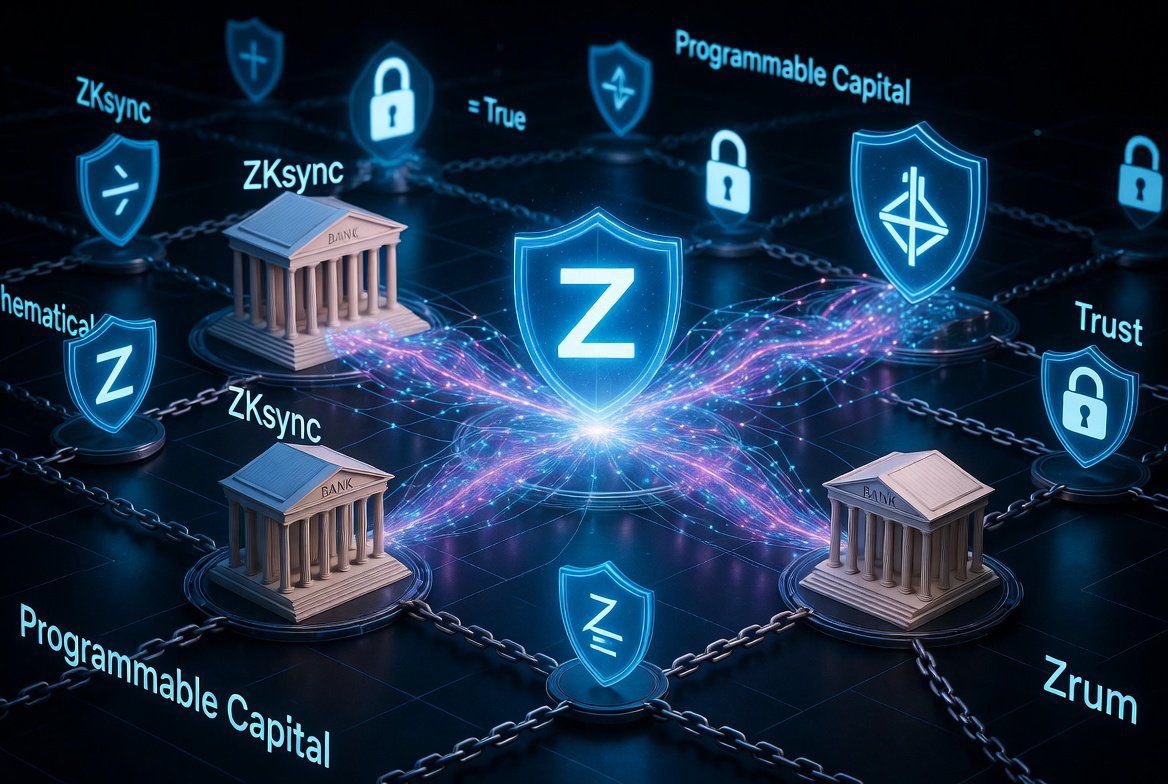
Prividium allows institutions to operate inside sovereign private execution environments.
The resulting state transitions generate zero-knowledge proofs finalized through Ethereum L1.
So institutions coordinate around cryptographically verified outcomes without exposing sensitive operational data across every participant in the network.
That changes how institutional networks evolve.
In fragmented infrastructure, every additional institution increases reconciliation dependencies.
In shared verification systems, every additional participant increases possible coordination pathways across the network.
And $ZK functions directly within that architecture.
$ZK is the only native asset of the ZKsync network.
Today it serves as:
• the governance token for protocol-level decisions
• the native gas token for ZKsync Gateway settlement before finalization on Ethereum
• the native asset of the broader ZKsync network
The larger shift may be that institutions stop scaling through duplicated verification layers and start scaling through continuously shared cryptographic coordination instead.
@humcan4 As a creator, I like the idea of earning access instead of grinding for random whitelist spots in Discord. At least the work feels connected to the ecosystem.
Whitepaper v1.5 is Now Live!
We’ve officially released our Whitepaper v1.5
It includes our vision, key updates, and the next steps for KieDex. Take a moment to go through it and share your feedback with us!
Read here: https://t.co/Gm99HsOXwx
#KieDex#KDX#Whitepaper#base
🤝 @kiedexapp x @NebulaiHQ
We are delighted to share that KieDex will be collaborating with Nebulai as we continue growing our ecosystem and fostering more community-led growth within Web3
KieDex is set to scale up our testnet futures ecosystem on Base, and we look forward to creating new possibilities with the Nebulai community.
Stay tuned for more updates
#KieDex #KDX #Nebulai #Partnership
A hospital can approve a patient discharge, and the insurance settlement can still remain operationally frozen long afterward.
Not because documents are missing.
Because insurers, payment processors, hospital systems, and auditors may all finalize the same claim state at different times across separate infrastructure.
One approval queue pauses.
Another system waits for reconciliation.
A third still treats the exposure as pending.
So money waits for coordination.
What looks like “delay” from the outside is often institutions trying to confirm they all recognize the same operational reality before capital moves.
That same synchronization problem scales across global finance.
More than $3.7 quadrillion in annual transaction volume moves through systems where institutions constantly align fragmented records, settlement conditions, and audit trails before value is treated as final.
To reduce uncertainty, the financial system relies on buffers.
Correspondent banking alone still requires roughly $27 trillion in pre-funded liquidity because institutions cannot always coordinate around a shared verified state in real time.
What stands out with @zksync is that the network approaches coordination differently.
Prividium allows institutions to operate inside sovereign private execution environments.
The resulting state transitions generate zero-knowledge proofs finalized through Ethereum L1.
So institutions coordinate around cryptographically verified outcomes without exposing sensitive operational data across every participant in the network.
That changes how institutional networks evolve.
In fragmented infrastructure, every additional institution increases reconciliation dependencies.
In shared verification systems, every additional participant increases possible coordination pathways across the network.
And $ZK functions directly within that architecture.
$ZK is the only native asset of the ZKsync network.
Today it serves as:
• the governance token for protocol-level decisions
• the native gas token for ZKsync Gateway settlement before finalization on Ethereum
• the native asset of the broader ZKsync network
The larger shift may be that institutions stop scaling through duplicated verification layers and start scaling through continuously shared cryptographic coordination instead.
Traditional finance operates at enormous scale, yet it still relies on slow, expensive infrastructure plagued by trapped capital and multiple intermediaries.
Why hasn’t the shift to onchain happened faster for institutions? Let’s break it down through three practical lenses.
Institutional adoption on @zksync is no longer just a roadmap discussion.
Parts of the network are already operational.
Cari Network alone represents 5 U.S. regional banks with more than $600B in combined deposits. That matters because deposits are the foundation of how banks create liquidity, issue credit, and operate within the broader financial system.
The people involved matter too.
Eugene Ludwig, the 27th U.S. Comptroller of the Currency, helped found Cari. That is not the profile of someone experimenting casually with blockchain infrastructure. Regulators and banking operators tend to prioritize stability, compliance, and operational reliability above all else.
What’s interesting is how institutional networks compound once they begin connecting.
The value is not just in adding another participant.
It’s in increasing the number of possible settlement and coordination pathways between participants.
10 institutions create 45 possible connections.
100 institutions create nearly 5,000.
This is the same network dynamic that expanded SWIFT from a few hundred banks into global financial infrastructure.
It’s also why infrastructure choice matters early.
Each institution building on ZKsync strengthens the connectivity of the broader network itself.
That context is important when discussing $ZK.
$ZK is the only native asset of the ZKsync network.
Today, its role is clearly defined:
• governance token for network-level decisions
• native asset of the ZKsync ecosystem
• native gas token for ZKsync Gateway
Gateway functions as the settlement layer that bundles transactions across ZKsync chains and Prividium zones before posting them to Ethereum L1.
The key point is that institutional adoption here is not being framed around speculation.
It is about building financial infrastructure where private execution, verifiable settlement, Ethereum security, and institutional coordination can operate within the same network architecture.
There is a detail about Cari Network that most people gloss over.
It wasn't founded by a crypto entrepreneur. It was founded by Eugene Ludwig, the 27th U.S. Comptroller of the Currency. The person who once oversaw the entire U.S. national banking system chose to build on @zksync with five regional banks and $600B+ in deposits behind him.
That choice tells you something.
When someone with that background selects infrastructure, it isn't a directional bet. It is a compliance decision. A risk decision. An operational decision. Every box that regulated finance requires had to be checked before that commitment was made.
Deutsche Bank built the Memento ZK Chain on the same stack. First Abu Dhabi Bank is live through ADI Chain. BitGo integrated custody directly into Prividium. These aren't announcements. They are institutions with real balance sheets making infrastructure decisions that are difficult and expensive to reverse.
35 more are in active evaluation.
What makes this worth paying attention to beyond the names is what happens as the network grows. Each institution that joins doesn't just add itself. It creates new direct settlement pathways with every institution already there. 10 participants create 45 corridors. 100 create nearly 5,000. SWIFT grew from 239 banks to 11,000 through exactly this dynamic.
The network compounds. Legacy correspondent banking cannot do that.
Sitting at the center of this network is $ZK. The only native asset of the ZKsync network. Fixed supply of 21 billion, no inflation. It functions as a governance token where holders control protocol upgrades, fee structures, and economic parameters through the Token Assembly, Security Council, and Guardians. It is also the native gas token for ZKsync Gateway, the layer that bundles and settles all activity onto Ethereum L1.
One network. One asset. And the people choosing it aren't doing so lightly.
What does it mean to you when a former chief banking regulator puts real institutional capital behind new infrastructure?