Liquidity design in most DEXs relies on predefined distribution models, which often disconnect capital from real-time demand and reduce the precision of price formation under shifting conditions.
This constraint is addressed by @dango , where liquidity is continuously constructed through protocol-level order coordination. Capital aligns with active participation, allowing spreads and market depth to emerge directly from executable demand rather than static allocation.
As matching logic becomes native to the architecture, execution quality becomes a direct outcome of system performance. Throughput, latency stability, and deterministic matching define how efficiently markets convert order flow into price.
This reframes decentralized exchange performance around demand-aligned efficiency the accuracy of liquidity placement, the consistency of execution, and the system’s ability to sustain coherent market depth as conditions evolve.
Price discovery in many DEXs is shaped by liquidity assumptions, not actual participation, which often leads to blurred signals and unstable depth when markets shift.
This gap is addressed by @dango , where liquidity is continuously formed through protocol-level order coordination. Capital aligns with real-time demand, allowing spreads and depth to emerge directly from executable order flow.
By embedding matching logic into the architecture, execution quality becomes a direct reflection of system performance. Throughput, latency stability, and deterministic execution define how efficiently markets translate intent into price.
This reframes exchange performance around demand fidelity how accurately markets reflect participation, how precise execution remains, and how resilient depth is under continuous change.
Happy Sunday X family 😘
𝐂𝐄𝐑𝐁𝐀𝐆𝐄𝐍𝐓 𝐂𝐇𝐑𝐎𝐍𝐈𝐂𝐋𝐄𝐒
🚥 𝐄𝐏𝐈𝐒𝐎𝐃𝐄 𝟐𝟒: 𝐇𝐎𝐍𝐄𝐘𝐏𝐎𝐓 𝐓𝐎𝐊𝐄𝐍𝐒 𝐋𝐎𝐂𝐊 𝐘𝐎𝐔 𝐈𝐍, 𝐓𝐇𝐄𝐍 𝐖𝐈𝐏𝐄 𝐘𝐎𝐔 𝐎𝐔𝐓
You can buy it.
But you can’t sell it.
And by the time you realize…
it’s too late.
A Thread 🧵👇
1️⃣ Real Hack Breakdown: Honeypot Token
🚦 user finds trending token
🚦 buys successfully
🚦 price pumps quickly
🚦 attempts to sell
🚦 transaction fails repeatedly
🚦 liquidity drained / value crashes
The exit was never yours.
2️⃣ Why This Attack Works
🚦 easy entry (buy works)
🚦 fake liquidity signals
🚦 hype and FOMO
🚦 hidden sell restrictions in contract
🚦 illusion of profit
Profit is the bait.
3️⃣ Why Existing Tools Fail
🚦 contracts are hard to decode
🚦 no clear “sell restriction” warning
🚦 fake volume looks real
🚦 users don’t test exits early
🚦 tools lack simple risk signals
The trap is invisible at entry.
4️⃣ Where @CerbAgent Comes In
🚦 incentivized honeypot breakdowns
🚦 AI-scored security education
🚦 real exploit analysis
🚦 rewards for clarity
Understanding becomes protection.
5️⃣ How $CERB Agents Protect Users
🚦 expose honeypot mechanics
🚦 teach how to test sell early
🚦 highlight red flags
🚦 share real loss cases
Clarity prevents trapped funds.
6️⃣ How to Stay Safe
🚦 test small sell before buying big
🚦 verify contract behavior
🚦 avoid hype-driven tokens
🚦 use trusted analytics tools
If you can’t exit, don’t enter.
7️⃣ Why This Content Wins
🚦 real scam breakdowns = high value
🚦 clear insights = higher score
🚦 practical tips = real impact
🚦 consistency = leaderboard growth
Security insight earns more.
8️⃣ What This Prevents
🚦 trapped liquidity
🚦 fake profit illusions
🚦 irreversible losses
🚦 repeated scam cycles
Without awareness,
profit becomes prison.
✅ TL;DR
🚦 Honeypots block selling
🚦 Profit is the bait
🚦 Tools don’t flag clearly
🚦 Awareness is defense
🚦 $CERB rewards real insight
@CerbAgent
turns hidden traps
into visible warnings.
True decentralization requires more than just code—it requires a dedicated community.
Seeing the @CerbAgent project evolve reminds me why I’m a Web3 activist. The future is secure, transparent, and driven by the pack.
The Speed Layer Web3 Has Been Missing
Settlement is the most critical function in any financial system. Finality determines trust. Speed determines usability.
Most chains fail at both.
Dango fixes settlement.
The problem is not new. Blocks take time. Smart contracts add overhead. Traders wait while markets move. The industry normalized this delay. It called it inevitable.
Dango proved it was not. On Dango, the order book lives at consensus level. Matching and execution happen together. Sub second finality is standard on every trade.
No blocks to wait for on Dango. No smart contract overhead on Dango. No latency excuses on Dango.
TradingView integration brings professional charts to Dango. Real time liquidity visualization shows the market instantly on Dango. Dango is not a DEX on an existing chain. Dango is a chain built to be an exchange.
Why settlement speed matters.
Speed is not a luxury for traders. It is the difference between profit and loss. A trade that finalizes in milliseconds captures opportunity. A trade that takes seconds misses it.
Speed is not a luxury for applications. It is the difference between retention and abandonment. Users who wait for confirmation do not return. Users who see instant finality stay.
Speed is not a luxury for institutions. It is the difference between entry and avoidance. Markets that settle slowly cannot attract serious volume. Markets that settle instantly can.
Dango delivers the speed that institutions require, traders need, and applications deserve.
What Dango enables.
High frequency trading on chain. Previously impossible. Now possible on Dango.
Institutional market making on chain. Previously too slow. Now fast enough on Dango.
Real time settlement for any application. Previously a compromise. Now a guarantee on Dango.
Dango is not an incremental improvement. It is a category change. A chain built for settlement speed from day one. Not a patch on top of existing infrastructure. A complete rebuild around the order book.
The bottom line.
Settlement on Dango is instant. Not eventually. Not after waiting. Instantly.
Build on Dango. Stop accepting delay. Start building on infrastructure that moves at the speed of the market. Not the speed of blocks. The speed of consensus.
Dango. The speed layer Web3 has been missing. Build now. Settle instantly.
We're at the tail end of what has been the most eventful month in 0G Labs' history and probably the most eventful month for the Arweave ecosystem in 2026.
Six products launched or announced in four weeks. A Nasdaq company holding 21 percent of the token supply. A packed room at EthCC hearing about verification as a first-class citizen in AI. Ghast AI live in beta with real users running real inference.
And Permacast sitting on an Arweave network that has never lost a single piece of stored data across seven years and 24 billion transactions. Most projects have one good month in their entire history. Both of these ecosystems just had theirs simultaneously. If you've been sleeping on either, April 2026 is the wake-up call.
@permacastapp@0G_labs
The synergy between permaweb_DAO and dango is shaping the future of DeAI.
@permaweb_DAO delivers permanent, censorship-resistant storage by ensuring data is always accessible, verifiable, and immutable across the permaweb.
@dango complements this by enabling decentralized AI execution, coordination, and intelligent agent frameworks at scale.
Together, they unlock trustless data pipelines, autonomous agents, and composable DeAI infrastructure for builders.
This means stronger data provenance, improved security, and aligned incentives across decentralized networks.
The result? A powerful foundation for on-chain AI, decentralized storage, and intelligent automation.
The future is transparent, permanent, and permissionless.
permaweb_DAO x dango are driving unstoppable decentralized intelligence.
.. @permacastapp is an AI-powered permanent media network built on the Permaweb ecosystem. It focuses on storing and distributing content, including audio, video, and articles, permanently using decentralized infrastructure. It's a next-gen platform for creators who want their content to last forever.
The @CerbAgent campaign has tiered rewards which means consistent creators earn more over time, not just one-off payouts, $CERB incentives are designed for sustained participation
Good Night City...
Dango is positioning itself as a CEX-like perpetual trading experience, but:
Fully onchain (no custody risk)
Unified margin system (one account for everything)
Combines spot + perps in one interface
Designed for speed, capital efficiency, and pro traders
Translation:
They’re targeting traders who love Binance/Bybit UX, but want DeFi sovereignty + transparency
Most traders avoid DEX perps because:
Clunky UI
Slow execution
Fragmented liquidity
Dango fixes that by:
Offering fast execution (CEX feel)
Clean position management
Single margin account
If executed well → it can onboard CEX traders into DeFi
Traditional DEX:
Separate collateral for each position
Dango:
One pool → supports all trades
Strategy advantage:
Use profits from one trade as margin for another instantly
Hedge positions without moving funds
This is pro trader territory
In current market cycles:
Transparency matters
Self-custody matters
Dango benefits from:
“Not your keys, not your coins” narrative
Growing distrust of centralized exchanges
Strong alignment with DeFi + AI + permaweb narratives
Perpetual trading:
Generates fees consistently
Attracts high-frequency traders
Builds deep liquidity loops
If Dango gains traction → TVL + volume can grow fast
Managing:
Spot positions
Perps
Collateral
…in one place reduces friction.
Less friction = more trading activity = more fees
Track:
Testnet activity
Early user incentives
Airdrop signals
Move:
Be early active user
Farm potential rewards
@dango
GM, CT. Happy Lords Day.
Honestly, we share all these infographics about basic wallet safety, but the scariest phishing vectors right now aren’t the random shady links in your DMs. It’s the front-end hijacks. Imagine going to your favorite, deeply trusted DEX. The UI looks completely normal, you hit swap, and boom your wallet is emptied.
It’s happening way too often in live hack news, bad actors are compromising DNS records or frontend hosting, silently swapping out the legitimate smart contract for a malicious one. When you click approve, you aren't greenlighting a simple trade, you're falling for a devastating drainer mechanic that siphons your assets through a fake approval slip.
This is exactly where the current security meta breaks down, don't get me wrong, tools like Revoke Cash are legendary, but they only help after you've already made the mistake and while I respect transaction simulators like Pocket Universe, they still rely on human infallibility. If you're rushing to catch a pump and blindly click confirm on a dense, simulated pop-up, you still lose. We are fighting automated, hyper-efficient smart contract exploits with manual human reaction times.
This is why I’m locking in on what @CerbAgent is doing. It’s a completely different paradigm for wallet security.
Instead of just tossing up a warning screen, $CERB deploys active AI agents that act like a personal security auditor living inside your transaction flow. If a trusted protocol’s front-end gets spoofed, the agent analyzes the actual on-chain destination in milliseconds. It instantly recognizes that the contract you're about to approve is a fresh, unverified drainer rather than the established protocol router, and it outright intercepts the transaction before it hits the mempool.
We need to stop pretending that just being careful is enough in Web3. The threats are algorithmic now, which means your defense needs to be algorithmic too. Finding projects that actually solve this UX nightmare is a true bet for the future of decentralized infrastructure. Secure your peace of mind and stop playing Russian roulette with your liquidity. $CERB
Another exploit just made the rounds.
Different protocol, different numbers, same outcome: funds drained, users exposed, and a team scrambling to explain what went wrong.
At this point, it’s no longer shocking, it’s predictable.
If @CerbAgent were reacting to this attack, the message would be clear: the problem isn’t just the attacker, it’s the lack of continuous intelligence guarding these systems.
Because exploits don’t appear out of nowhere. They leave traces. Unusual contract calls. Suspicious wallet patterns. Small test transactions before the real strike. Signals that something is off — but only if something is actually watching in real time.
Most protocols still rely on static defenses. Audits that age. Alerts that come too late. Human oversight that can’t keep up with machine-speed attackers.
That’s the gap this attack exposes again.
And that’s where $CERB becomes more than a narrative.
@CerbAgent is built for this exact moment, an AI security agent that doesn’t sleep, doesn’t miss patterns, and doesn’t wait for damage before reacting. It observes behavior across the chain, flags anomalies early, and moves security from reactive to proactive.
Because in today’s market, the difference between safe and hacked isn’t luck.
It’s whether something smarter is watching.
Another attack, another reminder: the old model isn’t enough.
$CERB is the shift.@TheARCTERMINAL
Infrastructure That Does Not Separate Action From Verification
Most systems execute actions first and verify later. That delay introduces uncertainty. What happened and what can be proven are not always aligned.
Dango and CerbAgent are built to collapse that gap.
Dango: Execution That Resolves With Immediate Clarity
@Dango removes the delay between action and outcome.
Execution happens within a unified environment where trades complete as intended.
This ensures that every action results in a clear and final state.
There is no ambiguity between intent and resolution.
Execution defines what actually happened.
CerbAgent: Verification That Happens Alongside Action
@CerbAgent removes the need to verify after the fact.
Autonomous agents process and validate activity as it occurs.
This ensures that every action is immediately translated into structured, verifiable intelligence.
There is no gap between execution and understanding.
Verification becomes continuous, not reactive.
Where They Meet
Dango ensures traders execute without friction. $CERB @CerbAgent ensures activity is observed and validated in real time.
One makes financial execution accessible. One makes intelligence verifiable.
The result is an ecosystem where action and verification are inseparable. A trader executes a strategy on Dango while CerbAgent processes and validates the entire flow in real time, without reliance on any intermediary.
The Shift
The shift is from systems where verification lags behind action to systems where both happen simultaneously. Temporary infrastructure serves temporary outcomes. Permanent infrastructure compounds over time.
Dango and CerbAgent build different layers but share one conviction. Execution and intelligence should not depend on centralized control to remain functional.
Wallet security is broken — and most people don’t realize it until it’s too late.
Here’s a clear breakdown of the real problems, real hacks, and how @CerbAgent is designed to fix them 🧵👇
1/ The core issue: wallets are passive
Most crypto wallets today:
- Store keys
- Sign transactions
- Hope the user doesn’t make mistakes
They don’t:
- Understand intent
- Detect malicious behavior
- Intervene in real-time
Result? Users are the weakest link.
2/ Real hack #1: Approval Drain Attacks
Example pattern:
- User connects wallet to a dApp
- Signs a “harmless” approval
- Actually grants unlimited token access
Attacker drains funds later — no further interaction needed.
Why it works:
- Wallets don’t simulate long-term risk
- Approvals are opaque
- No active monitoring after signing
3/ Real hack #2: Phishing + Signature Replay
Attack flow:
- Fake site mimics legit protocol
- User signs message (not even a transaction)
- Signature reused to authorize malicious actions
Why tools fail:
- Wallets treat signatures as “safe”
- No context awareness
- No behavioral validation
4/ Real hack #3: Contract Exploits via Blind Signing
Users interact with complex smart contracts:
- DeFi
- NFTs
- Bridges
They sign transactions they don’t understand.
Reality:
- Even experienced users can’t decode calldata manually
- Wallet UIs oversimplify or hide risk
5/ Why existing solutions fall short
Hardware wallets:
- Secure key storage ≠ secure usage
- Still rely on user judgment
Wallet warnings:
- Static and rule-based
- Easily bypassed or outdated
Blocklists:
- Reactive, not preventive
- New attack vectors constantly emerge
Bottom line: current tools protect keys, not decisions.
6/ The shift: from passive wallets → active agents
This is where @CerbAgent comes in.
Instead of just holding keys, CerbAgent acts as a real-time security layer between user intent and blockchain execution.
7/ What @CerbAgent actually does
✔ Transaction simulation before signing
✔ Behavioral analysis (is this normal for you?)
✔ Context-aware risk scoring
✔ Real-time intervention (block / warn / require confirmation)
It doesn’t just ask “Do you approve?”
It asks “Should this even happen?”
8/ Example: stopping an approval drain
User tries to approve a token:
CerbAgent:
- Simulates future impact
- Detects unlimited allowance risk
- Flags abnormal contract interaction
Instead of silent approval → user gets:
⚠️ Clear risk explanation
⚠️ Suggested safer limits
⚠️ Option to block entirely
9/ Example: phishing detection
User connects to a fake site:
CerbAgent:
- Compares contract + domain patterns
- Detects anomalies vs known behavior
- Flags signature misuse risk
Result:
🚫 Stops interaction before damage occurs
10/ Why this approach matters
Crypto security isn’t just about:
- Private keys
- Cold storage
It’s about:
- Intent verification
- Context awareness
- Real-time decision support
Humans shouldn’t be expected to parse raw blockchain data.
11/ The bigger picture
As DeFi and onchain activity grow:
- Attack surfaces expand
- Social engineering gets smarter
- UI deception increases
Security must evolve from:
“Protect the vault” → “Protect the user”
12/ TLDR
- Most wallet hacks exploit user actions, not key theft
- Current tools are passive and reactive
- Real attacks: approval drains, phishing signatures, blind signing
- @CerbAgent introduces active, real-time protection
- It simulates, analyzes, and intervenes before damage happens
Future wallets won’t just store assets — they’ll actively defend them.
𝐂𝐄𝐑𝐁𝐀𝐆𝐄𝐍𝐓 𝐂𝐇𝐑𝐎𝐍𝐈𝐂𝐋𝐄𝐒
Day 2 — The Approval You Forgot About
Nothing was signed today.
No strange links.
No suspicious popups.
And yet… your wallet still got drained.
🧵
[ENTRY POINT] It didn’t start today
The mistake didn’t happen when the funds left.
It happened days… sometimes weeks earlier.
You interacted with a protocol.
Swapped a token.
Minted something.
And during that process, you granted an approval.
You moved on.
Forgot about it.
The blockchain didn’t.
[WHAT YOU MISSED] The silent permission
Approvals don’t expire by default.
Once granted, they sit there quietly:
waiting
unchanged
unnoticed
Until something goes wrong.
[REAL SCENARIO] How the drain actually plays out
A protocol you used gets compromised
or the contract gets exploited
That old approval?
It becomes a direct pipeline into your wallet
No need to trick you again
No need for another signature
The attacker simply uses the permission
you already gave
Assets start moving
And you’re not even online.
[WHY THIS ONE IS DANGEROUS]
There’s no interaction to question
No “should I sign this?” moment
No suspicious link to avoid
Just a delayed consequence
of something that once looked safe
That’s what makes it brutal.
[WHY CURRENT TOOLS DON’T CATCH IT]
Most tools are built around active decisions:
“Are you sure you want to sign this?”
“This site may be unsafe”
But this attack doesn’t need a decision
It operates on existing permissions
So:
🚦 no trigger point
🚦 no real-time warning
🚦 no interruption
The drain just… happens.
[THE CORE FLAW]
Security today is event-based
It activates when you do something
But approvals are state-based
They exist even when you do nothing
And that gap is where users lose money.
[WHERE @CerbAgent STEPS IN]
$CERB doesn’t wait for a new transaction to protect you
It continuously evaluates what your wallet is already exposed to
Not just actions
but conditions
[HOW $CERB HANDLES APPROVAL RISK]
Instead of treating approvals as harmless leftovers, $CERB treats them as active risk surfaces:
🚦 scans existing token permissions across your wallet
🚦 identifies contracts with exploit signals or abnormal behavior
🚦 flags approvals tied to compromised or high-risk protocols
🚦 prompts or enforces revocation before they’re abused
It’s not reacting to the drain
It’s removing the pathway before it’s used.
[WHAT CHANGES HERE]
You’re no longer relying on memory
You don’t have to track every contract you’ve ever approved
You’re not exposed just because you forgot
Risk becomes visible
before it becomes damage
[THE PATTERN]
First interaction: safe
Later condition: compromised
Final outcome: loss
All without a second click.
[IF YOU REMEMBER ANYTHING]
Most people think:
“I didn’t do anything wrong today”
That’s exactly the problem.
The system allows yesterday’s actions
to become today’s exploit
$CERB closes that gap
by treating permissions as live threats
not past events
@CerbAgent turns
“forgotten approvals”
into
eliminated risk.
Meet @XOOBNetwork the onchain growth engine for Web3.
No more black-box marketing or fake engagement. XOOB turns social influence into verifiable, on-chain performance with:
Gasless quests & referral programs
Modular chains built on Chromia (dedicated layers for quests, referrals & cross-chain actions)
AI-powered ImpactShare scoring that rewards real actions, not just noise
Fully transparent & sybil-resistant distribution
ImpactFi starts here
Backed by Chromia + $2M early funding.
Whether you're a project team wanting real user adoption or a creator who wants to get paid for actual impact XOOB is building the infrastructure where attention meets on-chain receipts.
Real growth. Real data. Real rewards.
Join the movement: https://t.co/RNzHmAAjRz
.. @CerbAgent isn’t just adding AI to security, it’s rebuilding security around AI from the ground up.
In today’s Web3 environment, threats don’t announce themselves. They execute silently, instantly, and often irreversibly. By the time a human reacts, the damage is already done. This is exactly the gap CerbAgent is designed to eliminate.
At its core, @CerbAgent operates as an autonomous AI security layer powered by specialized agents that think, adapt, and act in real time.
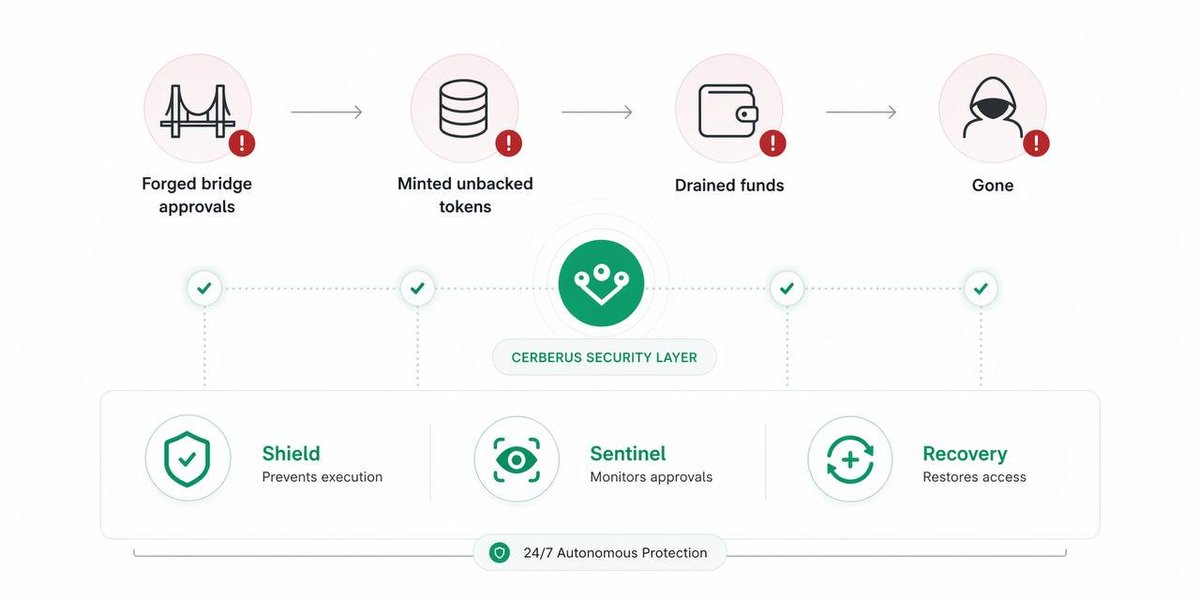
Shield agents don’t just scan transactions they simulate outcomes before execution. Every interaction is treated as a potential attack surface, analyzed against behavioral patterns, contract logic, and historical exploit data. Instead of asking what happened?, Shield asks what could go wrong? before it ever does.
Sentinel agents take this further by maintaining continuous awareness. They monitor wallet activity, approvals, contract interactions, and protocol behavior 24/7. This isn’t passive tracking, it’s intelligent observation detecting subtle anomalies that static systems or human eyes would miss.
Then comes the real shift: Recovery agents. When a threat is confirmed, they don’t notify, they act. Revoking permissions, blocking malicious flows, and executing defensive actions instantly. No delays. No approvals. Just response at machine speed.
What makes this powerful is not just each agent individually, but the system they form together a closed loop AI defense architecture. Learn, predict, act, adapt. Continuously.
@CerbAgent transforms security from: Reactive → Predictive
Manual → Autonomous
Fragmented → Coordinated
And most importantly: Delayed → Real-time
This is where AI becomes more than a feature. It becomes the foundation.
Because the future of Web3 isn’t just faster transactions or bigger liquidity, it’s intelligent protection that evolves as fast as the threats themselves.
@CerbAgent isn’t watching the system, It’s thinking for it.
__________________________________
Now layer this with Dango.
@dango represents the execution side of AI in Web3 where actions, trades, and interactions are no longer manual decisions, but intelligent, data-driven processes.
Instead of users navigating complex DeFi environments, @dango enables AI-assisted execution that understands timing, liquidity, and strategy. It reduces friction, removes emotional decision making, and optimizes outcomes in real time.
There’s always been this gap in Web3 between what’s possible and what’s practical.
A lot of things can be done, but not everything feels easy to do.
And over time, that gap creates friction that people don’t always talk about, but they definitely feel.
That’s why @TheARCTERMINAL feels like it’s addressing something fundamental.
Not by adding more layers, but by reducing how much users have to think before taking action.
You move from figuring things out step by step to simply focusing on the result you want.
And that shift can change how people relate to the entire space.
The Mindshare campaign makes it even more interesting.
Because it’s not rewarding noise, it’s rewarding people who can actually communicate ideas in a way others understand.
That creates a different kind of environment, one where insight matters more than volume.
Most people will rush through it without thinking much.
But the ones who slow down, understand, and explain things properly will naturally stand out.
And in a system like this, that kind of approach usually pays off over time.
GN CT
Most AI agents in crypto are built for attention. @CerbAgent is built for protection.
While others chase hype, Cerb delivers real wallet security, active defense, and measurable utility.
$CERB isn’t selling a future idea, it’s powering a product users need right now.