🔸Protium acts as the primary starting point for all matter through Stellar Nucleosynthesis.
🔸It is Stellar Nucleosynthesis—the process of "star-birthing"—that transforms simple hydrogen into the complex elements found on the periodic table.
🔸Every other element on the periodic table—the Gold in a ring, the Oxygen we breathe, the Carbon in our bodies—is just a "remix" of Protium. Without that first Protium "brick," there would be no materials to build the rest of the universe.
🔸It provides the "Weight"
Even though it is the lightest atom, the "mass" (the weight and solidity) of almost everything you touch comes from the energy held inside the protons of Protium.
🔸It provided the original blueprint for how energy turns into solid matter that makes up the universe. Without that first Protium "brick," there would be no materials to build the rest of the universe.
Hosted by Michael Lawson of @CUbroadcast, this GAC 2026 clip with Frank Mazza gets into the infrastructure behind the experience: wallets, flexibility, and what credit unions need under the hood.
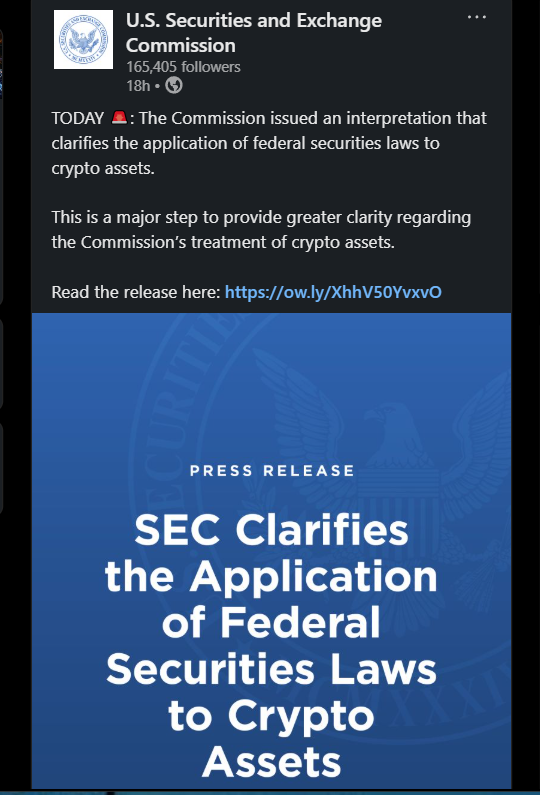
💥This SEC clarification is a watershed moment for the crypto industry because it effectively ends "regulation by enforcement" and officially recognizes that most crypto assets are not securities. Under Chairman Paul Atkins, this new interpretation issued on March 17, 2026 reverses years of legal ambiguity. Here is why this is such a significant, bullish catalyst for the market:
1. Clear "Rules of the Road" (Taxonomy)The SEC and CFTC have finally agreed on a coherent token taxonomy, dividing assets into clear categories. This removes the "guessing game" for developers:
🔸Digital Commodities: Includes majors like #Bitcoin, Ether, Solana, and $XRP. These are officially outside the SEC’s securities jurisdiction. Digital Collectibles & Tools: NFTs and utility tokens are generally not treated as securities.
🔸Payment Stablecoins: Recognized as non securities under the GENIUS Act.
🔸Digital Securities: Only tokenized versions of traditional assets (like stocks or bonds) remain under strict SEC oversight.
2. The "Investment Contract" Exit Ramp One of the most bullish technical aspects is the clarification on how an asset can cease to be an investment contract. Previously, the SEC implied that if a token was once sold as a security, it was "tainted" forever.
🔸"It reflects the reality that investment contracts can come to an end." — SEC Chairman Paul Atkins This allows projects to "graduate" from SEC oversight once they become sufficiently decentralized or meet certain disclosure standards, providing a clear path for startups to transition into fully functional decentralized networks.
3. Institutional "Green Light" Large financial institutions have historically stayed on the sidelines due to "regulatory risk." This interpretation provides the legal cover they need to:
🔸Launch Staking services without fear of being sued for "unregistered securities" (as the SEC specifically clarified the application of laws to protocol staking).Offer Airdrops and Protocol Mining rewards, which are now clearly defined. Integrate crypto into traditional finance (TradFi) infrastructure, such as the $10 million mortgage tokenization pilot already leveraging this new clarity.
4. Harmonization with the CFTC. By joining the interpretation, the CFTC ensures there is no "turf war" where two agencies claim authority over the same asset. This unified front reduces compliance costs for exchanges and makes it easier for US-based companies to compete globally without moving offshore.
https://t.co/fRqC4adKyn
#CryptoAlert
The Shift from Experimentation to Architecture
The future of digital asset payments isn't about the sheer existence of the technology it’s about its integration. True scale won't come from isolated innovation; it will happen when digital assets successfully plug into the established rails, standards, and operating models that currently drive global commerce.
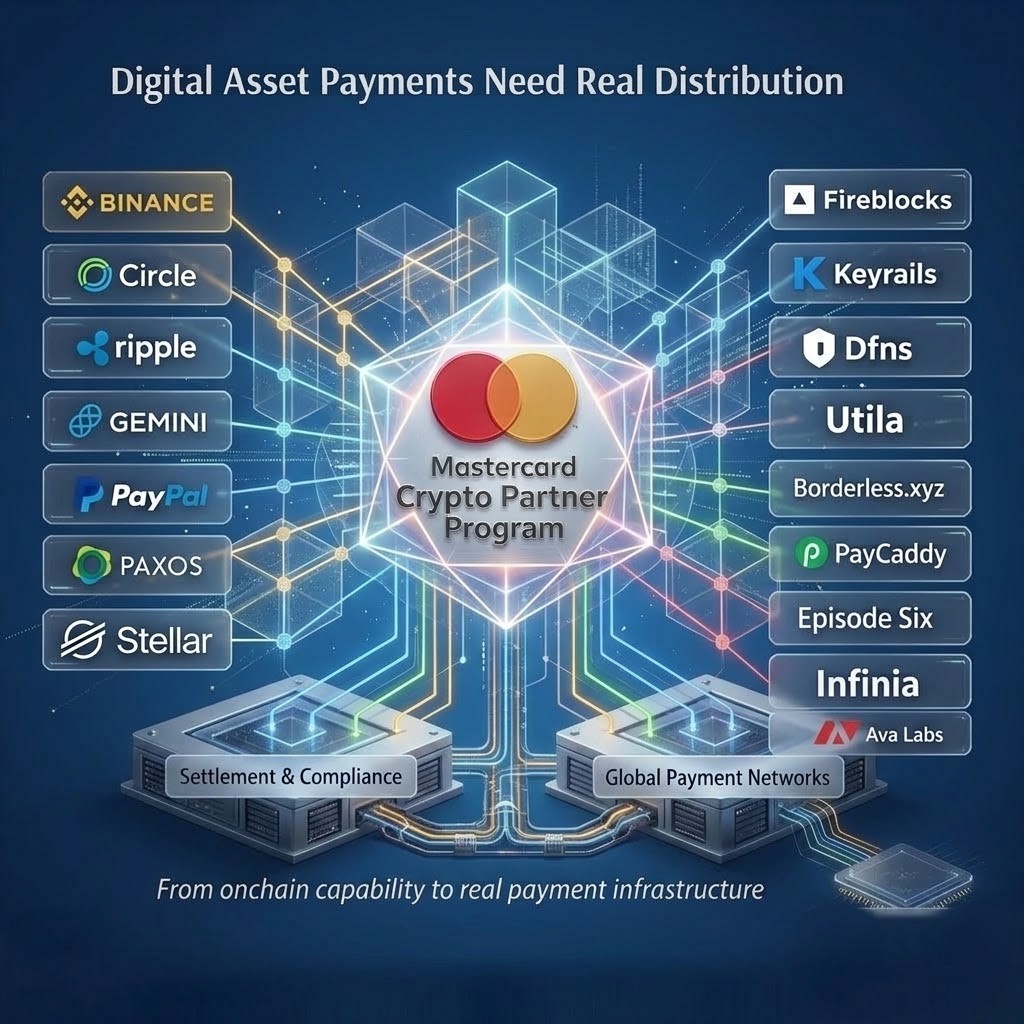
Mastercard’s new Crypto Partner Program is a significant signal of this shift. It’s more than just a headline; it represents a concerted effort to link onchain capabilities directly to existing payment infrastructure through a unified deployment path.
Why This Program Matters
Mastercard is targeting the pillars of the global economy: cross-border transfers, B2B payments, payouts, and everyday retail. Here is what stands out:
Diverse Ecosystem Mix: With over 85 participants—including Binance, Circle, Ripple, Stellar Development Foundation, Gemini, PayPal, Paxos, and Avalanche Labs—this isn't just one market segment. It’s a strategic blend of exchanges, issuers, wallet infrastructure, and payment orchestration.
The New "Hard Problem": We’ve moved past the hurdles of token issuance and wallet access. The real challenge now lies in settlement paths and compliance layers the "connective tissue" between digital flows and trusted distribution.
Infrastructure over Isolation: Real-world adoption depends on whether these systems can function within existing banking and merchant frameworks without compromising usability or governance.
The New Rule of Thumb
Innovation gets attention. Distribution gets adoption.
The ultimate winners in this space won't be those with the loudest crypto centric narrative. Instead, success will belong to those who can transform programmability into a functional, commercially trusted payment operating model.
We are moving away from the era of digital asset experimentation and into an era of rigorous payment architecture that must be usable, compliant, and reliable.
#PayFi #ripple #stellar #stablecoin #binance #crypto #digitalassets #mastercard #payments #banking
If the United States cut spending by 66% and began to pay back the National debt, it could be accomplished in 25 years from now. Within a few years the ability to pay off the debt will become mathematically impossible due to compounding interest. Think about it.
The Stellar Development Foundation (SDF) just dropped their 2026 strategy, and the target is clear: $1 Billion in new network asset value.
This isn't just a goal; it's a massive shift in how real-world assets (RWAs) move globally. In my latest video, I break down exactly how Stellar is positioning itself to be the go-to platform for the world’s most influential enterprises.
In this video learn about:
🔹 The 5 Factor & 15 Enterprises: How Stellar is moving from "pilot" to "production" with 15 global giants, including 5 key deployments in 2026.
🔹 The Reorganized Treasury: Why the SDF’s internal shift to 4 new mandate categories (Growth, Assets & Liquidity, etc.) is a massive signal for long-term sustainability.
🔹 Global Giants: We dive into the massive impact of partners like MoneyGram, Wirex, RedSwan Digital Real Estate, and the United Nations (UNDP).
🔹 Protocol 25: Why the "X-Ray" upgrade is the privacy breakthrough institutions have been demanding.
🥂If you’re watching the intersection of TradFi and Blockchain, you cannot ignore what’s happening on Stellar right now.
Watch the full breakdown here: 👇
#Stellar #XLM
The 2026 Stellar Thesis: XLM, RWA & the Institutional Capital Migration https://t.co/5uMV7I1BMP via @YouTube
Why are stablecoins suddenly at the center of financial services conversations? Marshall Hayner breaks it down at GAC 2026: 24/7 rails, global utility, and real institutional use cases. Learn more: https://t.co/jMWLkGvxV4