I’m presenting our research on how gaze is biased toward previous target locations in naturalistic scenes today at #VSS2026. Poster 36.450 in the Pavilion from 2:45 – 6:45 pm - join me if you want to chat!
New paper out in Affective Science!! 🎉
A musician who plays better also listens better. We found the same for faces - we show that deliberate facial mimicry is a measurable skill that predicts emotion recognition, even when measured in separate tasks.
https://t.co/AnoNvU918T
🚨 🚨 🚨
Some irrelevant features of a previous target guide attention during search, but others don't. Are they not encoded, or do they not guide attention?
In our new paper (with @NitzM98 & Dominique Lamy), we show that features that didn't guide attention, were...
1/2
🚨Proud to share our new paper in JEP:LMC (w/ Dominique Lamy)🚨
Attention is strongly biased towards recently selected locations, but while current theories assume this bias is inflexible, we show that it is actually flexible, but proactive.
A🧵:
1/
These results suggest that we need to modify the current view of the bias towards the previous target location.
Crucially, it suggests that this bias isn't maladaptive in dynamic environments, as long as we know what we are about to do next.
7/
🚨🚨
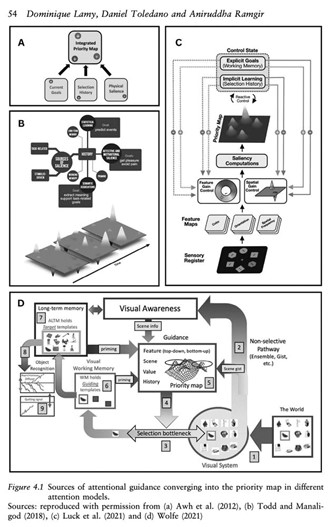
Very proud that our new chapter (w/ Aniruddha Ramgir & Dominique Lamy) on priority maps is out!
Many view this concept as fundamental in explaining how we attend. However, we argue that several critical questions remain unanswered.
1/3
The key questions we address:
1) How are the different factors that influence priority maps organized?
2) How do priority maps evolve dynamically over time?
3) How does temporal attention integrate with spatial priority?
We also review how this concept has emerged
2/3
1/🧠WHY do humans learn outcome-irrelevant information? Glad to share our NeurIPS behavioral ML workshop paper exploring the potential benefit of learning the value of outcome-irrelevant action features during decision-making, a behavior that surprisingly may aid in adapting to unexpected changes. Here’s what we found! 👇 @shaharnitzan
🤯
I just fed my recent paper to #NotebookLM and it auto-generated a 7-minute podcast about it!
It's sometimes inaccurate, misses key points, and can get over-dramatic🤣
Still very impressive!
Check out 2 minutes of the output: