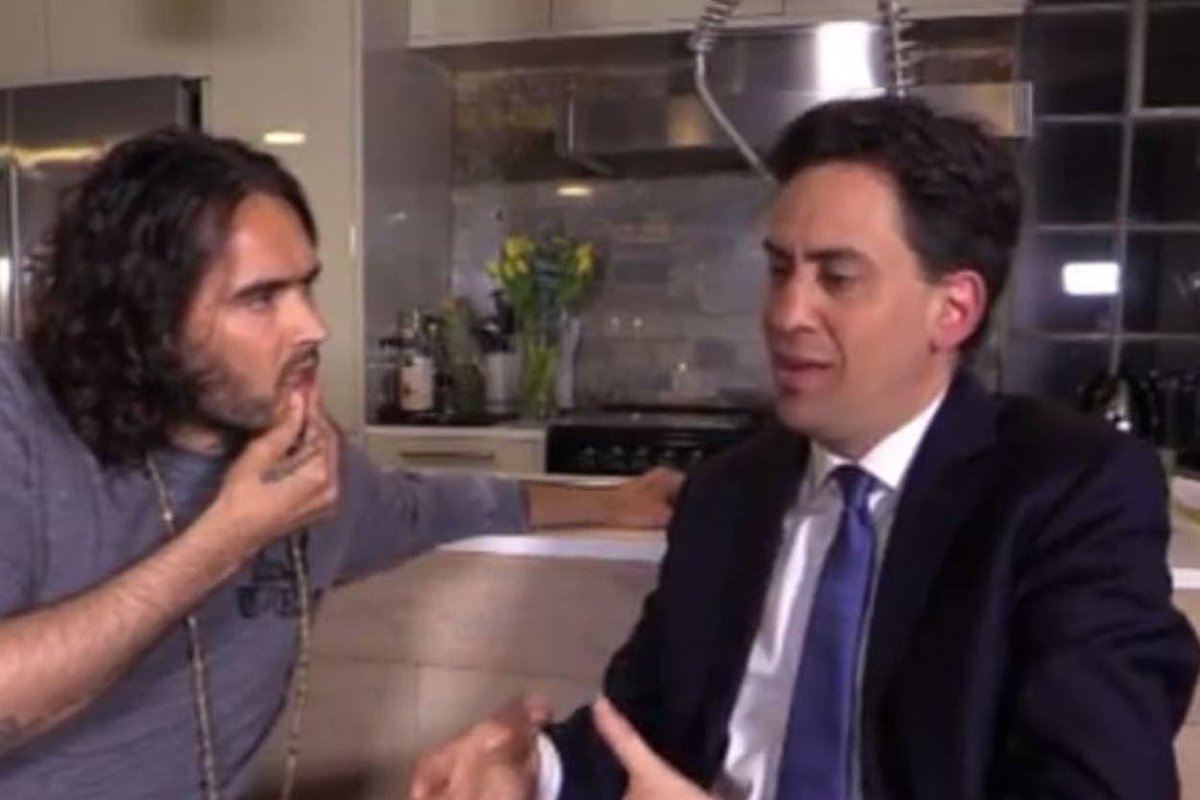
@scottjla@mdjcole@PMarlowe1939 He started telling people not to vote in 2013, which is also the year he guest-edited the New Statesman. He wrote Revolution in 2014.
@scottjla@mdjcole@PMarlowe1939 My point is it's just plain wrong to say Brand wasn't political in the mid 2010s. He was very political in that period and had a notable impact on British political discourse.
@scottjla@mdjcole@PMarlowe1939 The Leader of the Opposition met with him during the 2015 election campaign. He was desperate for his endorsement, and soon after received it.
@scottjla@mdjcole@PMarlowe1939 You may well be right. I obviously can't read his mind, but I wouldn't be surprised if his views are just whatever views are expedient to him at any given time. Nevertheless, he was outwardly far-left in the 2010s, and it led many figures on the left to fawn over him.
@scottjla@mdjcole@PMarlowe1939 He wasn't telling people not to vote because he was apolitical. He was telling people not to vote because he was a communist who wanted to break the system. It was explicitly political.
@WarGit They're of a notably lower quality. They fall apart ridiculously easily. Fortunately down my way you can still usually get a plastic one (old stock I suppose) but that won't last forever.
@tomhfh To be fair, I don't think it's always a political statement (although sometimes it definitely is). I think some people were left genuinely traumatised by the messaging around Covid and are still suffering from some form of PTSD now.
Just as a reminder, the Remain campaign claimed the stock market would crash, inward investment would collapse, the financial institutions would flee to mainland Europe, house prices would fall by up to 18%, there would be mass unemployment, and Britain would become an international pariah. Absolutely none of it happened.
Yes, he becomes a comic figure in the second half of the story, but that only works because he started out so sinister. He's basically a sociopath who doesn't consider himself bound by moral codes and is happy to exploit his own nephew for his own selfish means. But when he comes face to face with the consequences of his actions, he's completely out of his depth and becomes rather pathetic. The second stage of his character is less meaningful without the first.
@CptHastings1916 This thought has genuinely been going through my mind the past couple of years. I'm seriously considering writing a twenty-something part TV adaptation of the whole series, ready to start pitching it when the copyright expires. I'd make it as close to the books as possible.
I'm sorry but that's just Rejoiner wishful thinking. Whilst it's true that young voters tend to say they're pro-EU in the abstract when polled (vibes and all that), it ranks low on their list of priorities. Young people just don't care that much about Brexit. It's a debate from before their time.
In reality, the consequence of Burnham putting rejoining the EU in the manifesto would be that all the Labour seats that went Conservative in 2019, and then back to Labour in 2024, would go to the Conservatives again or to Reform. It would destroy a part of their support base they need in order to win a majority.
@Johnmcternan@Friedmanzone@tomhfh@Longshanks1307 Tom Harwood's entire point is that it's *not* a definition of who is and is not English. His suggestion is to use 'Anglo-Saxon' as the name of the ethnicity (which needs to be called something) so that 'English' can be used solely to refer to the nationality irrespective of race.