I would like you all to ask yourselves if you believe this would have the votes to pass, and whether Trump would sign it in the next two years.
If not, fine, but be honest that you’re setting up whoever governs in 2029 for failure—on climate and affordability.
@JasonBordoff's piece sorts through the noise on the BAAJA bill in a way I think is very helpful for those who want an honest assessment of the state of play.
The best arguments against #BAAJA are detailed, often technical, legal objections to the bill’s drafting that get lost amid all the overheated rhetoric. I spent time digging into them carefully, and came away concluding that they merit fixing if possible but the bill should be passed either way. In the meantime, don’t be distracted by misleading claims that the bill is a giveaway to fossil fuel companies, data centers, etc. 👇https://t.co/cbTLhyaW3X
Mike Levin has a lot more thoughtful statement here than anything Jared Huffman has said. But I think he’s still likely to face a binary choice - this bill or nothing. And if he prefers the status quo, then I think he’s making a serious mistake.
Levin acknowledges "there's no guarantee a better bill comes along that can actually become law soon," so he calls for continuing negotiations to "find a better balance" this Congress. But Senate negotiators are resistant to re-opening talks given time constraints in lame duck
Yeah the tl;dr for Huffman is he is basically against the core premise of the entire thing.
He is not serious about “getting to yes” on any sort of framework that accomplishes the bill’s goals, now OR in the new Congress.
If someone weighs the pros and cons of BAAJA and comes to a different conclusion than I do, I can respect that.
But I get mad when they misrepresent the bill. I get mad when they claim there’s a tradeoff-free option. And I get mad when they impugn the motives of the supporters.
It is simply not serious to say Sheldon Whitehouse is doing permitting reform for big oil. He's big oil's most consistent opponent in the Senate!
The Democrats' divide on BAAJA is between lawmakers willing to undertake actions with tradeoffs, and those who'd rather feel good but not pass anything into actual law.
If we cannot build, we cannot decarbonize.
And there is no alternative - this year or next - that can become law without Republican votes and Trump's signature.
Holding out for everything leaves us with nothing.
Dem BAAJA opponents owe us an explanation of how they propose to get Rs to support transmission reform
1. Which Republican priorities are you willing to give to get transmission?
2. Which Rs support your proposed compromise?
3. Where's your bipartisan draft text?
4. How will you get Senator Merkley, Senator Heinrich, future-Chair Pallone, future-Chair Huffman, Senator Capito, Senator McCormick, 60 Senators, the Dem House, AND Trump to all agree?
It's easy to say a bill isn't your preferred wishlist but it's hard to hash out a bipartisan deal. If you're going to get a better deal next Congress then tell us how
https://t.co/EKKjBzWVMy
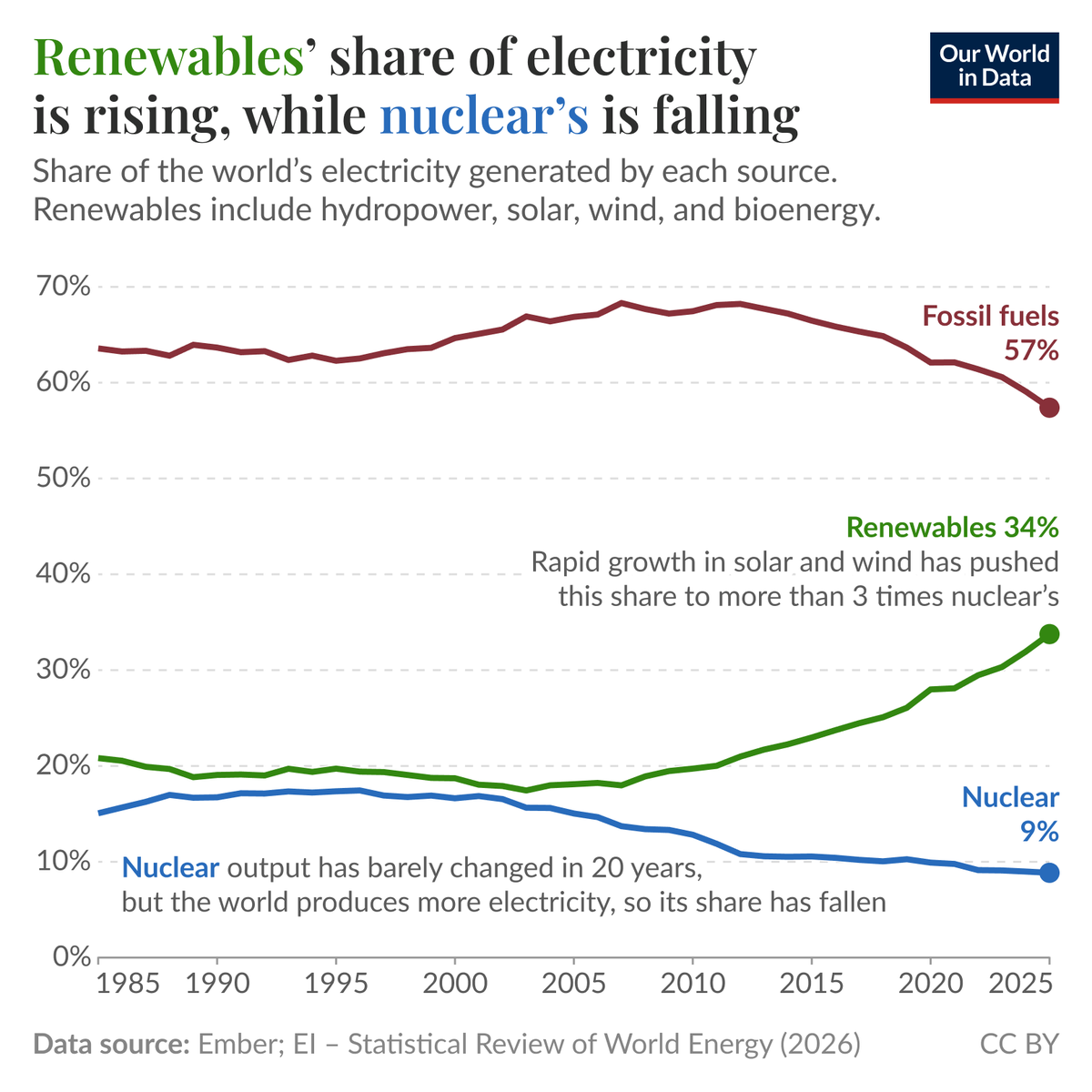
For decades the share of global electricity coming from fossil fuels was over 60% — renewables were rising, but that was offset by the decline of nuclear power.
Now this is finally changing. The share from fossil fuels is going down.
On permit certainty, we have to remember that it cuts both ways. Dems wanted this language bc no one trusts Trump! Right now, the admin is trying to revoke permits for wind farms that were legally approved. These sections make that much harder. The manager's amendment made sure to protect future clean air act regulations.
I totally think Casten is right that we aren't struggling to build gas pipelines or data centers, & we are struggling to build cheap clean power, because incumbents control the grid. That's why BAAJA matters! The interconnection, transmission, and regional planning reforms are huge and aimed at exactly the barriers he identfies.
Nvidia’s board says it relied on input from senior U.S. officials to conclude that bringing Jensen Huang back posed no national security risk. I have some questions. Who in our government weighed in? What did they tell the board? And on what basis did the board conclude there was no risk?
Mr. Huang was right to step down when the affair came to light. Just 11 days after Nvidia announced his departure, the board brought him back while its own independent investigation was still underway. Last week, the board said it didn’t intend to reinstate him. I’d like to know what changed.
“Any lawmakers in the House contemplating holding out for a better deal should resist the temptation: This is about as good as it’s ever going to get.”
https://t.co/fLaJW0MWj0
It's very likely that human society passed peak fossil fuels in the past three years.
The West had its peak 15-20 years ago, now China's peaking, and India's emissions growth is slowing.
Obviously more needs to be done, but this is a big moment.
Not all news is bad!
This feels relevant to the ACLU opposition to BAAJA over ICE detention centers.
Let’s use the right tools to stop bad things, instead of using environmental law to do things unrelated to the environment.