🚨Google is the latest tech firm to withhold its newest frontier model from UK's AISI for pre-release testing following pressure from the White House: https://t.co/027iMasMfp
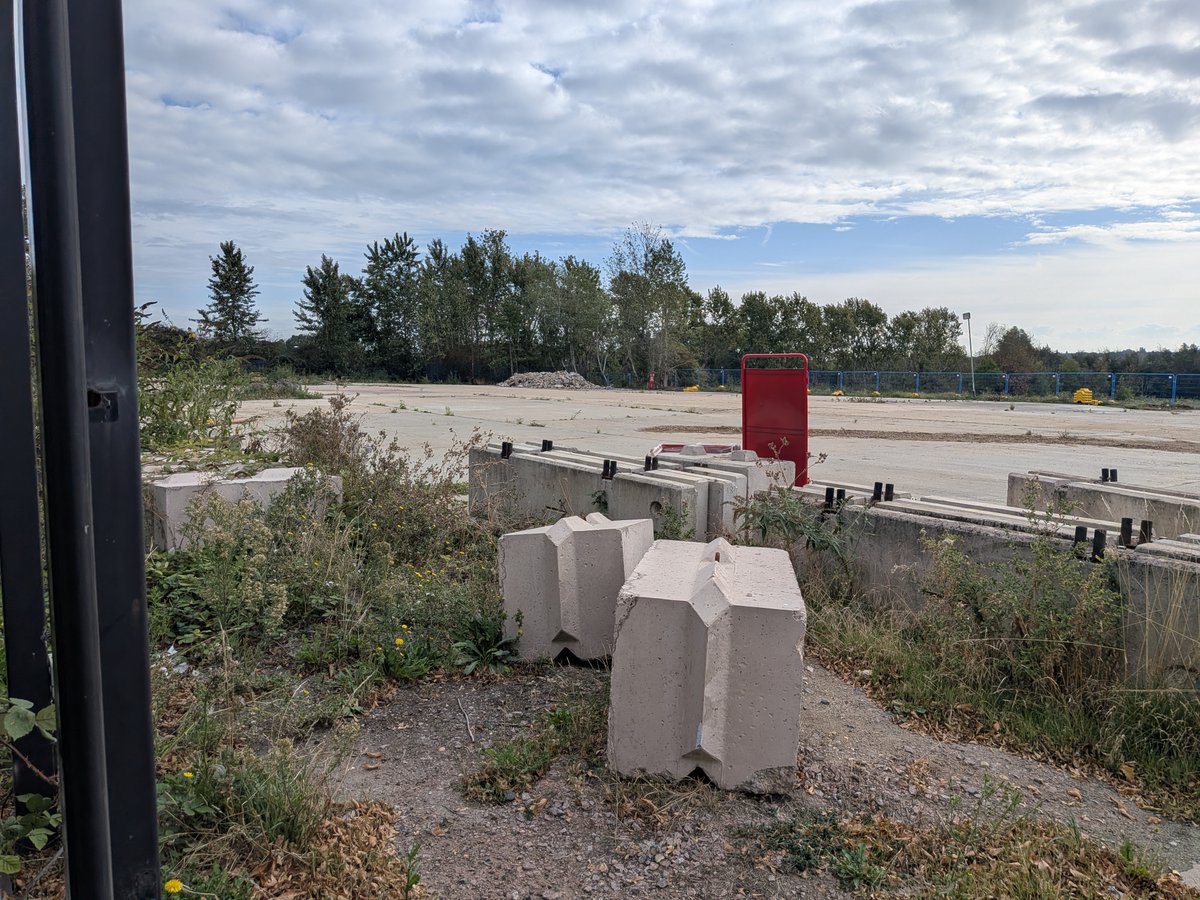
This Essex wasteland is meant to be home to one of the biggest data centres in the UK from 2027. But the developer, @nscale, has been told by @UKPowerNetworks it can't get enough power to the site until the 2030s. Again lack of energy holding back Britain's AI ambitions.
Happy Friday, in today's Morning Intelligence:
🤖 OXA's CEO on building the UK's robotic future.
🔓 @AISecurityInst's Astra findings
📅 Plus what to look out for next week on UK tech
👉https://t.co/WgeDdq7W0b
A 150MW data centre should be built down the road from me. It's:
✅Next to a substation and battery plant
✅On wasteland
✅Next to an A-road
✅Will use a closed-loop cooling system
😠But there is loads of opposition.
👉 https://t.co/HGeUCWLi1i
Nothing confirmed but a break-up of DSIT is looking increasingly likely, according to government officials and industry figures, despite a backlash over the weekend. More in today's Morning Intelligence: https://t.co/1mm4OlN8Vg
In today's Morning Intelligence:
🍽️ What Starmer told the G7 lunch of AI leaders
✋ We don't need any more tech strategies — do this instead
👣 The CMA's latest steps against Google
👉 https://t.co/eY2Qq6BLi5
In today's edition of The Morning Intelligence:
♠️ The sovereignty test has arrived before the UK is ready
📵 The government rushes out a social media ban
🧑💼 Latest job moves and vacancies
👉 https://t.co/A9gzmHx0a6
Scoop: Tony Blair's @InstituteGC began a consultation with staff on Wednesday about redundancies as it doubles down on AI tools, consultancy and policy. It will set up an AI centre this autumn. Full story in today's Morning Intelligence :👉 https://t.co/UfWJVD5Nga
In The Morning Intelligence today:
🙊 The @CMAgovUK chief didn't tell MPs about @awscloud links
🛡️ OpenAI's latest model is as powerful as Claude Mythos — why hasn't it caused the same panic?
✊ A group of workers at Google DeepMind want to unionise
👉 https://t.co/rAxaEJVH6X
In Wednesday's Morning Intelligence:
🍟 A bet on chips, international safety standards and a definition of sovereignty.
🇮🇳 India and the UK will work more closely on tech, the AI minister says.
🧑💼 Sadiq Khan has an AI-Jobs taskforce
👉 All here: https://t.co/rn8CLH93yK
In Tuesday's The Morning Intelligence:
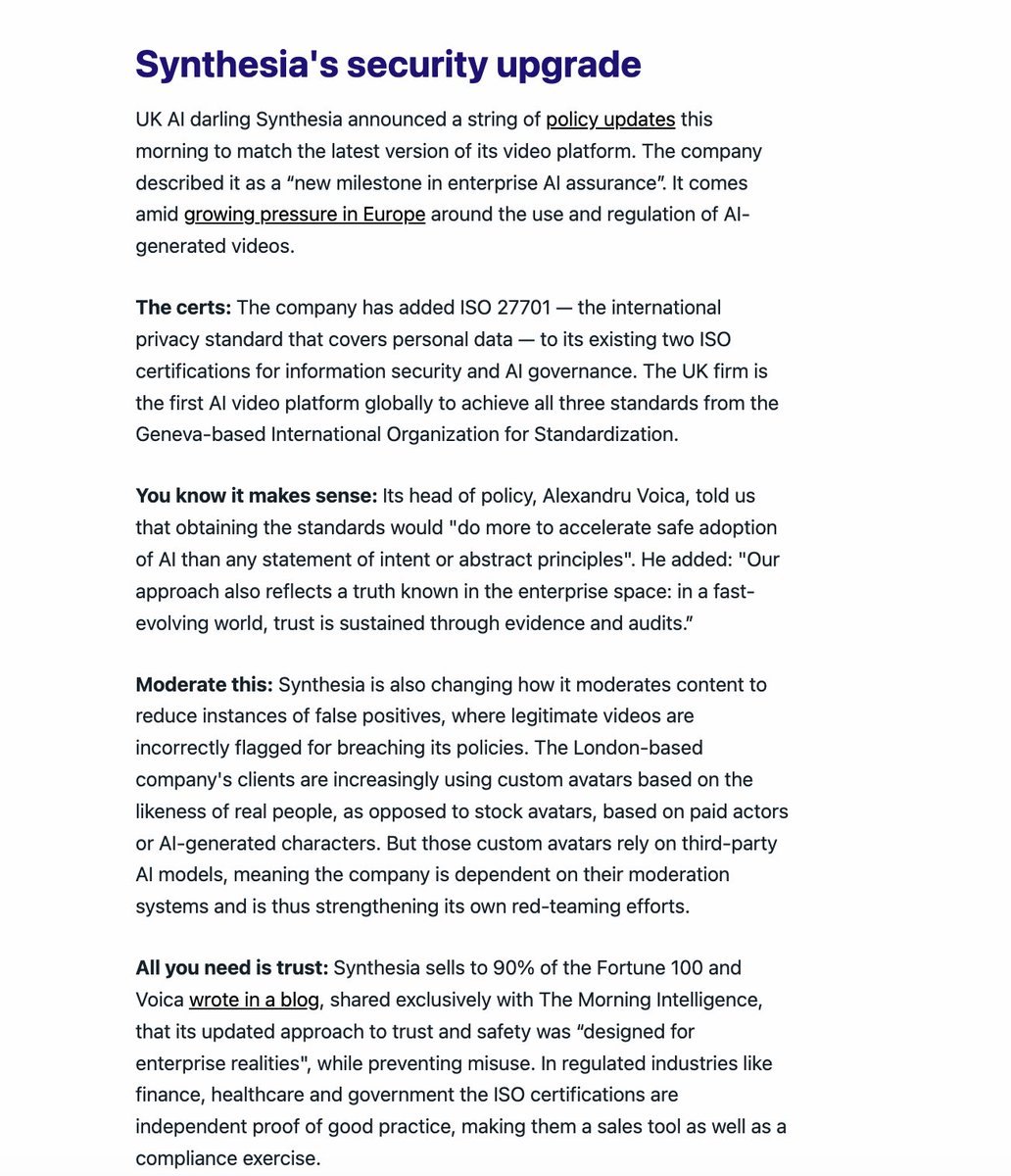
🔐AI video gets a security upgrade @synthesiaIO
🪑@Ofcom's search for a new chair enters the end-game
🧑💼Latest job moves
🎧 Listen/read: https://t.co/w16TuIjEM3
As AI video becomes more powerful, more interactive, and more personalized, the standards for security, privacy, and governance have to keep up with the speed of our product updates. That is exactly what we are announcing today, as covered by @TomSBristow in today's Morning Intelligence newsletter: https://t.co/qgFNiRvyqS (If you haven't already, please subscribe!)
With @synthesiaIO now certified for ISO 27701, alongside ISO 27001 and ISO 42001, we have reached an important milestone in enterprise AI assurance. Security, privacy, and AI governance are being built into the operating model of the company, giving our customers a level of maturity unmatched in enterprise AI software: https://t.co/HB2gnJD3wY
But how do these security and policy updates show up in the product experience?
Let's take avatars as one example. When we launched the first version of Synthesia, the platform only offered stock avatars based on the likeness of real actors. Since then, the category has evolved quickly. We added personal avatars, and more recently customizable avatars generated from prompts. That kind of product progress creates new creative possibilities for businesses, but it also requires clearer rules and more deliberate safeguards. So we have updated our policies to reflect the reality of these new avatar types while keeping our defenses against misuse, including preventing the creation of avatars depicting celebrities, public figures, or deceased individuals.
Another example is moderation. We were the first AI company to moderate content at the point of video creation because we believed then, and still believe now, that responsible deployment means intervening before harmful content is generated or distributed. But being early also meant learning where enforcement was too blunt. Previously, if a video broke our rules, a user could lose access to the whole project, including earlier versions that did not violate policy. We have now improved that flow so rejected videos remain editable, can be resubmitted directly, and do not cut users off from compliant previous versions. We are also continuing to invest in the systems and vendor integrations that improve moderation accuracy and reduce unnecessary disruption for legitimate users.
I'm really proud of the work we're doing in responsible AI, and we'll have more to share on this topic in the coming weeks. But if there's one important takeaway from what we've seen so far from 2026 is that the era when AI companies could treat security as a side document or an exercise in checking boxes is ending. Trust infrastructure is now core product infrastructure, and needs to be treated as such; the sooner more of our industry accepts that, the better.
Good morning. In today’s Morning Intelligence:
⚡Grid reforms for AI Growth Zones get going
🗣️MPs are restless at competition delays
🔞 An attempt to regulate AI chatbots
👉All here: https://t.co/kmeOnalafy
Good morning. In today’s Morning Intelligence:
🏃Ministers want to move fast on sovereign AI, MPs would like to debate it first
🛑 The tech secretary warns platforms on misogyny
🧑💼 Your boss overestimates how you’re using AI
👉All here: https://t.co/UkZekeQ1LG
In today’s Morning Intelligence:
⏸️ The AI-Copyright debate is stuck as a @UKHouseofLords report shows
⚒️ @Checkatrade's boss on AI’s impact on trades
🇬🇧 @InstituteGC wants a National Open Source AI Lab
All here 👉 https://t.co/5nRI1oHii4