🍃 Big day for @springboot developers! @sergialmar launched https://t.co/uHfYq2z2mS - the online community where we can share our content, opinions and learn from each other.
If you're not there yet, come and say hi!
https://t.co/UNLTqtYlEu
That's because this dude doesn't know what education is.
He speaks of growing wheat, herding sheep, riding a horse, and so on, but in the era of these skills, this was the kind of education given to slaves.
Only a slave, a person who was owned as property, and used as a machine for a task, could be expected to do one task for his whole life.
A gentleman, or even a freeman of the lower classes, was not a machine for labor, but a person who could be expected to act in his own interests, and thus would need to do many different things throughout his life, depending on what served his goals at the time.
And he would need to be able to independently learn these tasks, rather than needing to be taught them in childhood.
Therefore if a boy was to formally educated, that might include some of gentleman's skills (riding, fighting with a sword, the management of finances), but his education was centered around what education really meant:
A fundamental grounding in how to live and thrive as an independent and free-willed person.
Thus, he was taught the seven liberal arts of classical antiquity:
- Arithmetic
- Geometry
- Music
- Astronomy
- Grammar
- Logic
- Rhetoric
These were not trade skills in the sense that they did not enable the performance of any particular trade or task, but that wasn't the point.
The point was that they taught the young gentleman how to think and learn.
By contrast, modern government schools were founded to train clerks and factory workers at public expense... a servant class with the specific skills necessary to be useful workers, but not the general education to be independent or question their betters?
Have you noticed which two of these arts are utterly absent from a modern government-school "education"?
That's right, logic and rhetoric. Logic is how to arrive at true conclusions from known facts. Rhetoric is how to persuade.
A servant educated in logic might notice that the things he is being told are false. A servant educated in rhetoric might notice the techniques that are being used to persuade him to act in the rulers' interests instead of his own.
If you conceive of your children's education as training in career skills, whether that be growing rice or programming a computer, you are preparing them to be slaves, not free men.
If you properly prepare them to be free men, what skills will be lucrative or useful twenty years from now is irrelevant, because they will be prepared to learn them.
In my opinion, the seven liberal arts of the modern world are:
- Logic: how to derive truth from known facts
- Statistics: how to understand the implications of data
- Rhetoric: how to persuade, and spot persuasion tactics
- Research: how to gather information on an unknown subject
- (Practical) Psychology: how to discern and understand the true motives of others
- Investment: how to manage and grow existing assets
- Agency: how to make decisions about what course to pursue, and proactively take action to pursue it.
Notice that you didn't learn any of these things in school, even if you went to a so-called "liberal arts" college. Instead, they taught you things about mitochondria and calculus and symbolism in Jon Steinbeck novels where a boy has a dog, and the dog dies.
That's because liberal arts, whether you define them as I have, or slightly differently, are the arts of the master, the arts that make one a master, and therefore not be taught in a school for slaves.
Worry less about which "career skills" AI will take over, and more about whether you are training to be, and training your kids to be, high-agency, perceptive, self-motivated people who can navigate an unknowable future with an adaptable mind.
#JCON2023 🎥 by @pietervincken: Performing #Databases Migrations Without Overtime
Testing the migration on actual production (like) data is often a cumbersome and slow process if it’s possible at all. https://t.co/x38NXuoYf2’s Datab...
Watch now: https://t.co/iCWvBBqOf2
#Cloud
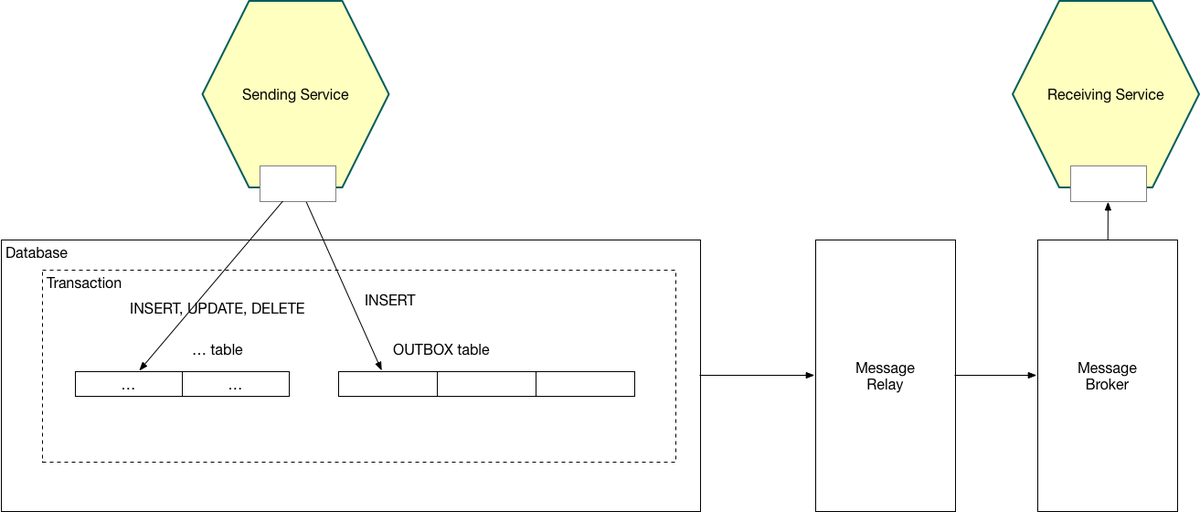
The Transactional Outbox pattern is a key pattern in the microservices architecture pattern language.
It enables a service operation to atomically update the database (e.g. persistent aggregates) and send a message/event to a message broker.
Nicolas Frankel (https://t.co/tEyVq27Y1O) Twitter account - @nicolas_frankel - got suspended while he fought disinformation about war in Ukraine spread by Russian trolls.
@TwitterSupport please review again this case and reconsider.
Java folks - please retweet for reach
🔥NEW PROJECT!🔥
'The Follower' is software searching how an Instagram photo was taken with the help of AI and open cameras.
Project page: https://t.co/Djzlu3rf39
YouTube video: https://t.co/WpD3gdkPIu
Support my work: https://t.co/lP6wVXSkJ3
🧵👇
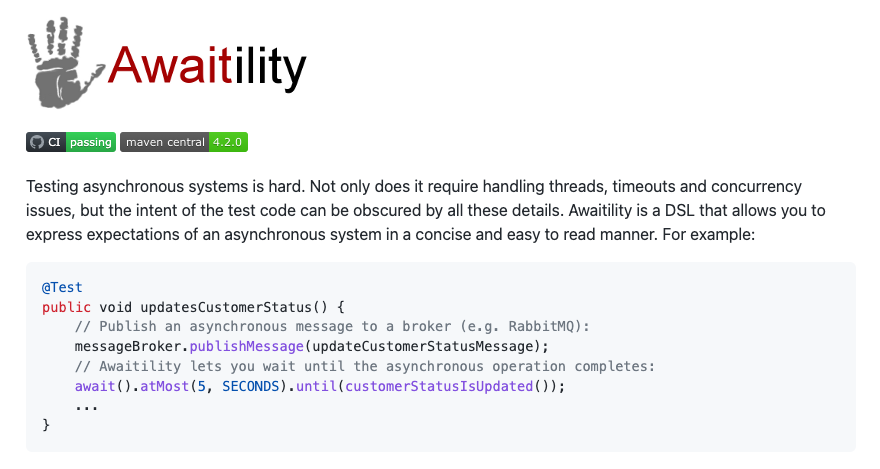
If you ever think of writing Thread.sleep() in your test class, please don't!
Whatever argument you put sleep will take either too long or too short and the are high chances your test will fail time to time especially on CI.
Use https://t.co/nYYYK8nfuj instead!
Quick 🧵 on what's "Head-of-Line Blocking" in @apachekafka, why it is a problem, and what some mitigation strategies are.
Context: Records in Kafka are written to topic partitions, which are read sequentially by consumers. To parallelize processing, consumers can be organized in
JWorks went to KubeCon | CloudNativeCon Europe 2022! Read all about our experience and get the key takeaways from the conference and the city of Valencia. #kubernetes#cloudnative#cloud@CloudNativeFdn https://t.co/VHNxEWwQfY
@KishoreBytes@robinfeh Separate the communication with Kafka from your service transaction.
Our service reads from a table of incoming messages, and puts it in a table with outgoing. Separate threads deal with consuming and producing to Kafka. The other consumers will need to do the same, if needed.