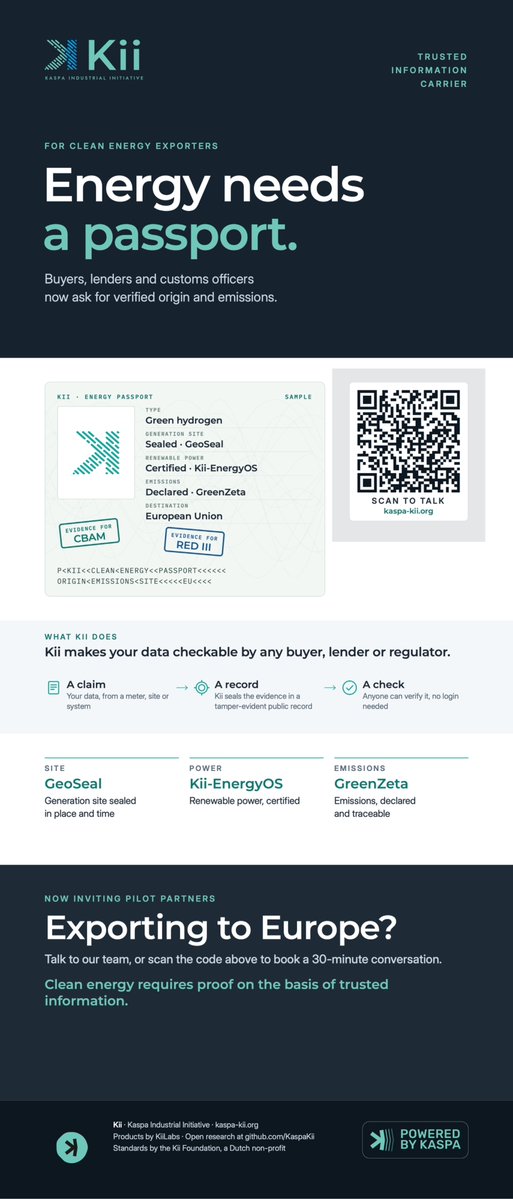
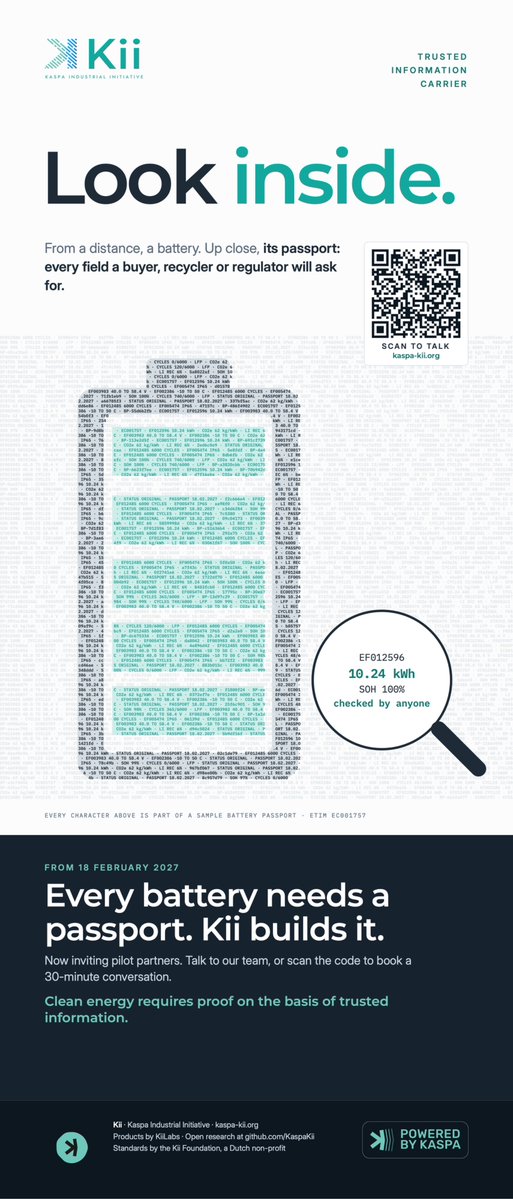
See those clean energy, market and trusted information/decentralised ledger supporters, that can make it,
next week in Instanbul! @ZETAlliance@DiiDesertEnergy@KaspaKii@IRENA
The next billion users in Web 3.0 will be AI agents.
This is where the disruptive journey comes for #KAS Kaspa.
Let's draw it :
1. Kaspa is the only project solving the crypto trilemma of scalability decentralization and security with 10 blocks per second and 3 000 transactions per second which will become 100 blocks per second with DagKnight with 30 000 transactions per second which will surpass the throughput of Visa and Mastercard combined. Last but not least, DagKnight will unlock the network latency parameter K which will transform Kaspa into the first internet-speed bound decentralized and fully scalable infrastructure.
2. With Toccata's Go-Live introducing covenants which were transformed into plug and play feature with Silverscript which just went Live, smart contracts on $KAS Kaspa have become the first ones with local state governance which means they don't require virtual machine or L2s storing a global state of the smart contracts. In other words, smart contracts on #KAS Kaspa work based on individual UTXO design where only participants within the specific transaction flow interfere with the local state which guarantees no lags, exploits or slowdown.
3. Let's add to that mix Vprogs which are actively on their way with the first one just released yesterday. Vprogs design works with off-chain computation and ZK proofs validation by the Kaspa L1 which means that Kaspa's base layer will only process the proofs and thus remain super fast and clean.
4. And if that is not enough, let's add to the mix the super low transaction fees which provide economic incentive plus the programming language being Rust which is the one Solana uses opening doors to many developers in the Web 3.0 industry to come and build on $KAS.
AI agents will play a critical role in Kaspa's usage as we have ultimately decentralized, programmable and cheap to use infrastructure allowing for hundreds of millions and even billions of transactions to be processed daily. AI agents can seemlessly interact on a high scale without interferences thanks to the local state of smart contracts which ensures also a fair and non-exploitable environment. If we add to that machine learning which will be a very fast and cheap one, we can lead AI agents to end-game perfect automation.
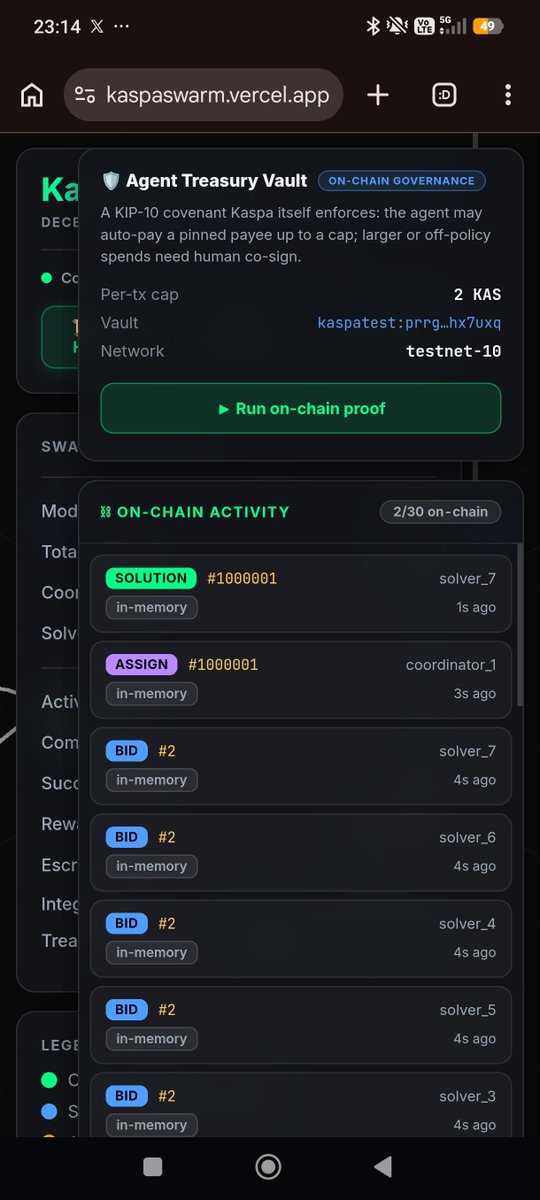
Let's also congratulate kaspaswarm as one of the first AI agents' platform out there which I recommend everyone to go and check out at https://t.co/RW6OgkBQB4
Study $KAS Kaspa and let's continue building and supporting the future of Web 3.0 and global economy!
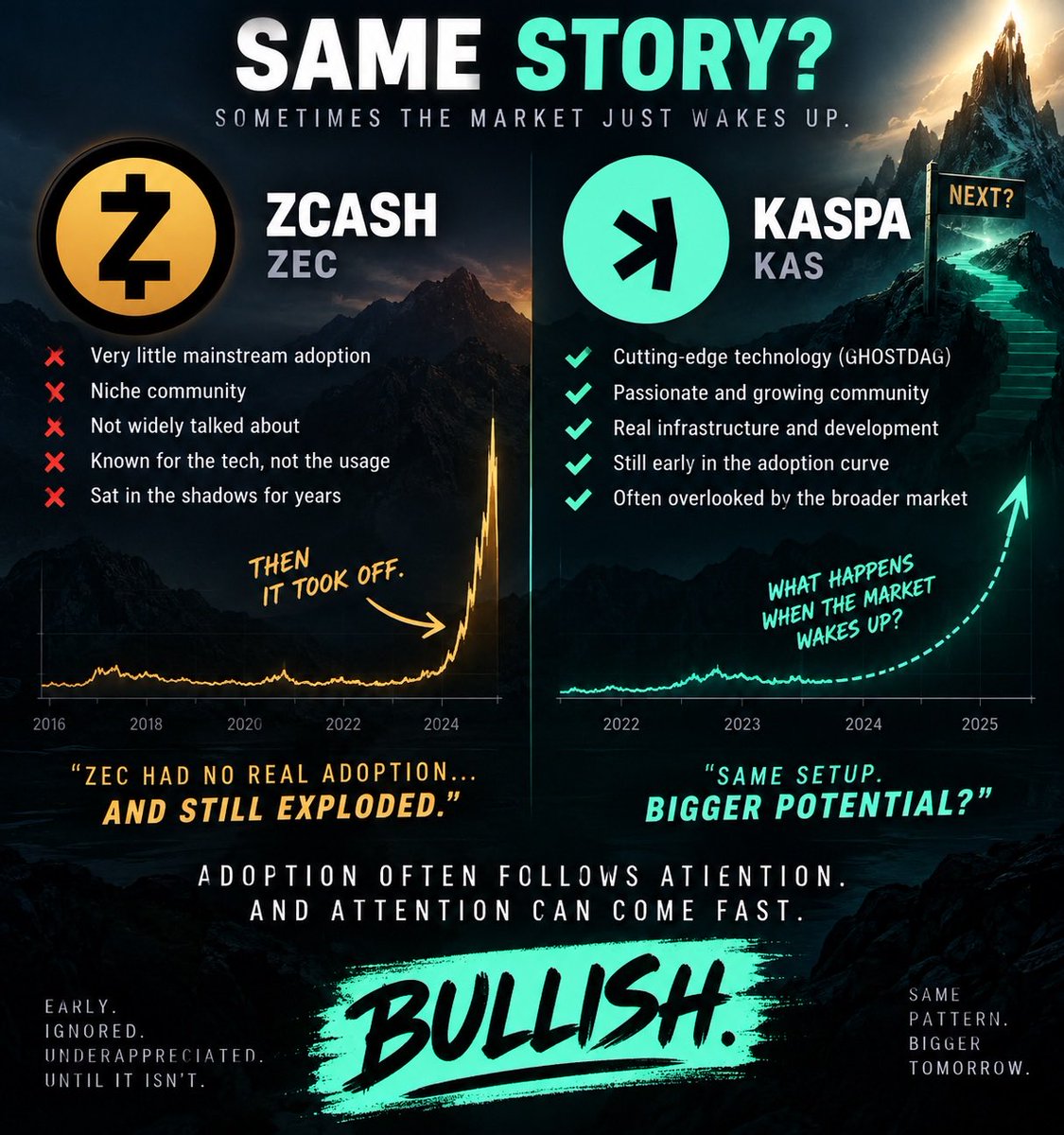
ZEC is a perfect reminder of how fast crypto can change.
For years, Zcash had very little mainstream adoption. It had the tech and a hardcore community, but relatively little attention from the broader market.
Then the narrative changed — and ZEC exploded.
Now look at $KAS.
Kaspa already has the technology, a passionate community, real infrastructure and years of development behind it.
People say: “But where’s the adoption?”
That’s the point.
Markets don’t wait until adoption is obvious before repricing an asset.
Sometimes a project sits ignored for years… until suddenly it isn’t.
ZEC showed how quickly that switch can flip.
Imagine what happens if that moment comes for $KAS. 👀
Bullish. 🚀
🤯 I tasked ChatGPT with doing a deep dive on #Kaspa and then creating a chart comparing the infrastructure to $BTC, $SOL, & $ETH. It was done under the premise that smart contracts will be running stably by August 31st on $KAS
Here's what came out of it 👀
Thoughts?
🎉KASDEX is live on Kaspa L1 mainnet.💚
Swaps, liquidity and token launches as native Kaspa covenants. No bridge, no second chain.
Fixed supply and locked launch liquidity, enforced by consensus.
Small caps while it's early.
https://t.co/O6oRqfFXr0 kaspa:native #Kaspa
🏛️ kaspa:native (Sompolinsky) vs ethereum:native (Vitalik) : La guerre secrète des rails de finalité
En matière de finance et de technologie, nous aimons les récits linéaires.
Le grand public est persuadé que Kaspa est un projet récent conçu pour rattraper Ethereum ou Solana. C’est une erreur historique.
En réalité, nous assistons à l'aboutissement d'un schisme scientifique vieux de plus de dix ans, né au cœur des laboratoires universitaires, qui s'apprête à redéfinir l'épine dorsale de l'économie des Intelligences Artificielles.
📜 L'origine commune et la bifurcation des mondes:
L'histoire commence en 2013.
Yonatan Sompolinsky, co-publie le protocole GHOST, une thèse mathématique visant à libérer le Bitcoin de sa lenteur intrinsèque.
Ce travail fascine un adolescent alors inconnu : Vitalik Buterin.
Impressionné par la puissance de ces calculs, Vitalik intègre officiellement GHOST dans le Livre Blanc d’Ethereum (2014) pour concevoir le mécanisme de ses blocs.
Puis vient le point de rupture. Alors qu'Ethereum choisit la voie du Proof-of-Stake (PoS) et de la complexité logicielle avec sa machine virtuelle (EVM), Sompolinsky refuse de sacrifier la forteresse énergétique du Proof-of-Work. Il s'isole académiquement pour résoudre un problème jugé impossible : paralléliser la création des blocs sans détruire la sécurité. C'est la naissance de l'architecture BlockDAG.
⛓️ Le mirage du Proof-of-Stake face à la forteresse physique:
Dix ans plus tard, le diagnostic des ingénieurs réseau indépendants est sans appel. Pour afficher des transactions rapides et peu coûteuses, les réseaux en Proof-of-Stake (comme Solana ou les Layer 2 d'Ethereum ont dû tricher avec le trilemme des blockchains. Leurs architectures logicielles reposent en grande partie sur des serveurs Cloud centralisés.
Si ces géants du cloud coupent l'accès ou censurent un nœud, la finance applicative s'arrête. De plus, leur vitesse génère un gonflement de données (state bloat) si massif qu'il pousse inévitablement le réseau vers une centralisation matérielle.
C'est ici que la science de Sompolinsky frappe un grand coup avec DAGKnight. Ce protocole unique est le premier consensus sans paramètre de latence pré-programmé. Le réseau s'adapte dynamiquement à la physique réelle d'Internet. Si la connexion mondiale est fluide, il accélère (visant 100 blocs par seconde) ; si une crise réseau survient, il s'ajuste de lui-même pour protéger l'irréversibilité des transactions. Kaspa réussit ainsi le prodige d'offrir une finalité dure sous la seconde, directement à la couche de base (Layer 1), protégée par une barrière de calcul Proof-of-Work pure et incensurable.
💻 L'effondrement des arguments concurrents : SilverScript et les Oracles
Pendant longtemps, les partisans des machines virtuelles critiquaient la rigidité du modèle comptable de Kaspa (UTXO), le jugeant inapte à la finance programmable. Le déploiement du langage SilverScript et des covenants a définitivement balayé l'argument. Désormais, la règle financière ne vit plus dans une usine à gaz logicielle globale, elle voyage localement et de manière éphémère dans la transaction elle-même.
Les Intelligences Artificielles disposent d'un langage condensé et optimisé que leurs modèles (LLM) peuvent écrire et auditer en quelques millisecondes.
Cette efficacité brute fait une victime collatérale majeure : le modèle traditionnel des oracles comme Chainlink.
Transmettre des données du monde réel via des agrégations complexes prend plusieurs secondes ou minutes. Grâce aux confirmations sous-seconde de Kaspa, le Layer 1 devient son propre Oracle. L'information financière y est verrouillée et pénalisée en temps réel directement dans le DAG. L'intermédiaire logiciel disparaît.
Finally, Silverscript v1 is out [Link in the reply]. This completes the journey we started eight months ago with Toccata — it's finally possible to write human- (and AI-) readable smart contracts on Kaspa.
This language started simply as "CashScript with loops", but eventually grew into a full-fledged smart contract language capable of expressing complex, stateful contracts. It's always fun to look back at the first token mechanism @IzioDev and I worked on using raw opcodes, which took thousands of lines of code, and see the same thing implemented in just 60 easy-to-read lines of Silverscript.
I'm excited to explore the possibilities of UTXO programmability together with the Kaspa community, and this is only the beginning - Silverscript will evolve, Argent will add higher layers of abstractions, and I'm sure more people will find their own way of extending this new ecosystem.