Can we improve energy-based diffusion models by solving a classification task? 🤔
🚀 Excited to share DiffCLF, accepted at ICML 2026 🇰🇷! ! We predict a sample’s noise level, and recover densities as a by-product.
Joint work with @theh2o64 (co-lead) and @jmhernandez233. [🧵1/n]
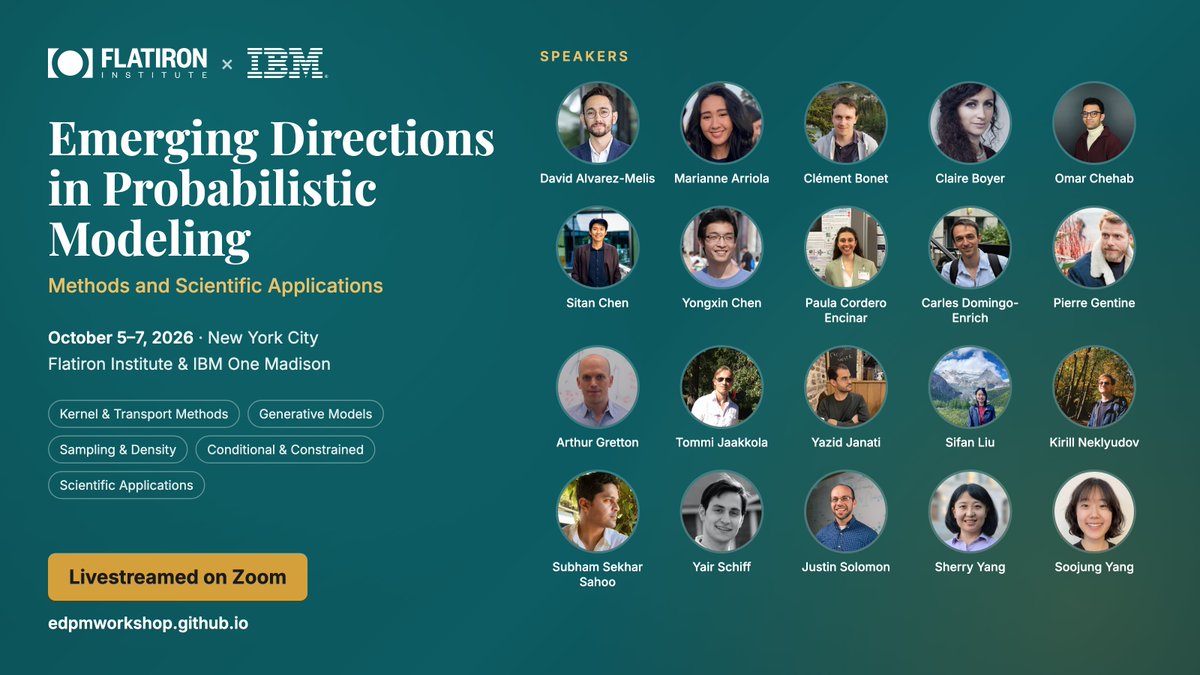
📣 Our workshop on Emerging Directions in Probabilistic Modeling is next week, Oct 5–7 in NYC!
Full schedule: https://t.co/qqevwslS24
Can't join in person? Talks will be livestreamed on Zoom. Register here: https://t.co/ZO3LiVEqYn
Scallop (https://t.co/EK7aAkX59A, for flow maps with likelihood) and STNCE (https://t.co/KwHQ4Ibprw, for learning EBMs) are accepted by NeurIPS!! Details will be released soon ⚽️
A wonderful way to wrap up the first year of my PhD. Can't wait for the wonderful December 🦘🐨🏝️!!
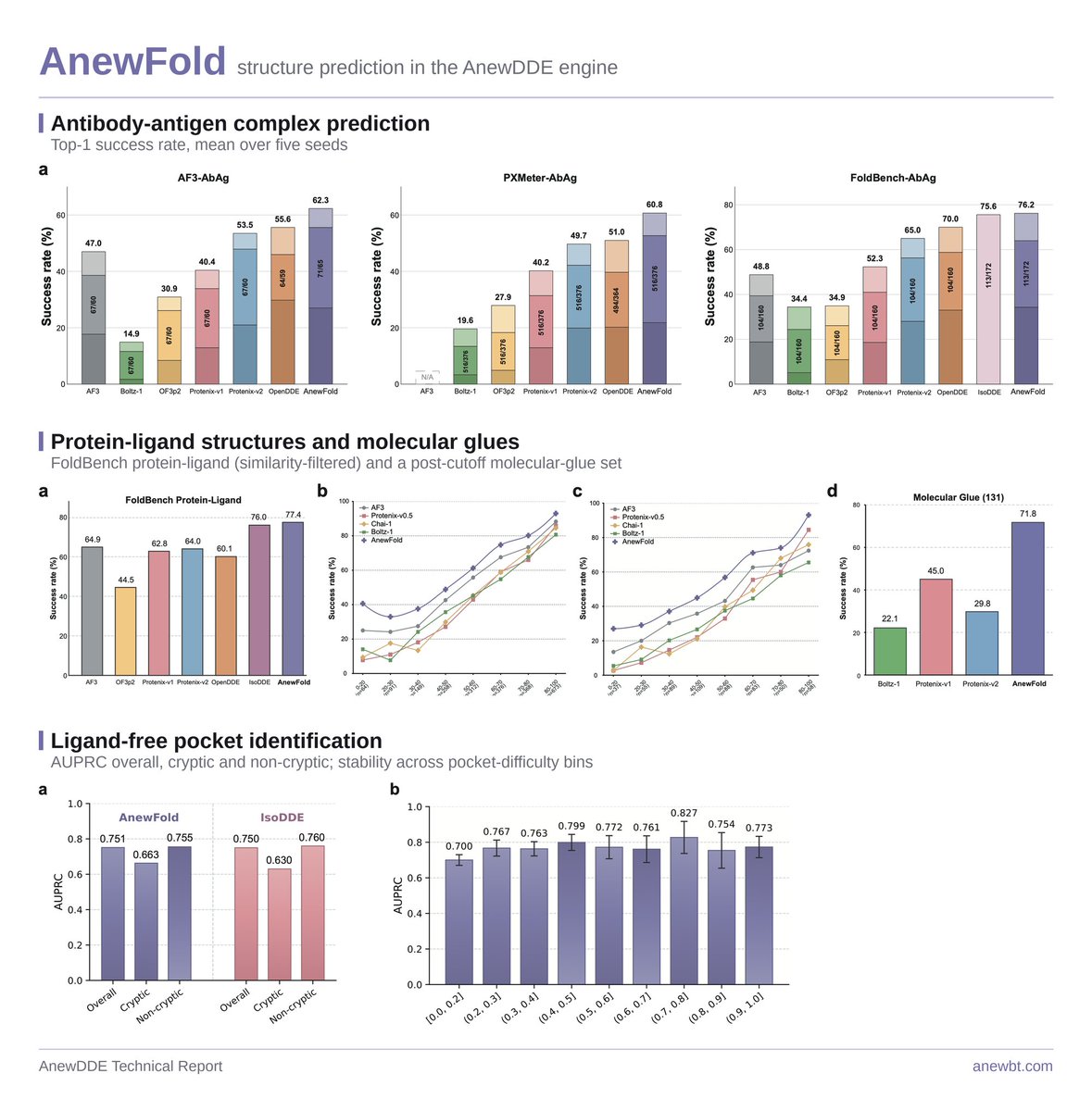
AnewFold, the structure module of AnewDDE.
76.2% top-1 on FoldBench-AB. 77.4% on similarity-filtered FoldBench protein–ligand.
On a post-cutoff molecular-glue benchmark: 71.8%, vs 45.0% (Protenix-v1) and 29.8% (Protenix-v2).
Hardest cases, widest margin.
We optimized over 30 open-source models for structure prediction and molecular design, making them 4x faster on average using an internal research model here at @AnthropicAI. We also created a low-memory "Big" mode that allows structure prediction for molecular machines larger than 10,000 amino acids on a single GPU. All the optimized code is open-sourced.
Claude can now use these optimized models to achieve state-of-the-art molecule design results with a 100x reduction in GPU hours needed.
Models like AlphaFold3, OpenFold3, and Boltz-2 spend much of their computation on triangle attention and triangle multiplication, which are cubic in runtime and memory.
We developed FlashPairformer with Claude, achieving a new state-of-the-art speedup of 2.7-2.9x on triangle attention and 1.7-3.2x on triangle multiplication compared to baselines.
We used "Big" mode to fold human mitochondrial complex I, the TRiC chaperone complex, a proteasome, and a bacterial ribosome, each closely matching its experimentally determined structure. To our knowledge, these are the largest structures ever folded accurately using structure prediction models. Claude also folded an entire protein compartment using a single 8-GPU node.
Thrilled to introduce AnewDDE, an agentic drug discovery engine that brings together biomolecular structure modelling, molecular design, affinity prediction, and scientific reasoning in a closed-loop workflow.
Read the technical report: https://t.co/ygaSR3s7QR
Why reversible SDE solvers—and how do we build them?
In the coming Tuesday, Sep 8th 4pm-5pm UK time, we will have @zwblasingame to talk about his ICML oral paper "Rex: Reversible Exponential (Stochastic) Runge–Kutta Solvers" (https://t.co/NiYGlcc47d) 🚀
Zoom link 👇
🦾Scaling robot data is essential. But as we built VLAs, we kept asking a complementary question: beyond data scaling, how can we make the backbone learn more transferable knowledge from the same trajectories?🤔
From the StarVLA team, meet VLAct — a VLA-oriented VLM backbone built with representation-centric continued pre-training.
🚀 92.5% on RoboTwin 2.0
🌍 Ahead of all World Action Models on RoboDojo
⚡ Full continued pre-training on 16 GPUs
🔓 Data, code, models & training pipeline fully open
More results & insights in the thread 🧵👇
Can a flow map expand its dimensionality while denoising in a few steps?
In the coming Tuesday, Aug 25th, 4pm-5pm UK time, we will have @_sophia_tang_ from UPenn to talk about "Expanding Flow Maps" (https://t.co/YHV972azGW) 🔥
Join us via Zoom 👇
🎓 Update: I defended my PhD ! 2 months ago actually, with some vacation in between 😅 Huge thanks to @AlainDurmus for this amazing journey 🙏
🚀 Next: from September, I’ll join CFM ML Lab as a Postdoc with Eric Vanden-Eijnden, still working on generative models & sampling!
I will be presenting my most recent work "Bridging stochastic flow maps and Boltzmann generators with normalizing flows" (done in collab with @TonyRKOuYang and @hlws_bot) this morning 🙂
Excited to host the generative modeling and sampling workshop next week, with @cdomingoenrich in the beautiful summer of Boston @MSRNE!
(and no regular seminar as last week)
Explorative Modeling (XM) and IMLE are getting a lot of attention today, and people have asked how to understand IMLE from a probabilistic perspective.
I wrote a short blog post showing that IMLE can be derived as the zero-noise limit of a finite-sample approximation to Spread MLE.
https://t.co/UP1MGyTb1V
🚀 Excited to talk more about SSFMs next week!
If you missed our talk this past Monday and want to learn more or ask some questions, tune in next Tuesday
How to make flow map stochastic?
In the coming Tuesday, July 28th, 4pm-5pm UK time, we will have @sgmccallum and @zwblasingame to talk about "Strong Stochastic Flow Maps" (https://t.co/UISt0j7Hwl). Do join us!
zoom link 👇
definitely one of my dream job if I'm not doing ai4s research... if it is from man city or barca, then will be even better🤣 (and I hope this position in arsenal is not limited to design corner tactic😏
We're hiring a Research Engineer at @Arsenal ⚽🔴⚪ to work directly with our Men's First Team!
We're building state-of-the-art AI models for the football domain. This role will focus on building the application layer for our research to advance coaching and analysis workflows.
New preprint alert (my final PhD paper ♥️)
Twisted Schrödinger Bridge Matching (TSBM)
We “twist” classic diffusion losses to tackle trajectory inference under physical constraints, encoded via a differentiable state cost
Paper: https://t.co/qAuFRIcxvu
with Github link
(1/5)