EGLD, I did simulation AI
/ SI with MultiversX TPS
At 150K TPS Ai said it would
Produce 12.5 Billion micro Transactions per Day. The most normal top ten crypto
Runs under 200 million per day. EGLD, I think we're early
Lol. 😎🌄🔥🚀🍕💰📸👀💚🌊
@KuroshiKusama Silver lining is the speed at which it dumps is also the speed at which it rises (albeit five years ago now)…get your box of tissues out from under your bed because egld will explode (soon)
The biggest differences between @NEARProtocol and @MultiversX :
On Nearly $NEAR, when you launch a token:
→ 1% fee on every trade by default
→ Creator gets 60%
→ Protocol gets 40%
→ You can also add up to 4% extra tax
This actually lets creators survive and build not dumping
A blink takes ~300 ms. This video ranks L1s by block time. That is not when the tx becomes irreversible.
Block time → finality
$APT 38 ms → at commit
$FOGO 40 ms → ~1.3 s
$SUI 69 ms → at commit
$SOMI 100 ms → at commit
$SOL 269 ms → ~12.8 s
$TON 414 ms → ~0.8 s
$CRO 429 ms → at commit
$BNB 450 ms → ~0.65 s
$SEI 472 ms → at commit
$ICP 480 ms → at commit
$NEAR 589 ms → ~1.2 s
$EGLD 600 ms → ~100–250 ms intra-shard, ~2.4 s cross-shard
$KTA 686 ms → at commit
$KAIA 1 s → ~1 s
$AVAX 1.2 s → ~2 s
$FOGO is #2 on blocks, not on finality. $SOL produces a block in 269 ms and finalizes in ~12.8 s. $EGLD is #12 on cadence, not on irreversibility.
"At commit" = Chainspect shows 0 s. That is not a click-to-receipt timer.
A few quick notes
(1) Network. Supernova is live, running with remarkable speed and precision.
(2) Exchanges. Over the next 5–10 days, global exchanges and other independent partners will begin reopening deposits and withdrawals. The rollout is gradual by design. Each exchange follows its own rigorous internal process, built to protect users and keep the recovery smooth.
(3) Security report. An in-depth security analysis is still underway. Several critical elements are already mapped and understood, from the bugs and their fixes to the technical implications and the path to recovery. A few discussions with independent parties remain open. The findings are preliminary, but one stands out above the rest. The tools, methods, preparation, and coordination behind this attack appear to go well beyond those typically associated with amateur attackers. The observed sophistication bears the hallmarks of advanced, experienced, repeated threat actors, including groups operating at the level historically associated with hacker organizations such as Lazarus. Attribution is not yet confirmed, but it is worth stating this out loud: to have successfully defended our users against Lazarus, or another group of that caliber, is a milestone we are proud of! Huge respect to all independent partners, including global exchanges, who have mobilized with extraordinary speed for the greater good of protecting users and the network!
(4) Lessons. More importantly, the larger lesson goes beyond this incident. As an industry, we have entered an era of permanent, constant, unending war. Open-source financial infrastructure operates on a global battlefield, continuously exposed to increasingly sophisticated attackers, tools, and methods. Under these conditions, the traditional definition of security is no longer sufficient.
Three capabilities are becoming non-negotiable:
(a) a relentless defensive and offensive security tooling arms race;
(b) continuous, 24/7 red-teaming and penetration testing;
(c) blitz-speed detection, coordination, and response.
We have been intensifying precisely these capabilities over the past 3–6 months. What happened over the last few days is one visible incident among several potential threats that have been identified, contained, or neutralized through increasingly proactive security work.
This reality is not unique to MultiversX. Every major open-source stack, every blockchain (bitcoin and ethereum not excluded), and soon, every closed source software stack, will increasingly have to adapt to an environment where infrastructure is continuously and deeply probed, attacked, and tested. That requires a much more rugged approach to code. A more adversarial approach to architecture design. And ultimately, a fundamental rethinking of how safety-critical software is built and defended.
The three measures above are critical today. But over time, we will need to go much further and rethink security from the ground up for the new world we are actually operating in. Verifiably correct-by-construction software is about to have its moment and become fashionable very quickly. Reality has a way of accelerating standards. Not so much by preference, but by necessity.
$EGLD HAS A BIGGER STORY THAN PRICE ACTION.
MultiversX continues focusing on high-throughput blockchain infrastructure and Web3 applications.
As competition between Layer-1 networks grows, the important metrics increasingly include actual usage and developer activity.
#EGLD #MultiversX #Layer1 #Web3
Remember the Near chart?
Remember the Quant chart?
U should have bought before the announcements and when charts looked exhausted
Have conviction and know what you hold - buy $EGLD 🧠
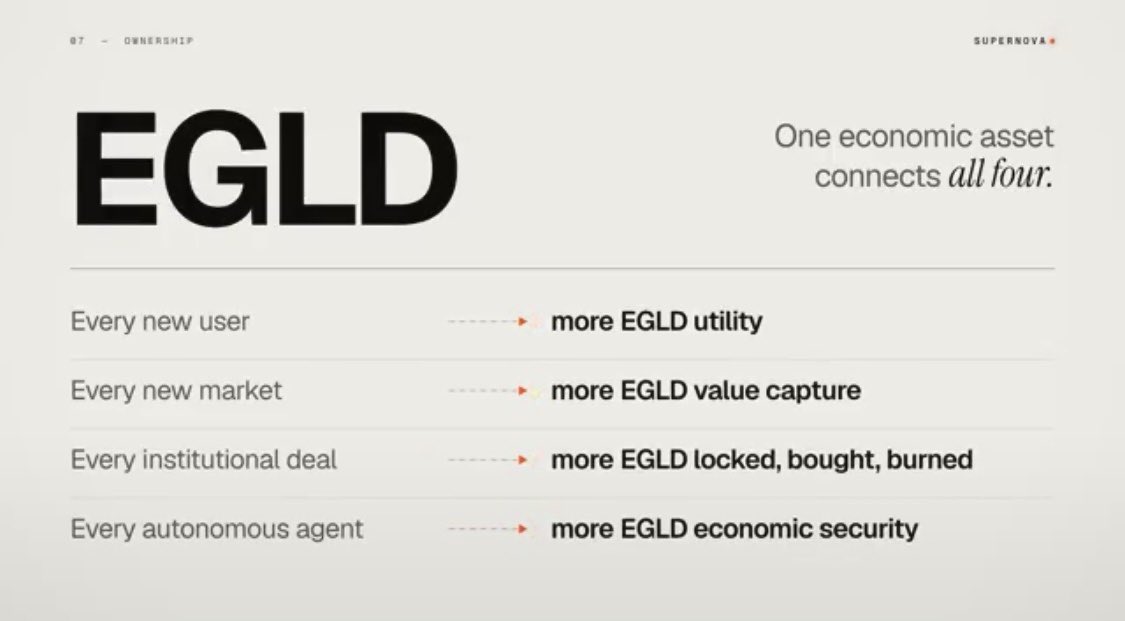
🪙 #FinanceComputer unifies @MultiversX, @xMoney_com , and @xPortalApp into a global financial infrastructure where $EGLD is the central economic engine, powered by every user, card, payment, and autonomous agent.
https://t.co/djTlB2qBJz
🌐 @MultiversX is back online with #Supernova active and recovery complete featuring 21,798 TPS, 9.26M accounts, 629M transactions, and 14.3M $EGLD staked while the ecosystem continues to grow through @xPortalApp , @xMoney_com , and new integrations.
We need an update for this video @AltcoinDaily!
@MultiversX is one hell of a project!
Sleeping giant at the beginning of this cycle.
elrond-erd-2:native