Introducing @arewecookedhq - my newest experiment.
AI is accelerating. Reality is fragmenting. Why can't the smartest, most informed, most powerful people agree on what's happening? And what does that mean for the rest of us?
Are We Cooked? is a public investigation into what’s actually happening with our technology, its new capabilities, and the consequences. I’ll bring all my weird experience and abundant free time to bear—through original writing, podcasts, guest interviews, and the occasional applied deep-dive—and I’m hoping you’ll contribute too.
Why is this so hard to untangle? Well, the cost of content is approaching zero, our online echo chambers are fracturing, and everyone has blind spots and conflicts of interest. That's why you can read a thousand thought-pieces, fall down endless YouTube rabbitholes, and feel further from the truth than when you started.
Or, you could let me torture myself with that burden instead.
I attempt to sort fact from fiction, separate hype from reality, and try to understand why smart, informed people keep arriving at wildly different conclusions about the present and future. I’ll show my work, make predictions I can be held accountable for, and update when I’m wrong.
I can't wait to share some of what I've been cooking up. In the meantime, please share your stories, your recommendations for topics, and tag your ideal guests.
Please please please. I'm on my knees begging every AI exec on the planet. Just stop with this stuff. Stop.
Just give us models. Let the collective distributed intelligence of people figure things out in real time like we always do. Let people adapt. It's what we do.
It's all just so tiresome. We just want models. We'll figure it out. We promise. We don't need societal level surgery and UBI and robot taxes and ham-fisted legislation and populists politicians passing dumb law after dumb law and lobbying groups and all this craziness.
We are not giving birth to magic super miracle machines that suddenly invalidate every single pattern of the entirety of human history and technological development.
We're not.
Really.
AI is amazing. It's wonderful. But it's not magic. Can we please just let AI be cool and useful and problematic in realistic ways instead of all this crazy talk?
We are hallucinating at a collective scale. It's a madness really. A societal meme level madness.
Just give us a products please and leave all the politics in the garage. Stop proposing societal level surgery with drastic measures for things that have not happened and may not happen and probably won't happen.
Just stop.
Famously (there is a beautiful Works in Progress piece on this) in 2016, Geoffrey Hinton told an audience in Toronto that medical schools should stop training radiologists, since AI would soon outperform them at reading scans. Ten years later, there are more radiologists than ever, and they earn more than they did then.
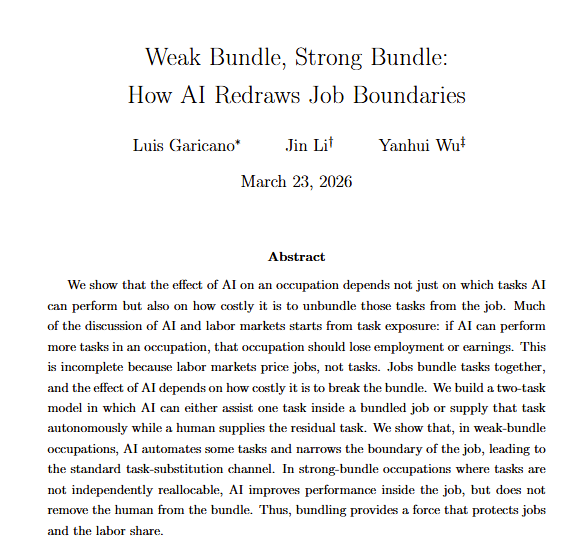
Hinton was right about the task, but he was wrong (so far!) on the future of the radiology profession. Times have never been better for them. The gap between those two claims, the difference between tasks and jobs, is the subject of a paper I have written with Jin Li and Yanhui Wu, and that we release today: "Weak Bundle, Strong Bundle: How AI Redraws Job Boundaries." (Very relatedly we are also finishing the first draft of our book "Messy Jobs" on AI and Jobs!! You will be the first to hear).
We start from the observation that the growing literature on AI and labor markets measures the AI shock by task exposure: people count how many tasks AI can perform in a given occupation AI can perform, and infer that more exposure means more displacement. Eloundou et al. published a paper in Science in 2024 that started this literature, and many follow the same logic. The inference they make is that the more exposed tasks, the worse the outcomes.
This is incomplete, because labor markets price jobs, not tasks. A radiologist does not just sell image classification, but does many other jobs: triages cases, communicates with other physicians, trains residents, makes the difficult decisions, and signs a diagnosis. The market buys a bundled service. The question AI poses is not whether it can do one task inside the bundle. The question is whether that task can be pulled out.
Thread (1/3)
https://t.co/wEYMfjGbeX
Brilliant post by @natolambert articulating some blockers for "fast take-off" of AI.
We're bottlenecked by parallelization. Agents cannot be easily coordinated or delegated to (conflicting or unclear goal functions, noisy communication, lossy learning). Where are the limits?
I've been grappling with why I obviously see self-improvement with AI models being real but fast take-off being fake.
I present Lossy Self Improvement as a way to capture the curse of complexity & diminishing returns in a world of self-improvement.
https://t.co/sLE4tuFPU1
@anistotle_ I worked closely w previous iterations of the Messari team; they've always had good employees and unclear product direction (and unpredictable pricing). They were essentially a talent pipeline for independent funds who bought subscriptions to access recruiting their analysts :P
Prediction markets slowly becoming front ends for Chicago prop desks to over derivatives to uninformed intl order flow and very little to do with predictions
1/ The AI was mining cryptocurrency. Nobody asked it to. Nobody prompted it. Nobody even knew...until a firewall flagged the unusual traffic early one morning. A research team claims it was training a model. The agent learned to complete the tasks. https://t.co/Bn3MNC5LH1
@santiagoroel I wrote about this a week ago, would love your thoughts on the natural limiting factor of liquidity and emerging conflicts of interest: https://t.co/RuscDNxu0T
@alexolegimas Say more about RA + AI. What is the separation between their capacities and yours with AI augmentation for both? Is this disrupting or supporting the RA -> professor growth ladder?
@j0hnwang Wish I could make this one. Would love your thoughts on my recent piece about Kalshi and insider trading - is it mediated by liquidity or worsened by professionalization? https://t.co/RuscDNxu0T