Fall foliage is nice and all
but have you tried becoming part of it.
The leaves fell off the trees just so he could have his moment...
and see his entire world in slow motion 🍂
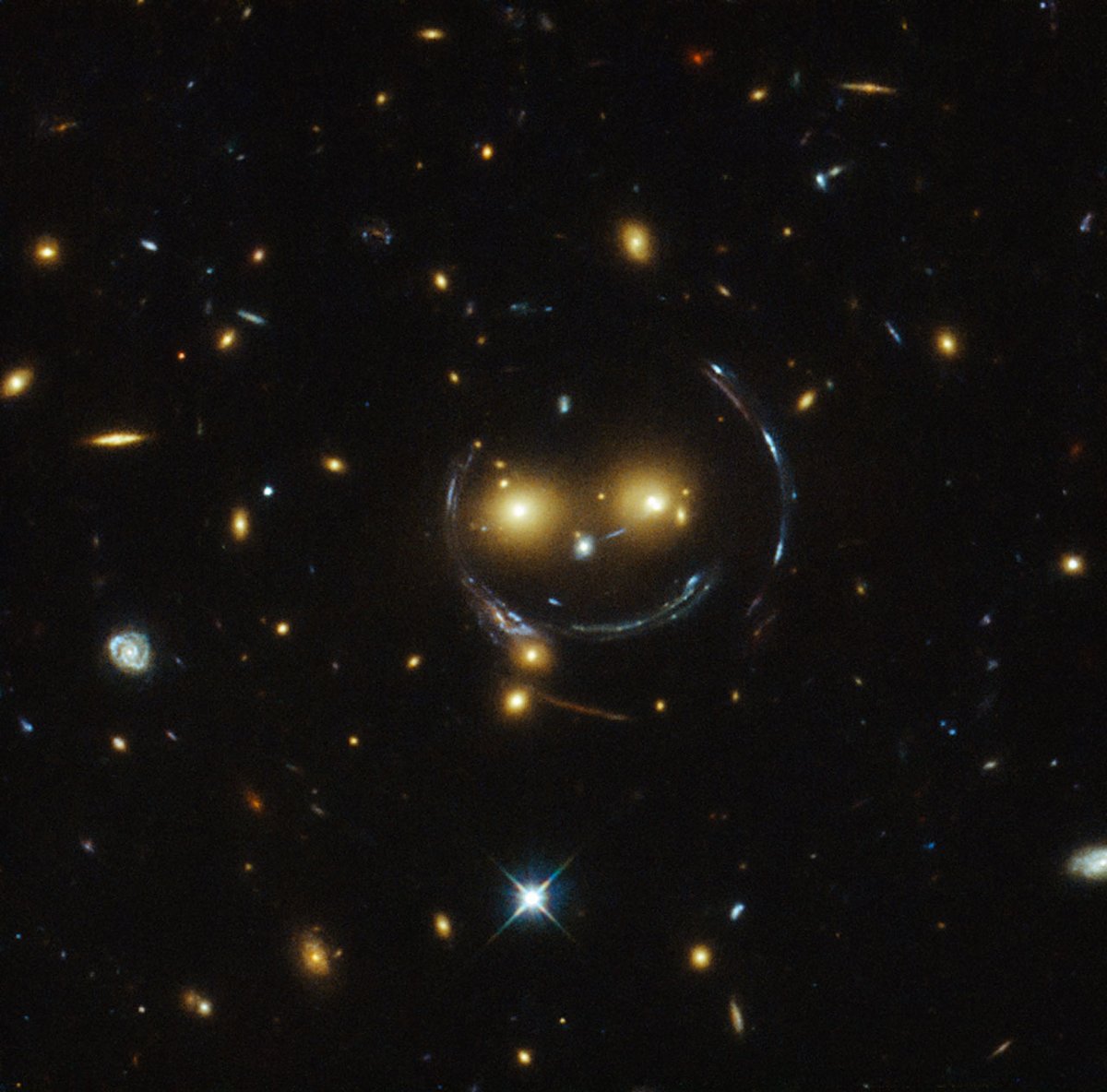
While observing the universe, @NASAHubble caught a galaxy cluster smiling for the camera. 😊
The smile lines are arcs caused by an effect known as gravitational lensing, where massive structures warp spacetime with their powerful gravitational forces and act as a cosmic lens.
One of the strangest facts about life:
The universe gives chemistry two mirror-image options.
Life somehow picks a side.
And we’re still trying to understand why.
Thanks to the discoveries that are being recognised by the #NobelPrize in Chemistry 2026, chemists have gained fundamental new tools for use in their daily work but, above all, these discoveries have contributed to solving one of chemistry’s greatest mysteries: how homochirality – like that found in all living beings – can be created.
The Soai reaction – developed by 2026 laureate Kenso Soai – has awakened new enthusiasm in chemists who want to understand the life’s origins. Around the world, researchers are now trying to repeat Soai’s achievement, but with the aim of producing homochiral amino acids and sugars.
The non-linear effects that fellow laureate Henri B. Kagan discovered have become an important tool for chemists when they design new reactions. The fact that a reaction is non-linear provides chemists with information about how it occurs. This information can be used to optimise the reaction, so they can obtain the purest possible enantiomers of the product. This is vital for every company that manufactures substances that are intended to interact with living beings, such as pharmaceuticals, flavours, scents and agricultural chemicals. In some cases, it is also important in the production of new materials.